Showing posts with label CNN. Show all posts

Friday, December 28, 2007

A Requiem for Ms. Benazir Bhutto

Your fate was sealed before you were born. You have been murdered by the psychopaths who have carefully nurtured their power around the globe. May your courage in facing them down for the sake of your people inspire them to see the reality of pathocracy.

Blue Ibis

******************************************
Benazir Bhutto - A Warning To Us All

Joe Quinn
Sott.net
Thu, 27 Dec 2007 09:34 EST
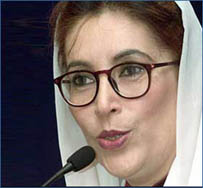
Benazir Bhutto - Murdered by the Pathocrats

Former Pakistani Prime Minister Benazir Bhutto was murdered Thursday December 27th, 2007 in Rawalpindi, a city near Pakistan's capital Islamabad. Having survived an attempted assassination in October, under the cover of a "suicide bombing" Ms. Bhutto was shot in the neck and head from close range.

Coincidentally (or not) almost 29 years ago her father, Zulfikar Bhutto, also a former PM of Pakistan, was hung in the very same city by then Pakistan dictator General Zia Ul-Haq. In 2003, alleged 9/11 mastermind Khalid Shaikh Mohammed was arrested in Rawalpindi. The evidence for Khalid's involvement came largely from the now destroyed CIA torture tapes. Small world. It should come as no surprise therefore that, while separated by decades, the untimely deaths of Ms. Bhutto and her father are, in the context of the American-led war on terror, inextricably linked. Suffice to say, the fingerprints of the Pathocrats are everywhere.

The Arrogant Empire

To fully understand the forces that have shaped our modern world and brought it to the socio-political precipice upon which it now sits, we cannot speak of "America" or even "the US government" in terms of a single isolated nation and group of political leaders. America today is a long and well-established empire whose seat of power extends far beyond Washington D.C. With military bases in at least 121 of 187 world countries and an economic footprint that is global in scope, "America" today is a world-wide phenomenon rather than a single Western nation.
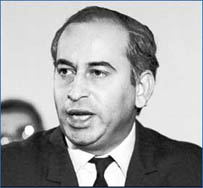
Zulfikar Bhutto

Like dozens of similar cases around the world over the past 100 years, the ousting in 1977, and murder 18 months later, of the democratically elected Zulfikar Bhutto could not have happened without the support of the then US government and CIA. Former US attorney general and outspoken critic of US foreign policy Ramsey Clark was directly involved in attempting to have Zulfikar Bhutto's sentence commuted, although he was ultimately prevented from representing him at trial by General Zia. Clark has pointed directly at CIA involvement:

"the similarities in the staging of riots in Chile (where the CIA helped overthrow President Salvador Allende in 1973) and in Pakistan [in 1977] are just too close."

GeoStrategy

Up until 1989 and the "fall" of Soviet Russia, Pakistan sat on Russia's southern border and represented Russia's only access to the warm trading waters of the Persian Gulf. From a strategic point of view and in the context of the "cold war", it made perfect sense for the empire to attempt to expand its global influence and at the same time deal a significant economic blow to the Russians. Both Pakistan and neighboring Afghanistan were therefore firmly in the empire's sights.

The empire's problem with Zulfikar Bhutto was an ideological one. He, like all truly humane political leaders was not inclined to allow the Pakistani people to become fodder for the relentless march of the American empire. In a speech in October 1966 Bhutto proclaimed: "Islam is our faith, democracy is our policy, socialism is our economy. All power to the people."

In terms of the empire's designs on South Asia, (which included the longer term goal of setting up a future phony "clash of civilisations" between Islam and the "Christian West") Bhutto could not be allowed to establish a largely secular, socialist Pakistan and simply had to go. Indeed, over the past 60 years, no quarter has been given to any leader of a Muslim nation who was not either naturally fascistically-inclined or prepared to bow down before the empire.

"Islamicization"

General Zia then was given the necessary support and assurances by the representatives of the US empire in order to feel confident to force Bhutto from office and later hang him on trumped-up charges of corruption. He then went about establishing strict Islamic law and a brutal penal code. Zia changed the punishment for damage against property from a fine or imprisonment (or both) to the amputation of the right hand of the offender. For robbery, the right hand and left foot of the offender was the price. For adultery the new punishment was flogging (100 lashes) for both men and women, if unmarried and, if married, the culprit was stoned to death. Zia also promoted military officers on the basis of religious devotion. The Koran and other religious material becomes compulsory reading material in army training courses and according to journalist Kathy Gannon "Radical Islamist ideology began to permeate the military and the influence of the most extreme groups crept into the army." The BBC also acknowledged that Zia's self-declared "Islamization" policies created a "culture of jihad" within Pakistan that continues until present day. And all of it rubber-stamped by the "greatest democracy on earth".

General Zia

General Zia also created tens of thousands of madrassas, or religious boarding schools, the very same madrasses referred to by Donald Rumsfeld when he said:

"Are we capturing, killing or deterring and dissuading more terrorists every day than the madrassas and the radical clerics are recruiting, training and deploying against us?"

Soon thereafter, (1979-80) large quantities of American dollars began flowing into the good general's coffers, and Zia was clearly well aware of his commanding position. What price would the empire pay for his geo-strategically positioned nation? When offered a $400 million "aid" package by US President Jimmy Carter, Zia sneered and said "peanuts". (Carter used to be a peanut farmer).

Overthrowing Democracy

In the end, the empire funneled $billions to Zia, on the proviso that he used most of it to fund a bunch of fuedal warlords known as the Taleban over the border in Afghanistan. Afghanistan you see, had recently taken a turn for the worse in much the same way that Pakistan had under Bhutto. In 1973 Dr. Mohammad Daoud had declared a new Republic of Afghanistan, ousting the monarch government of Mohammed Zaher Shah in a bloodless coup d'etat. Daoud was an extreme conservative and ruled as absolute dictator. In response to the oppressive policy of the new regime the People's Democratic Party of Afghanistan, PDPA, was formed, but in 1978 Daoud's ordered the arrest of almost the entire leadership of the PDPA.

The progressive masses in Kabul saw the arrests as an attempt to annihilate the PDPA, just as the military junta had done to the workers' parties in Chile in 1973 (with US backing). An uprising by the lower ranks of the military freed the popular party leader, Nur Mohammad Taraki. Within a day, Daoud was overthrown and a revolutionary government proclaimed, headed by Taraki.

According to the CIA's own casebook in Afghanistan:

Before the revolution, 5 percent of Afghanistan's rural landowners owned more than 45 percent of the arable land. A third of the rural people were landless laborers, sharecroppers or tenants.

Debts to the landlords and to money lenders "were a regular feature of rural life". An indebted farmer turned over half his crop each year to the money lender.

"When the PDPA took power, it quickly moved to remove both landownership inequalities and usury." Decree number six of the revolution canceled mortgage debts of agricultural laborers, tenants and small landowners.

The revolutionary regime set up extensive literacy programs, especially for women. It printed textbooks in many languages-Dari, Pashtu, Uzbek, Turkic and Baluchi. "The government trained many more teachers, built additional schools and kindergartens, and instituted nurseries for orphans", says the country study.

Before the revolution, female illiteracy had been 96.3 percent in Afghanistan. Rural illiteracy of both sexes was 90.5 percent.

By 1985 there had been an 80-percent increase in hospital beds. The government initiated mobile medical units and brigades of women and young people to go to the undeveloped countryside and provide medical services to the peasants for the first time.

Among the very first decrees of the revolutionary regime were to prohibit bride-price and give women freedom of choice in marriage. "Historically, gender roles and women's status have been tied to property relations. Women and children tend to be assimilated into the concept of property and to belong to a male."

Before the revolution, a bride who did not exhibit signs of virginity on the wedding night could be murdered by her father and/or brothers.

After the revolution, young women in the cities, where the new government's authority was strong, could tear off the veil, freely go out in public, attend school and get a job. They were organized in the Democratic Women's Organization of Afghanistan, founded in 1965 by Dr. Anahita Ratebzada.

The revolution and the establishment of the social government under Taraki challenged the old fundamentalist Islamic order. Afghanistan was slowly being turned into a progressive and libertarian country with a somewhat secular government providing equal rights for all.

So, like I said, Afghanistan had taken a 'turn for the worse' from the point of view of the empire, and was now being led by a socialist, secular (read 'Communist') government. Something had to be done. So, the CIA began building a mercenary army, recruiting feudal Afghan warlords and their servants for a "holy war" against the "communists", who had liberated "their" women and "their" peasants.

Baiting The "Commies"

But the empire has always been eager to maximise its gains, and along with correcting the growing political 'aberration' in Afghanistan, there was the chance to 'stick it' to the Commies.

Zbigniew Brzezinski served as US National Security Advisor to President Jimmy Carter from 1977 to 1981. In an interview in "Le Nouvel Observateur" Jan 15-21, 1998, p.76, he tells us:

Brzezinski: According to the official version of history, CIA aid to the Mujahadeen began during 1980, that is to say, after the Soviet army invaded Afghanistan, 24 Dec 1979. But the reality, closely guarded until now, is completely otherwise: Indeed, it was July 3, 1979 that President Carter signed the first directive for secret aid to the opponents of the pro-Soviet regime in Kabul. And that very day, I wrote a note to the president in which I explained to him that in my opinion this aid was going to induce a Soviet military intervention.

The "pro-Soviet regime" mentioned here was the socialist government of Tariki that was advocating women's rights and education for all.

Question: Despite this risk, you were an advocate of this covert action. But perhaps you yourself desired this Soviet entry into war and looked to provoke it?

Brzezinski: It isn't quite that. We didn't push the Russians to
intervene, but we knowingly increased the probability that they would.

The fact is that the Russians were enticed to intervene in Afghanistan because of the aforementioned aid and weaponry that the US was supplying to the Feudal warlords who were seeking to overthrow the socialist government of Taraki - the one that had begun to reform and open up Afghan society.

Question: When the Soviets justified their intervention by asserting that they intended to fight against secret involvement of the United States in Afghanistan, people didn't believe them. However, there was a basis of truth. You don't regret anything today?

Brzezinski: Regret what? That secret operation was an excellent idea. It had the effect of drawing the Russians into the Afghan trap and you want me to regret it? The day that the Soviets officially crossed the border, I wrote to President Carter, in substance: We now have the opportunity of giving to the USSR its Vietnam war. Indeed, for almost 10 years, Moscow had to carry on a war unsupportable by the government, a conflict that brought about the demoralization and finally the breakup of the Soviet empire.

Question: And neither do you regret having supported the Islamic fundamentalists, having given arms and advice to future terrorists?

Brzezinski: What is most important to the history of the world? The Taliban or the collapse of the Soviet empire? Some stirred-up Moslems or the liberation of Central Europe and the end of the cold war?

So, there you have it. The American empire is currently engaged in an unending "war on terror" with "some stirred up Moslems" as the opposition, which the empire themselves "stirred up".

Drugs For The World

But there were also the spoils of empire to be considered. With the help of President Zia, Afghanistan was deemed a country perfectly suited for the production of vast quantities of opium, the proceeds from which the empire would use to fuel its progress and at the same time flood certain population centers with narcotics and engage in a little "social engineering" (the black neigborhoods of America being a case in point).

CIA covert weapons shipments were sent by the Pakistani army and the ISI to rebel camps in the North West Frontier province near the Afghanistan border. The governor of the province, Lieutenant General Fazle Haq, who author Alfred McCoy calls Pakistani President Muhammad Zia ul-Haq's "closest confidant and the de facto overlord of the mujaheddin guerrillas" allowed hundreds of heroin refineries to set up in his province. Beginning around 1982, Pakistani army trucks carrying CIA weapons from Karachi (Pakistan) would arrive in Haq's province and return loaded with heroin, protected from police search by Pakistani intelligence (ISI) papers. By 1982, Haq was listed with Interpol as an international drug trafficker, not to mention a CIA asset. Despite his worsening reputation, visiting US politicians such as CIA Director William Casey and Vice President George H. W. Bush continued to meet with him when they visited Pakistan. Haq then moved his heroin money through the criminal Bank of Credit and Commerce International (BCCI). A highly placed US official later stated that Haq "was our man... everybody knew that Haq was also running the drug trade" and that "BCCI was completely involved".

Both European and Pakistani police complained that investigations of heroin trafficking in the province were "aborted at the highest level". In 1989, shortly after Benazir Bhutto took over as the new ruler of Pakistan, Pakistani police arrested Haq and charged him with murder. He was considered a multi-billionaire by this time was gunned down and killed in 1991 before he could be tried. Even President Zia was implicated in the drug trade. In 1985, a Norwegian government investigation led to the arrest of a Pakistani drug dealer who just happened to be President Zia's personal finance manager. When arrested, his briefcase contained Zia's personal banking records.

Echos Of 9/11

Washington spent billions of dollars every year in funding their proxy Russian war, with the son of a prestigious and wealthy Saudi family with close ties to the Saudi royals, Osama bin Laden, serving as the figurehead for the warlords (and Western public). During it all, the empire's man, General Zia was tasked with overseeing the disbursement of the money, weapons and the manufacturing of heroin. With the Soviets defeated, Afghanistan in the grip of the ultra-conservative Taleban war-lords and Pakistan economically and politically impoverished under US-backed military dictators, the American empire had provided itself with both a laboratory from which to stage-manage an "Islamic terror threat" and a theatre in which to wage war upon that threat.

Interestingly, Zia died in a mysterious plane crash in August 1988. Shortly after a smooth take-off, the control tower lost contact with the aircraft with witnesses reporting that it was flying erratically. The aircraft then nosedived before exploding on impact, killing General Zia and several other senior army generals, as well as American Ambassador to Pakistan Arnold Raphel and General Herbert Wassom, head of the American military attaché in Islamabad. For many reasons, not least of which is that there were many people who wanted Zia dead, it is highly unlikely that Zia's the crash was an accident. Several conspiracy theories have been proposed with the most interesting being that the Israeli Mossad brought down the plane. Barbara Crossette who was the New York Times bureau chief in South Asia from 1988 to 1991 interviewed the American ambassador to India in 1988, John Gunther Dean.

Dean alleges that Israel wanted to prevent Pakistan from acquiring nuclear weapons and urged the US congress to investigate the Israeli-Indian axis. As a reward for speaking his mind Dean was accused of mental imbalance and sent to Switzerland for 6 weeks to "rest" before being asked to resign. Most interesting of all however is the method used to bring down Zia's plane. Pakistan's official report on the crash found traces of chemicals in the wreckage of the plane, a lot of which was buried in the sandy earth or scattered around the site by the impact of the crash. Those chemicals, the Pakistanis said, were phosphorous, chlorine, potassium, antimony, and pentaaerythritol tetranitrate. Specifically, phosphorous was found on mango seeds and skins in the wreckage. Several crates of mangos had been loaded onto the plane before take off and that the fruit had been laced instead with a debilitating, possibly fatal gas. Khalid Hasan a Pakistani analyst writing in the independent Pakistani newspaper "Friday Times" in 2004, said that it was VX gas. Ambassador Dean claims that he was also told in New Delhi that there was VX gas on the plane. Those that have read our book 911: The Ultimate Truth will immediately understand why the suggestion that Israel was involved in using fatal gas to bring down passenger aircraft is particularly intriguing.

Benazir

At the tender age of 24 Benazir Bhutto found herself under house arrest in the wake of her father's imprisonment by General Zia in 1977. She was allowed to leave Pakistan for the UK in 1984 leading her father's Socialist Pakistan People's Party (PPP) in exile. She would later become the first and youngest female prime minister of Pakistan and of any Islamic nation when she led the government from 1988-1990 and again from 1993-1996. In both cases she was ousted by false charges fabricated by the same Punjab elites and powerful landlord families that had opposed her father and prevented both from implementing the reformist, secular policies so desired by the Pakistani people.

Throughout her career the young and glamorous Benazir successfully and accurately portrayed herself as a refreshing contrast to the overwhelmingly male-dominated political establishment. In 1998 Benazir went into self-imposed exile in Dubai where she remained until she returned to Pakistan on 18 October 2007 after reaching an understanding with CIA-asset President Musharraf who took power in a military coup in 1999. Under the terms of the agreement with Musharraf she was granted amnesty and all (trumped-up) corruption charges were withdrawn. Since the expulsion order on her was lifted, Benazir had been campaigning fiercely for the PPP and was widely expected to present a serious challenge to CIA-installed dictator Musharraf in the upcoming general elections.

While en route to a rally in Karachi on 18 October 2007, two explosions occurred shortly after Bhutto had landed and left Jinnah International Airport. She was not injured but the explosions, later alleged to be a suicide-bomb attack, killed 136 people and injured at least 450. Despite the obvious threat to her life from those who had most to gain from death, including but not limited to Pakistani dictator and CIA asset Musharraf, Benazir remained true to her belief that political leadership is defined by service to the ordinary people of this world. As such she insisted on continuing to travel to public rallies around the country. She stated recently:

"I decided not to be holed up in my home, a virtual prisoner," she wrote. "I went to my ancestral village of Larkana to pray at my father's grave. Everywhere, the people rallied around me in a frenzy of joy. I feel humbled by their love and trust."

But in a world such as ours, love and trust are increasingly assailed on all sides by a darkness that seeks to violently extinguish all noble ideals, and from one perspective we could say that Benazir's bravery was foolhardy. From another perspective however, it is possible that her sacrifice will ignite in millions of others a righteous anger that may yet thwart the darkness that threatens to engulf us all. There is one thing we can say for sure, and that is that Benazir faced the psychopathic threat to her own future and that of all humanity with open eyes. In the aftermath of the first attempt on her life in October she stated:

"Soon thereafter, I was asked by authorities not to travel in cars with tinted windows - which protected me from identification by terrorists - or travel with privately armed guards. I began to feel the net was being tightened around me when police security outside my home in Karachi was reduced, even as I was told that other assassination plots were in the offing."[See here for a message she sent to CNN's Wolf Blitzer regarding her security]

As the PPP party leader announced her death, the Pakistani knew instantly where to look for the culprits as they erupted into shouts of "Musharraf is a dog". Let's not forget who his masters are.

Benazir Bhutto, died a sacrificial lamb but also a stark warning of what our leaders have in store for us all. The bottom line is: wake up, before it's too late.
Tuesday, August 21, 2007

For the Media Savvy (You know who you are . . . .)

Think you've got a good bead on things newswise? Think again. In a world with the degree of media concentration we have, you can bet we are being spoon-fed the news we are supposed to hear. DO all you can to protect the 'Net! From Signs of the Times.

Blue Ibis

***********************************************

It's no coincidence that the American corporate media is the wealthiest communication systems in the world, yet also one of the worst in terms of educating its citizens. Extraordinary riches require extraordinary efforts to divert public attention from extreme inequality and the democratic deficit under which Americans suffer. Despite the abundance of media sources throughout this country, Americans still endure a staggering ignorance regarding the reality of U.S. foreign policy.

Horrendous media coverage no doubt accounts for much of this ongoing tragedy. While there may be more information available today than at any time in history (in light of the rise of cable news, the Internet, and other technological developments), the quality of that news leaves much to be desired. News reports today do not provide the public with the context needed to evaluate the events happening around them in a critical way. This lack of context is of no surprise to those who understand that media coverage is designed to indoctrinate and divert attention, rather than to educate. The prolific comic George Carlin has this insight to share concerning the American media's commitment to class warfare:

"The real owners [are] the big wealthy business interests that control things and make all the important decisions. Forget the politicians. The politicians are put there to give you the idea that you have freedom of choice. You don't. You have no choice. You have owners. They own you. They own and control the corporations. They've long since bought and paid for the Senate, the Congress, the state houses, the city halls, the judges. And they own all the big media companies so they control just about all the news and information you get to hear. They spend billions every year lobbying to get what they want. Well we know what they want. They want more for themselves and less for everyone else. They don't want a population of citizens capable of critical thinking. They don't want well informed, well educated people. That's against their interests. They want obedient workers."

There's an easy enough way to create apathetic, obedient consumers: simply take away any meaningful content from the media system upon which they rely. This is perhaps best seen in the mass media's extreme reliance on junk food and fluff "news," at the expense of real stories that might have some direct relevance to our lives. A brief survey of television news coverage puts this reality into better perspective. A poll done by the Pew Research Center showed that, in the sample period studied (the week of February 12th, 2007), "While 6% of coverage on all media sectors (newspapers, network TV, cable TV, radio and the Internet) was devoted to [Anna Nicole] Smith's death, fully 20% of cable news focused on this story. At the height of the media's feeding frenzy (the two day period immediately following Smith's death), 24% of all coverage and 50% of cable news was devoted to the story." The effects of such disproportionate coverage did not go unnoticed by viewers or researchers. When asked who they had heard the most about in the news, the "most memorable people" listed in the study was Anna Nicole (recognized by 38% of viewers), followed by George Bush (28%), Barack Obama and Hillary Clinton (both 3%), and Nancy Pelosi (1%).[1] In other words, Anna Nicole Smith had more name recognition than all of the other highest scoring figures combined. This is particularly disturbing for those with even a minimal commitment to democracy, considering that the Anna Nicole story ranked at the very bottom of the list in terms stories viewers felt were "deserving more of my time" (only 3% of viewers felt Anna Nicole deserved more of their time, as opposed to 15% and 12% respectively who felt the Iraq war and the 2008 campaign deserved more time). Viewers can look forward to a deluge of celebrity gossip "news" if they tune into the cable news networks this summer. A brief review of CNN shows that in the 99 days of summer from early May through early August, viewers could find a news feature on one of three celebrities (Lindsay Lohan, Paris Hilton, and Nicole Richie) on average once every other day. That's a pretty extraordinary frequency considering the stories covered just three people. While cable news may be the worst medium to follow for those who are interested learning something from the news, this hardly excuses print news, which has also performed pitifully in terms of publishing meaningful stories and information. A summary of the following stories gives us a better picture of how much is missing from print media.

1. Hugo Chavez & Iran: A New York Times story from early August repeated complaints from Argentinean Jews about Chavez's close ties with their government, in light of Venezuela's close relationship with Iran.[2] As the story explained, such complaints come at a particularly sensitive time, in light of the Iranian President Mahmoud Ahmadinejad's supposed promise to "wipe Israel off the map."[3] Of course, Chavez has also been routinely demonized by American media outlets for his alleged "totalitarian" and "anti-American" disposition, which is thought to justify the Bush administration's aggressive and belligerent rhetoric and actions against his government and people.[4]

What you won't hear: Such stories consistently and conveniently leave out the fact that 1. far from an authoritarian, Chavez has been democratically elected twice by the people of Venezuela in heavily monitored elections. Over 72% of Venezuelans voted in the 2006 election, in which Chavez received nearly 63% of the vote - over 20% more than Bush received in 2004 when he claimed to have earned the "political capital" of the American people. Chavez is quite popular due to his populist disposition and his commitment to redistributive politics, much to the chagrin of America's corporate and political elites. 2. Chavez is not "anti-American," at least if we understand "America" to include the 300 million Americans who inhabit it. Far from being a hate-monger, Chavez has actually expressed deep admiration and sympathy for the American people. It is the Bush administration that originally incited antagonism toward Chavez, not the other way around. It doesn't take a genius, but rather access to decent news coverage, to understand why. It is now known that the Bush administration conspired with Venezuelan military leaders during a failed 2002 coup that briefly overthrew Chavez, and ordered for the dissolution of the country's democratically elected National Assembly, its constitution, and Supreme Court. Chavez was quickly returned to power, however, after a popular uprising against the conspirators. Good luck finding such revelations regularly reported in the American press - hysterical anti-Chavez rhetoric plays much better with American elites who are more concerned with destroying Venezeula's democracy than preserving it. Of course, one can only imagine what American reporters would say about Chavez if he had taken part in a coup aimed at overthrowing the Bush administration. At the very least, a military invasion and overthrow against Venezuela would be considered quite legitimate amongst American media reporters, owners, and editors. The equivalent prescription - that the Bush administration must be overthrown by Venezuela - is considered unthinkable in the minds of America's politico-media elite. Better to leave such double standards unaddressed though, as they fail to flatter American political and economic elites.

2. The Anti-War Movement: An August 7th story in the Chicago Tribune reported on the activities of anti-war protestors throughout America's heartland.[5] The article focused on the activities of two protestors, Ashley Casale and Michael Israel, who are traveling to towns and cities across the country spreading their message against the occupation of Iraq.

What you won't hear: Don't expect to actually hear anything substantive about why Casale and Israel are protesting the war - those reasons are nowhere to be found in the Tribune piece. While the story is full of references to various anti-war banners carried by the protestors reading "Peace," "Bring the Troops Home," and "War is not the Answer," there is not a single coherent argument against the war visible throughout the 1,000-word piece. The lack of a context for understanding anti-war arguments is not isolated to the Tribune's coverage. A content analysis of articles printed in 2007 (from January to July) in the New York Times discussing withdrawal from Iraq reveals a similar pattern. At a time when the majority of Americans are opposed to the occupation and favor withdrawal within a year, there are virtually no criticisms of the war (from quoted sources) reflected in the New York Times coverage. Criticisms of the occupation as driven by imperialism or a desire to control Iraqi oil are not mentioned a single time in the coverage. Neither is the challenge that the U.S. is conducting an illegal occupation. No source is cited arguing for withdrawal on grounds condemning U.S. terrorism and American responsibility for the deaths of hundreds of thousands of Iraqi civilians. Majority Iraqi public opposition to the occupation is never mentioned by a quoted source in a single story either. Concern with excess American military casualties is also left out of quoted sources entirely. Even pragmatic assessments that the war is unwinnable or too costly are not mentioned at all. In fact, the only criticisms that appear at all amongst quoted sources in 2007 coverage include just one mention of Iraqi nationalism as a motivating force for rebellion (in a story on Iraqi political leader Moqtada al-Sadr), and three references to American public opposition to the war. These four quoted sources arguing for withdrawal throughout 2007 can hardly be characterized as fulfilling the requirements of a robust debate over the reasons for staying in or leaving Iraq. On the other hand, arguments for the war from quoted sources are well represented in the New York Times coverage. Sources who oppose withdrawal are cited regularly arguing that Iraq faces civil war in light of current conditions or withdrawal (a claim that shows up in 23% of stories). In addition, those who oppose withdrawal cite the threat of Iraqi terrorists and Iraqi militias/insurgents in 19% and 8% respectively in the Times articles. Far and away, the largest number of justifications for remaining in Iraq come from those who reference the importance of supporting the troops. References to the troops show up in 51% of all the Times stories. It is perhaps fitting that the "support the troops" rationale is the most commonly appearing defense of the war in stories on withdrawal, at least if the point of media coverage is to deter meaningful public policy debate. The "support the troops" claim is clearly the most vacuous of all the pro-war arguments. In-and-of-itself, the claim doesn't constitute a serious defense of the occupation, considering that both pro and anti-war critics cite the need to "support the troops" when arguing in favor of, and in opposition to, withdrawal. Even President Bush has admitted that both pro-and anti-war advocates support the troops. Such references, then, can hardly serve as the crux of a substantive pro-war argument.

3. Iran, the U.S., & the Nuclear "Threat" Iran's alleged nuclear threat to the United States and its allies has been a mainstay of American media coverage for at least the last four years.[6] This is clearly the case when reviewing major media coverage. A content analysis of the Washington Post's news stories, editorials, and op-ed coverage of Iran's alleged nuclear weapons shows a pattern of deception, one-sidedness, and manipulation. A review of over 230 Post news stories, 31 editorials, and 58 op-eds from 2003 through 2007 shows that assertions suggesting Iran may or is developing nuclear weapons appeared twice as often as claims or assertions that Iran is not or may not be developing such weapons. The paper's op-eds and editorials are even more slanted, as 90% of editorials and 93% of op-eds suggest Iran is developing nuclear weapons, as opposed to o% of editorials and 16% of op-eds suggesting Iran may not be developing such weapons. Belligerent rhetoric is also used far more often in regards to the Iranian "threat" (of which there is no evidence of to date) than to the far larger U.S. and Israeli military threat to Iran (which has been announced vocally and shamelessly over and over throughout the American and Israeli press). Belligerent terms are applied twice as often in regards to Iranian development of nuclear weapons. Such terms, portray Iran as a "threat," and discuss the "fear" invoked by a potentially nuclear armed Iran, as well as the "danger" of such a development - as contrasted with similar references to a U.S. "threat," to the "fear" of a U.S. or Israeli attack, or the "danger" both countries pose to Iran.

What you won't hear: While there is plenty of vilification featured throughout the stories on Iranian WMD, you can forget about reading a level-headed review of the actual intelligence available discussing whether Iran is actually developing such weapons. While the International Atomic Energy Agency (IAEA) is referenced in 61% of the Post's editorials and 29% of its op-eds, the IAEA's actual conclusion that there is "no evidence" Iran is developing nuclear weapons is referenced in just 1 editorial (3% of all editorials) and in only 1 op-ed (2% of all op-eds). Similarly, the IAEA is cited in 73% of all the Post's news stories on Iranian weapons, despite the fact that the paper tilts by a ratio of 2:1 in favor of assertions that Iran is developing nuclear weapons. It appears that the IAEA itself, rather than its actual conclusions, has propaganda value for U.S. media and political elites. Don't bother looking for damning evidence implicating the U.S. for double standards and hypocrisy in dealing with Iran either - you won't find them. References to the fact that it was the U.S. itself that originally supported Iranian uranium enrichment show up in just 1% of the Post's news stories, and in just 3% of all op-eds, and none of the paper's editorials. The same goes for admissions that the United States is undertaking a similar project of enriching its own uranium for use in a new generation of American nuclear weapons (the major distinction, however, is that the U.S. openly admits to its project, while Iran has admitted to no such program). The very activity that U.S. leaders are condemning Iran for secretly pursuing is arrogantly advocated and pursued by the United States (the only country to have ever used nuclear weapons on civilians), although one wouldn't know any of this from looking at the coverage. U.S. enrichment of uranium for use in nuclear weapons receives not a single mention in Post editorials and op-eds, and receives only fleeting mention in the paper's news stories.[7] Similarly, while the global nuclear non-proliferation treaty (preventing its signatories from developing nuclear weapons) is mentioned in regards to Iran in 38% of the Post's news stories, 39% of editorials, and 14% of op-eds, the treaty is not brought up in a single news story, and appears in only 3% of editorials and 2% of all op-eds in terms of it its application to the United States. The conclusion couldn't be more obvious to the astute reader - though both the U.S. and Iran have both signed the agreement, it only realistically applies to the U.S. International non-proliferation law is meant only for American enemies: the United States is bound by no such rules, even when it has ratified them.

Any honest reading of the results above can lead to no other conclusion: U.S. media coverage has reached appalling levels. Short of conducting a major research project like one of those undertaken above, it is very difficult for citizens to acquire the critical information needed to arrive at realistic assessments of what is going on in the world. How can citizens make informed decisions regarding public policy when they are subject to systematically skewed, propagandistic news coverage? America's parochial press is not designed to promote debate or to educate, but rather to repeat the official line. Citizens (outside the intellectual, political, and business elite) are expected to conform to the ideal of the apathetic consumers who know little about international affairs, and care even less. Such ignorance is encouraged in a mass media more concerned with selling products than engaging citizens. As Noam Chomsky cogently argues: in a democracy, "You can no longer control people by violence. You can't just throw them into a torture chamber. You have to find other means. One means is propaganda. Another means is rabid consumerism, to try to drive people into massive consumption. In the United States the economy has suffered under the neoliberal policies, as has been the case worldwide, and is maintained to a high extent by consumer spending...From infancy children are deluged by propaganda telling them: buy, buy, buy, and so on...These are devices to try to control the populations and ensure that the private tyrannies endure." The American press is not producing enlightened citizens, but rather alienated consumers. Whether the public will stand up and rebel against such contempt, however, is a question yet to be answered.

Anthony DiMaggio is the author of the book, Mass Media, Mass Propaganda: Examining American News in the "War on Terror" (forthcoming December 2007). He has taught Middle East Politics and American Government at Illinois State University. He can be reached at adimag2@uic.edu


Notes

[1]Pew Research Center, "Iraq Most Closely Followed and Covered News Story," 23 February 2007,

[2]Alexei Barrionuevo, "Jews in Argentina Wary of Nation's Ties to Chávez," New York Times, 7 August 2007.

[3]Even the claim that Ahmadinejad has threatened to "wipe Israel off the map" appears to be a distortion originating in Western propaganda, rather than in the public record. Numerous scholars and reporters such as Juan Cole and Jonathan Cook have countered the standard claim that Iran is calling for the destruction of Israel, citing Ahmadinejad's actual statement, which quoted the late Ayatollah Khomeini as promising that Israel's illegal occupation of Jerusalem would "vanish from the page of time." To make such a claim in opposition to an occupation is quite different from calling for a state's destruction. All this, not to mention that Iran's supreme leader Ayatollah Khameini has public supported the Saudi plan calling for a two state settlement between Israel and Palestine, in explicit recognition of the right of Israel to exist.

[4]For a recent sample of anti-Chavez pieces, see the following: Kevin Sullivan, "Chavez Casts Himself as the Anti-Bush," Washington Post, 15 March 2005, 1(A).; Dale Van Atta, "World's Most Dangerous Leaders," Readers Digest, July 2007, <>> and Fox News, "The Iron Fist of Hugo Chavez," 4 February 2005

[5]Colleen Mastony, "Peace March Becomes Somewhat Less Lonely," Chicago Tribune, 7 August 2007.

[6]For a brief sample of recent mainstream media pieces on Iran, see: Robin Wright, "As U.S. Steps up Pressure on Iran, After Effects Worry Allies," Washington Post, 16 August 2007; and Sheryl Gay Stolberg, "Bush Differs with Karzai on Iran," New York Times, 7 August 2007.

[7]I have only found a single story referencing U.S. enrichment of uranium for use in nuclear weapons from 2003-2007 (within stories talking about Iran), and that story wasn't even primarily about Iran and nuclear weapons, but focused rather on the U.S. enrichment efforts. The 690 word story referenced Iran just once in 12 paragraphs: Walter Pincus, "U.S. Plan for New Nuclear Weapons Advances," Washington Post, 20 October 2006, 11(A).

Wednesday, February 07, 2007

DU Military Coverup and a Democratic Backpeddle

Below, find two Iraq Stories. One about those sent to the front lines and bear the brunt of greedy psychopathic arms manufacturers. The other is about the too-little-too-late repentence of the the Dems.
Blue Ibis
*********************************************************************
Army made video warning about dangers of depleted uranium but never showed it to troops


David Edwards
RawStory
Tue, 06 Feb 2007 15:26 EST

A special investigation on the effects of depleted uranium reveals the Army made a tape warning of the effects of depleted uranium which was never shown to troops despite the fact the Pentagon knew the agent to be potentially deadly, CNN reports Tuesday.

Depleted uranium -- or DU -- was used in the Gulf War as a projectile that could penetrate tank armor. A group of soldiers are suing the US government because they are sick from exposure; despite the unshown video, the Army denies that depleted uranium represents a serious health risk.

CNN reporter Greg Hunter explains. The soldiers "report similar ailments. Painful urination, headaches and joint pain. They say Army doctors blame their symptoms on post traumatic stress. We showed them a tape the Army made in 1995, a tape the Army never distributed. It warned of potential D.U. hazards. The army's expert on D.U. training concedes some information contained on the tape is true. For instance, radioactive particles can be harmful."

A doctor who once investigated DU for the Army now believes that the health risks are serious.

"In the 1990s this doctor studied D.U. health effects for the U.S. military," Hunter says. "Now a private researcher, he says his own test of these veterans showed abnormally high levels of D.U. this their urine and that those levels pose a serious health threat."

"One doctor... calls it, quote, 'a radiological sewer,'" Hunter adds. "The Army adamantly denies that."

Go to RawStory for Video

Take the time to watch a psychopathic system in action. Not only are these five men dying from DU exposure, but thousands of Iraqi men, women and children. Thousands more Lebanese men, women and children will die from the DU weaponry, thoughtfully provided by the U.S. to Isreal. Remember, radiation contamination is for hundreds to thousands of years:

"One doctor... calls it, quote, 'a radiological sewer,'"

Where are the residents of these places to go, now that the U.S. and its allies have destroyed their land

After this I find the Dems mea culpa a little lame . . . . . .

Half of Democratic Senators Regret Iraq Vote

By: Christian Lowe and Daniel W. Reilly and Carrie Budoff
Politico.com
Tue, 06 Feb 2007 12:55 EST

Half of the current Democratic senators who backed President Bush's call to war in 2002 say they now regret authorizing the invasion of Iraq, according to a Politico survey.

But while nine of 18 Democrats who backed Bush now wish they had not, Republicans had fewer misgivings -- only three voiced regret. The lack of a similar GOP groundswell highlights the dilemma that some senators from the president's party face as they seek re-election amid sagging voter support for the war -- and, specifically, the president's plan to send 21,000 additional troops to Iraq.

From Maine to New Hampshire to Minnesota, potential Democratic challengers in the 2008 elections are already gearing up campaigns that will try to capitalize on the past and present congressional debates on Iraq.

"It is hard to see how Iraq does not remain a central issue," said Steve Marchand, the Democratic mayor of Portsmouth, N.H., and a potential challenger to Sen. John Sununu, R-N.H., next year.

As senators began a historic debate Monday on Bush's troop surge, a majority said they were wary of its success, with 58 telling The Politico that they opposed the plan. Yet, a core group of Republicans remained undecided on whether to express that discontent with a "yes" vote on a resolution critical of the president's plan.

The survey findings underscore the volatility of the debate at the outset of the 2008 Senate campaigns. The vote on a resolution opposing a troop boost will likely emerge as a defining moment, second only to the 2002 vote authorizing the Iraq invasion that for some senators has become the most painful episode of their public careers.

While the prospect of an up-or-down vote has left senators from across the country weighing public opinion against party loyalty and political prospects against national security policy, for more than 50 senators who held office in 2002, the Iraq war vote remains a matter of conviction.

"When I made up my mind to vote no, I went home and slept like a log," said Sen. Patrick Leahy, D-Vt.

For others, the resolution is the chance to start righting a wrong. A dozen of the 100 senators surveyed by The Politico over the last week, including nine of the 18 Democrats who backed the war in 2002, said they regret their choice.

"I have apologized to my constituents and it will be something I will regret for as long as I live," said Sen. Tom Harkin, D-Iowa, who faces re-election next year and is supporting a non-binding, resolution crafted by Sen. John Warner, R-Va., and Sen. Carl Levin, D-Mich., that opposes Bush's troop boost.

Critics of a congressional rebuke of Bush say it is wrong-headed, the latest misstep in a four-year odyssey through the shifting sands of the Middle East with no simple resolution. At least 30 senators -- all Republicans, with the exception of Sen. Joseph I. Lieberman, I-Conn. -- told The Politico that the Bush plan should be given a chance.

Many of those senators also criticize the Warner-Levin measure as a feel-good resolution that offers little concrete direction about how to steer the nation through the mounting sectarian fighting in Iraq.

"The Democratic Party is making a huge mistake," said Sen. Lindsay Graham, R-S.C., also up for re-election next year. "We all embrace withdrawal at some point. But they will not talk in detail about what would happen in Iraq if we left in six months."

The senators facing the most excruciating decision in the coming days are the 20 Republicans and 12 Democrats -- particularly Sununu, Sen. Susan Collins, R-Maine, and Sen. Norm Coleman, R-Minn. -- who are next in line to face voters.

The three Republicans are feeling intense pressure here and in their home states, as opposition researchers catalogue their moves. Democrats in New Hampshire, Minnesota and Maine say the war -- and how their Republican senators have voted on it -- will dominate their campaign strategies.

"It will be one of the litmus test issues for Senator Sununu," said Marchand, the Portsmouth mayor. "In New Hampshire, if you look at last November, it's pretty clear that people of New Hampshire have made a statement with regard to the war in Iraq."

Sununu can't escape the question.

Reporters chase him down in the Capitol hallways, and collar him near the Senate elevators. Antiwar activists cajole him with pickets outside his Portsmouth office and television ads in the state urge him to reject the troop buildup in Iraq.

Sununu's coyness might be expected: He is considered one of the most vulnerable senators.

Five years ago, Sununu was a three-term congressman, elected to the Senate by a slim margin in a state that puts a premium on independence. As divergent as Washington is from the North Country, the wooded territory of New Hampshire that hugs the Canadian border, the political climate was far different then.

Bush, who campaigned for Sununu, enjoyed a 72 percent approval rating in the state, nearly twice what it is now. A month before the election, Sununu, like many of his colleagues, urged the passage of the war resolution, saying Saddam Hussein had shepherded the development of weapons of mass destruction.

"If we wait until Iraq succeeds in achieving these goals, we will have waited too long," Sununu said in 2002, when he voted in the House to support the move to war.

These days, Sununu's position on Iraq is hard to categorize -- and his state's electorate increasingly impatient with the war.

Sununu voices discontent with Bush's policy. "We made significant mistakes after Saddam Hussein's fall in April of 2003," Sununu wrote in a column posted on his Senate Web site last month.

But he has not backed a resolution challenging Bush's policy,and he voted against the most critical one when it came before the Foreign Relations Committee -- although even then Sununu expressed concern about the buildup.

"John Sununu is looking at what happened in New Hampshire: the decapitation of the Republicans," said Ross K. Baker, a Rutgers University political science professor who has written several books on Congress. Voters ousted the state's two congressmen, both Republicans, and turned the statehouse Democratic.

Sununu and Sen. Judd Gregg, R-N.H., "both feel the ground is shifting under them," Baker added.

As Sununu surveys his options, at least five of his fellow Republicans have signed on to Warner's compromise resolution. All are among those up for reelection next year. Coleman, who could face a Democratic challenge from liberal radio talk show host Al Franken, has been trying to carve out a middle ground, criticizing Bush in one breath, and raising questions about a quick troop withdrawal in the next.

The first-term senator grew testy with reporters last week, ruffled at the suggestion that politics was steering his decisions.

"This is not about the election, and a lot of us ... find that offensive," Coleman said. "This is about the toughest decision you make in the Senate."
[yeah, right . . . . ]

He can expect the issue to dog him.

Jessica McIntosh, spokeswoman for the Minnesota State Democratic-Farmer-Labor Party, said Iraq would "absolutely" be the centerpiece of the party's campaign against Coleman. And like Sununu and Collins, Coleman has been targeted by VoteVets, a political action committee that began a national campaign last week arguing that those who decline to oppose the president's plan "don't support the troops." The group has raised about $500,000, which it has spent in four states and the District of Columbia.

Collins, who voted for the war in 2002, also faces the likelihood of running for re-election against an antiwar candidate in a state that favored Democrats for president and governor during the last two elections. At least three potential challengers have emerged.

Collins, however, has been one of the most vocal critics of Bush's surge plan, resisting softer resolutions crafted by Sen. John McCain, R-Ariz., in favor of those pushed by Warner.

While she says politics has nothing to do with it, others wonder. Next year's election "certainly will be a challenge for her," said Chellie Pingree, the former president of Common Cause who got drubbed by Collins in the 2002 Senate race, and is considering another run. "Now, Collins, like a lot of Republicans, (are) looking for ways to re-craft their stand. That's the politically unpredictable part. That didn't work for everybody in this cycle."

**************************************************
Notice there's ot a word of concern about the constituents these clowns are elected to serve. Just how to manipulate the great uwashed to they can get or keep the perks and privileges that they've become accustomed to.

Pathetic