Showing posts with label Hamas. Show all posts

Saturday, March 07, 2009

Line in the Sand - The Mad Activist writes to Gaza

Dear People of Gaza,

I'd like to take this opportunity to apologize for doing absolutely nothing in the last few months to stop your suffering.

Although I cannot feel your pain, I have seen it on the news. I've read that 1.5 million of you civilians endured weeks of being fired on and bombed with American-made weapons, and that 22,000 of your buildings now lie in ruins, 80% of your crops are gone, and much of your food, water, medicine, and electricity remain shut off and blockaded.

I would love to help you, being as how I am a politically attuned person, living in a country whose primary Enlightenment Value is "Liberty and Justice for All." However, what with the flu going around this winter, my immune system is shot, and I think I've got a virus. So I must send my regrets.

Let us hope, as the killing of over 1,300 of your men, women, and children fades from the news, that the lobbing of occasional rockets into Israel will stop, so we can reflect on the three Israelis who died in this conflict, and their ten soldiers - at least four of whom tragically succumbed to friendly fire.

Well, I'm off to my doctor appointment. Meantime - with the knowledge that Hamas got you into all this - I send you healing vibrations.

Dear Gazans,

I hate doctors. You guys are so lucky that you have so few left. This dude had the nerve to tell me my whole problem is "psychosomatic." I'm outraged! Well. OK. Maybe he's right. I mean, who am I to stand up to the American Medical Association?

OK - notice, People of Gaza - how fast I just caved? There's a Message here: Each of us likes to feel that she or he is a moral powerhouse of courage, perspicacity, and will! In fact, we rarely are.

From the co-ed who scrubs the floor of the men's room with a toothbrush so she can enter a sorority; to the boy who joins the gang-bang to prove he's not queer; to the occupying soldier who strip-searches "towel-heads" to demonstrate patriotism - we do stupid, sometimes unspeakable things to avoid being kicked out of a group of people we love and/or respect. I ought to know; I've been kicked out of just about every group there is.

So you see, my desire to take a risk as an individual is microscopic, compared to my need to feel that I am acceptable to those I love. And so, People of Gaza, deepest sympathy, but your lives are as nothing, compared to my fear of being seen as an anti-Semite.

Dear Gaza Peeps -

JOKE! I was kidding! HA HA! Please do not allow what I said in my last note to fuel more of your Islamic militancy. Maybe my fear of being called anti-Semitic is itself anti-Semitic. I can accept that. The point is, nobody bullied me into this. My refusing to see what the Israeli government is doing to you is more an act of devotion than a sin of omission.

Truth to tell, I've been seen at the occasional Midtown rally against the Israeli government's treatment of Palestinians. But I can never bear to stay. It's better that my friends stay - my Jewish friends who resent that their Judaism is used to justify oppressing you. I envy them for being called "self-hating." It's much nicer than "anti-Semitic." But there I go again with my infernal anti-Semitism...

Dear Palestinians:

Haven't you been getting my messages? I'm sorry, but as a psychosomatic, I really must decline your relentless, unvoiced pleas for help. Please stop suffering; it's very self-centered. Don't you see who the real victims are? Don't you see how brutally we Westerners have been battered by news of your dying and dismemberment? Maybe if you moved to Rwanda or Darfur or Bosnia, I could get involved. In any case, I am not accountable to you; Western Civilization has told me I don't have to be.

But I forget: you're not part of Western Civilization, are you? Besides the Intifada, that's probably your greatest fault.

I know it's hard to accept our basic precept, but try: Civilized people can enjoy a peaceful, egalitarian Democracy only after indigenous peoples (e.g., you) have been annihilated. Ask any Chippewa.

Look, People of Gaza-

Maybe if I gave you a little history lesson, you'd go away. It's like this: for centuries, Western Civilization was infused with anti-Semitism - which remains very real today. Western Civilization, built in part on Jewish culture, went on to kill millions of Jews, whose devastated survivors arrived from Europe on your shores. No one ever deserved a homeland more than they did - unless it was you.

Or perhaps you don't need a homeland. Perhaps, as others have suggested, you don't really exist. Maybe we Westerners share a vast psychosomatic condition, and you Palestinians are all in our heads. In that case, People of Gaza, pity us. I'm going to go lie down, now.

Susie Day can be reached at: sday@skadden.com

Sunday, February 22, 2009

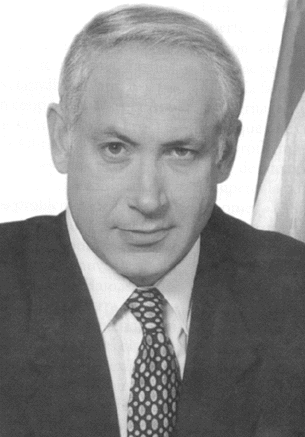
Netanyahu, Israel's Mussolini

Once again, it's time to take a step back and look at the larger picture of the mess in the Middle East. SOTT provides a crack analysis of one of the principle drivers of the continuing conflict.

Blue Ibis
*************************************************************************
Netanyahu, Israel's Mussolini


Image


Andrew Lobaczewski studied at close range a deviant category of humans who, when they manage to grab pivotal positions of power, hold a devastating potential for raining death and destruction down on humanity, simply to further their own interests. These individuals are known as psychopaths, and they move skillfully and purposely throughout the higher echelons of the global body politic. And like clockwork, they slot themselves into all the significant seats of power.

One such individual interests us today. It seems that dangerous moves are afoot which threaten the safety of the entire planet, and that he plays a key role.

At present, it is very clear that the global psychopathic manoeuvres gravitate significantly around the state of Israel, which takes its place at the centre of an horrific downward-spiral of violence, blood, despair and devastation almost beyond human imagining, which spews forth across the surrounding areas, and threatens to envelope the entire earth in its darkness.

A significant part of this phenomenon is the astounding ability of denial, to insist that reality is not represented by the evidence, but instead reality must conform to how "I say it is". When a whole society becomes infected with pathological influence then this affliction of denial becomes endemic throughout the general population. But essentially, this is the 'skill' of the psychopath.

Amos Gunsburg clearly describes this:
They make pronouncements without substantiation. To them, these pronouncements represent what reality is ... pronouncement by pronouncement. The present pronouncement may contradict what they said a moment ago. This means nothing to them. They make no attempt to deal with the contradiction.

They demonstrate a total lack of understanding what we mean by a "fact." In their writings and in their speech, they do not use that word.

We humans find this hard to believe. The use of facts is such a basic part of our lives. We base our conclusions and our actions on them. We go on from there to test things and establish more facts. When we debate, we present facts, and show how we derive our observations and our positions from them.

Without facts, all we have is what we call "fantasy."

Since these creatures have a human appearance, we assume they must think like us ... be aware of what we are aware. We think they MUST know what facts are. When they don't address the facts, we say they are playing a game. We think they do know what the facts are, but don't want to admit it.

Not so! They DON'T know what a fact is. When we speak of facts and ask them to address the facts, they look at us with vacant eyes. They don't know what we're talking about.

They study us because their strategy is to pass as human. They hear us use the words - facts, evidence, substantiation. They lack the human capacity to understand what we mean. What they do is ignore our reference to facts, ignore our requests for them to supply facts, and hope we won't notice it's due to their lack of comprehension.

From "Beyond Insanity" - Amos M. Gunsberg
It is a trademark feature of the Bush Neocon administration, as former Wall Street Journal reporter and author Ron Suskind wrote in New York Times Magazine:
"In the summer of 2002, after I had written an article in Esquire that the White House didn't like about Bush's former communications director, Karen Hughes, I had a meeting with a senior adviser to Bush. He expressed the White House's displeasure, and then he told me something that at the time I didn't fully comprehend - but which I now believe gets to the very heart of the Bush presidency.

"The aide said that guys like me were 'in what we call the reality-based community,' which he defined as people who 'believe that solutions emerge from your judicious study of discernible reality.' I nodded and murmured something about enlightenment principles and empiricism. He cut me off. 'That's not the way the world really works anymore,' he continued. 'We're an empire now, and when we act, we create our own reality. And while you're studying that reality - judiciously, as you will - we'll act again, creating other new realities, which you can study too, and that's how things will sort out. We're history's actors ... and you, all of you, will be left to just study what we do.'"
Nowhere does this mindset have more of a stranglehold, than in Ehud Olmert's Israeli Zionist administration, with its insistent and increasingly hysterical denial of the worsening Palestinian holocaust.

The war of words against Iran has also definitely intensified lately. And there are other things going on at the same time, so perhaps all these things are linked?
"In politics, nothing happens by accident. If it happens, you can bet it was planned that way." - Franklin D. Roosevelt
We see this exact same brutal unblinking denial of reality when we study some of the rhetoric being issued from the mouth of Benjamin Netanyahu:
Drawing a direct analogy between Iran and Nazi Germany, Likud leader Benjamin Netanyahu asserted Monday that the Iranian nuclear program posed a threat not only to Israel, but to the entire western world. There was "still time," however, to prevent Tehran from acquiring nuclear weapons, he said.

"It's 1938 and Iran is Germany. And Iran is racing to arm itself with atomic bombs," Netanyahu told delegates to the annual United Jewish Communities General Assembly, repeating the line several times, like a chorus, during his address. "Believe him and stop him," the opposition leader said of Iranian President Mahmoud Ahmadinejad. "This is what we must do. Everything else pales before this."
So perhaps we should pay more attention to the skillful adept of the "repeated lies will be accepted as truth" doctrine?

The more one looks, the more one finds that next to Netanyahu, Olmert is nothing but an amateur. Netanyahu has friends in high places - it seems he is high up on the psychopathic power elite hierarchy, with the requesite mindset to match.

If this is so, let's see if we can spot those who buttered his bread and sponsored his meteoric rise to the top of the Israeli political and economical scene. Along with economic achievements, we see his professional track record is characterized by an unusually large number of Intelligence ties. Quite exceptional for a 'bright and ambitious young man'.

21 Oct 1949 - Born in Tel-Aviv

1956 - 58, 1963 - 67 - Grows up in the U.S., where his father, the historian Professor Benzion Netanyahu, taught history. Later, mainstream sources will trace Netanyahu's so called 'philosophy' to his father, who was a proponent of the idea 'that the historic bitterness between Arab and Jew made for a seemingly intractable situation'.

A pretty interesting philosophy, especially when Jewish historians and archeologists took an active role in fabricating the myth called the Jewish nation.

1967 - 1972 - Returns to Israel in order to serve in the IDF in the years 1967-72, and reaches the rank of captain in the elite unit, "Sayeret Matkal", the fighting branch of the Israeli Intelligence Services. He participates in a number of missions including the Beirut Airport operation and the rescue of hijacked Sabena Airlines hostages.

One wonders if it wasn't an early rehearsal and stage preparation for Operation Entebbe.

1972 - 1976 - Studies in the U.S. and receives a first degree in Architecture and a second degree in Business Administration at M.I.T, and also studies political science at MIT and Harvard University.

Then he takes a position at the Boston Consulting Group - where his boss is Ira Magaziner, a later aide and policy advisor to President Clinton. Magaziner is best known for leading, along with Hillary Clinton, the failed 'Task Force to Reform Health Care' in the early Clinton administration.

A bit of curious trivia: Magaziner is currently chairman of Clinton Foundation HIV/AIDS Initiative and and the Clinton Climate Initiative. It looks like he may be one of those who help to maintain a scientific 'dominant paradigm' and conformity built into the system of government grants.

04 July 1976 - His brother Jonathan (Yonni), regarded as something of a war hero having already been awarded the Medal of Distinguished Service in Yom Kippur, is killed in the course of Operation Entebbe. Recently released documents show that it was Shin Bet/Mossad cover operation. Netanyahu's brother was the leader of the assault, and the only Israeli military casualty of the raid.

Was his death a necessary sacrifice in order to inculcate in Israelis psyche Netanyahu's image as a brother of a hero?

1979 - Returns once again to Israel, leaving his blossoming career at prestigious consulting firm behind him; sets up the 'Jonathan Institute for the Study of Terrorism' and organises an international Anti-Terrorism Conference, which is attended by various high profile and powerful figures such as George Bush, George Shultz (U.S. Secretary to the treasury, and professor at the infamous Chicago Graduate School of Business), and Richard Perle (President Reagan's Assistant secretary of Defense). In this way he rapidly becomes established on the global stage, making key connections in politics, economics and the military.

After such apparent success he makes a surprising move and takes a senior position at Rim Industries (furniture manufacturer) in Jerusalem, as marketing manager.

Another bit of trivia: Shultz, who's considered to be Netanyahu's protégé, is called the father of Bush doctrine, which evidently advocates fabricating evidence and staging false flag operations in order to embark on so called 'preemptive wars'.

Today Shultz is the chairman of the JPMorgan Chase. The same JPMorgan that is a shareholder in the Federal Reserve, and the one who bought Bear Stearns for 2$ a share after it was funded up to $30 billion of Bear Stearns' less liquid assets.

1982 - Rises instantly through the diplomatic ranks to a highly visible position: he is invited by Israel's Washington Ambassador, Moshe Arens, to be his deputy.

It looks as though Arens was directed by the same people in the Reagan administration who attended Netanyahu's conference three years earlier. He was quoted saying:
"People got a good laugh when they heard I phoned a furniture factory to find a deputy. What sold me on Bibi was his organization of the anti-terror conference and the strong impression he made on American leaders who participated."
1984 - 1988 - Rapid political climb continues: he is appointed as Israel's ambassador to the UN, where he becomes a media figure, with regular TV appearances on Ted Koppel's Nightline and Larry King Live.

Less than three months earlier while in New York, he is visited by George Bush and George Shultz, who further invest in his growing publicity and organizes another conference on terrorism in Washington.
The Washington conference, held on June 24-27, 1984, was a mega-event. Some 36 experts on terrorism spoke during the four-day conference, including the self-described universal fascist Michael Ledeen, and many others from the U.S. neo-con stable who would later play an essential role in spreading the intelligence lies that were used for the invasion of Iraq.
Netanyahu continues to expand his circle of friends who later will play a major role in his election to the Prime Minister post.
[Stephen] Friedman, a 50-year-old attorney from Philadelphia, serves as the lawyer for the Likud Party in the United States. He is one of Netanyahu's oldest childhood pals and also part of whole new cast of American Jewish players that might be called the Friends of Bibi, or FOBB.

Like the celebrated inner circle surrounding Bill Clinton, Netanyahu's American friends, a small fraternity of influential and like-minded Jewish lawyers, businessmen, financiers and columnists, have been helping finance his ambitions and carrying Netanyahu's political water ever since he set his sights on the Israeli premiership in the early 1980s. [...]

FOBB can be divided into two distinct categories: his small inner circle of close male pals, some of whom date back to his high school days outside Philadelphia in the 1960s, and the somewhat larger second string of associates who met and bonded with Bibi while he served as Israel's deputy ambassador to Washington and ambassador to the United Nations in the 1980s.[...]

One of those Netanyahu met at this time and brought into his inner circle was Merv Adelson, ex-husband of TV journalist Barbara Walters and former head of Lorimar studios.[...] Adelson became Netanyahu's Hollywood connection.

Another member of Netanyahu's inner circle is Ronald Lauder, a former U.S. ambassador to Austria and wealthy international businessman. [...] Lauder, 50, has hosted a number of gatherings at his Manhattan apartment, where he introduced Netanyahu to State Department officials, members of Congress, wealthy investors and financiers.
1988 - 1993 - After returning from the U.S. and acquiring powerful neocon allies, Netanyahu is elected to the 12th Knesset as Likud member and appointed as Deputy Foreign Minister and later the Prime Minister's spokesman.

His close ties with big-shots of the mainstream media turned out to be worthwhile. During the Gulf War he practically dominates CNN network's airtime.
According to a March 1991 story in the Washingtonian, a Palestine Liberation Organization official phoned CNN's headquarters in Atlanta during the first week of the war. "This Israeli has been on the air for more than half an hour," he fumed, referring to Netanyahu. "CNN is becoming a propagandist for the Israelis."
March 25, 1993 - Netanyahu elected as Likud Party Chairman and the party's candidate for Prime Minister.

1996 - 1999 - Acts as Israel's 9th Prime Minister.

By winning the election, Netanyahu surprised many who thought that pre-election favorite Shimon Peres was going to win. But it seems that his election wasn't exactly based on luck. Apart from being supported and helped behind the scenes by U.S. businessmen, lawyers and Hollywood moguls, there was one additional curious element, a wave of suicide bombing shortly before the election. This fact was considered as a main catalyst in Peres' downfall. As described by the National Review:
Before the assassination, Netanyahu was running neck and neck with Rabin in opinion polls. This despite the fact that Netanyahu had only a fraction of Rabin's enormous experience as a soldier and statesman. Netanyahu and his strategists were confident of victory. But after Rabin's death, Netanyahu at once plunged 20 to 30 points behind Peres. It took the slaughter of dozens of Israelis in a wave of Arab bomb attacks to switch the momentum back to Netanyahu, who had repeatedly warned of such attacks.
This makes an astounding preview of the events of 9/11, in which it also took an unprecedented attack on home soil with numerous casualties, to turn around Bush's failing popularity in the US. We see the telltale signs of the ubiquitous Mossad 'false flag' operation. As always, one has to ask "who benefits?" This opens up a horrific window into the possibilities of the psychopathic mindset: where lives are sacrificed without hesitation, in order to further one's own agenda.

But, like Bush's presidency, Netenyahu's reign as Prime Minister will be marked as a period of record levels of failure and embarrassment. Such was the failed assassination of Hamas leader Khalid Meshal. Considering that Hamas was a creation of Mossad and frequently used in order to maintain the myth of Palestinian bomber, we get a story with an additional manipulation twist.
The attack on Khalid Meshal by five or six Israeli agents disguised as Canadian tourists looked like of a rushed mission mounted without Mossad's usual meticulous preparation, suggesting someone high up ordered an immediate hit.[...]

[W]hat would killing Meshal have accomplished? His murder would certainly have triggered new Hamas bombings.[...] Two days before attempting to kill Meshal, Israel apparently received a message from Hamas offering a 10-year cease fire in exchange for Israeli withdrawal from the West Bank and ending Jewish settlements. Netanyahu claims he only got this exceptionally important message after the botched assassination. His supporters blame Mossad chief Danny Yatom for sitting on the message. Yatom denies it.

This is part of a furious battle of leaks raging between Mossad and Netanyahu's cabinet. Some Netanyahu supporters claim the Mossad hit was a rogue operation never authorized by the prime minister.

Mossad partisans leak back that it was all Netanyahu's harebrained idea - and that he's now trying to make Mossad chief Yatom fall guy for the fiasco. Other critics say a hard-line cabal inside Mossad is determined to thwart any peace with Palestinians - which is likely true.

Meanwhile, the failed plot has ignited a train of strange events. To divert blame from Israel, a former Canadian ambassador to Israel endangered his countrymen's lives by suggesting Canada was involved in the plot.

In another bizarre twist, while publically ordering Arafat to keep arresting Hamas members, Netanyahu freed from prison Hamas founder Sheik Yassin, and 70 other Hamas 'terrorists' in order to get his Mossad assassins back from Jordanian custody.
Apparently top psychopaths don't like amateurs, especially if it is one of their own. The failed assassination triggered harsh response from the White House, expressing dissatisfaction with Netanyahu's performance.
It is being called the worst fiasco in the history of Israel's once-vaunted intelligence service, the Mossad. It raises, once again, serious questions about Prime Minister Benjamin Netanyahu's mental fitness. It provoked unprecedented expressions of disgust from the Clinton administration -- "we loathe him," one White House official remarked -- and left experienced observers to wonder what other disastrous pratfalls the Israeli leader has in store for the dying Middle East peace process.
Perhaps that might explain forced resignation of the agency's then chief, Danny Yatom after another bungled operation, this time in Switzerland in 1998. Netanyahu was eager to set the record right.

But this spy fever weirdness was only the tip of the iceberg. There was another curious story uncovered by Biranit Goren and Einat Berkovitch journalists from Ha'ir who tried to dig into Natanyahu's past.

They discovered that in 1987, Netanyahu applied for credit using his American social security number 020364537. There were four requests and each request applied with a different name: Benjamin Netanyahu, Benjamin Nitai, John Jay Sullivan and John Jay Sullivan, Jr.
Binyamin Netanyahu is the name Israel's current prime minister was given at birth and which he now uses. In June 1973, during his studies at MIT, Netanyahu submitted a petition to the Boston court, asking to change his name from Netanyahu to Nitai; "I prefer a shorter name", he wrote on the request form. The petition was approved, thus the second name has an explanation. The last two names, however, remain a mystery. Furthermore, the address attached to these names - somewhere in Malibu, California - does not exist. Who, then, is John Jay Sullivan?

Biranit Goren and Einat Berkovitch from Ha'ir tried to find out. They looked into Netanyahu's credit account. This file is supposed to hold information regarding bank accounts, loans, credit cards and so forth; yet, surprisingly, the file was empty. It is as if Netanyahu never had a debt, had never taken out a loan, and always paid his bills up front and in cash.

Goren and Berkovitch then attempted to examine Netanyahu's social security file, but were denied access. They did, however, find out that Netanyahu's file has a different classification than most. They were denied access not merely due to the 1974 privacy act, but because the file had a "confidential" classification. Goren and Berkovitch have explained that such a classification only applies to five categories of people: those who work for one of three federal agencies - FBI, CIA, IRS - or those who are considered to be terrorists or criminals. Since it is unlikely that Netanyahu fits the latter two categories, or that he worked for the IRS, it appears that he was on the payroll of a security agency - the CIA or FBI.
Obviously, an official explanation and denial were offered without delay, but the bad taste remained, especially when Netanyahu's Intelligence ties were popping up from all directions.

Benjamin Gilman, one of Netanyahu's closest allies in Congress, had close relations with Shabtai Kalmanovitch, 'a charming, tanned Russian-Israeli entrepreneur'. He was an operative for Mossad until 1988 when Mossad discovered that Kalmanovitch wasn't such a valuable asset as they thought. He was arrested in Tel Aviv and charged with being a KGB spy.

And then we have stories like this:
Perhaps the most secret and worrying ties concern what is supposedly a high-tech services company. Yediot Ahronot relates how Netanyahu wooed a local Likud leader. "He was invited by Netanyahu to a meeting in his office at Systematics in Ramat Gan. The head of the company, Oded Levental is a candidate for a financial post in the new government."

Systematics is at the core of serious research by American alternative publications, including the usually reliable Media Bypass. In short, the allegations are that the National Security Agency had handed Systematics stolen software called Promis that opened a trap door to the world's secret banking transactions. About 250 Americans, mostly politicians, had their illegal foreign accounts emptied of over $3.5 billion in the operation. It is claimed that Colin Powell dropped out of the presidential race after his account electronically vanished.

Leading figures in the operation included George Bush, Caspar Weinberger and two Arkansas attorneys, Vince Foster Jr. and Hillary Rodham Clinton on behalf of Clinton financier Jackson Stephens. The research invariably concludes that Foster was murdered because he knew too much about the scam.

A leading investigative writer, Sherman Skolnick, writes:
"Some contend Systematics is an NSA proprietary and spies on banks overseas. Can Systematics rightfully deny spying actually done by buffers or cut-outs between Systematics and NSA? Systematics, through a spokesperson, vigorously denies Foster assisted it in any spying on foreign banks but remains apparently silent on whether Hillary Rodham Clinton assisted Systematics in some nefarious activities."
Is it fair to ask why Systematics provided Netanyahu office space and if this was the sum total of its involvement with him?
The Economic angle: But having his hand in various clandestine operations was only part of his activities. In the position of Prime Minister he begins to implement a controversial free market economy program.

As discussed here he 'transferred the Israeli economy towards free market principles'. And when we refer to 'free market principles' we are talking about the very same Friedman Chicago School of Economics that has been used to systematically rape and pillage the entire planet, as Naomi Klein describes in 'The Shock Doctrine'

One of Netanyahu's immediate actions after taking the post was to introduce an aggressive policy of privatization backed by two economic think-tanks. One of the think tanks is Hoover Institution with George Shultz as one of his high profile conservatives.

By taking the road of mass privatization, Netanyahu mimicked his U.S. and British progenitors - Ronald Reagan and Margaret Thatcher.

After being defeated by Ehud Barak in the 1999 election for Prime Minister, Netanyahu decided to 'retire' from politics. Perhaps he was requested to retreat into the background for a while in order to make preparations for the next round. He conveniently surfaced again right after 9/11.

12 September 2001 - In the aftermath of 9/11, Netanyahu starts to show his true colors. He can hardly contain his delight. Compare his reaction (as reported by the New York Times):
"It's very good." Then he edited himself: "Well, not very good, but it will generate immediate sympathy [for Israel]."
to that of his Palestinian counterpart:
Yasir Arafat, leader of the Palestinian Authority, looked shaken as he appeared before reporters in Gaza to deplore "this terrible act." "We are completely shocked," Mr. Arafat said. "Completely shocked."
2002 - 2005 - In 2002 appointed as Minister of Foreign Affairs and then, in the course of 2003, as Minister of Finance.

07 July 2005 - During the London 7/7 bombings, again Netanyahu appears to be more than just a neutral bystander, though the relevant events were conspicuous only by their absence from the mainstream press. SoTT observed:
Guess where Rudolf Giuliani just happened to be on the morning of July 7th 2005? Rudy was lounging at the Great Eastern hotel just a few yards from Liverpool street station where one of the bombs went off. In the same Great Eastern hotel where Giuliani was staying, the Tel Aviv Stock Exchange just happened to be hosting its economic conference. Guess who the keynote speaker was? Israel's then Finance Minister Benjamin Netanyahu.

As it turned out, Netanyahu never arrived at the Great Eastern Hotel because, as news reports in the days after July 7th informed us, Netanyahu had in fact received a warning from the Israeli embassy, (by way of the British Metropolitan police) that bombings were to occur and that he should stay in his hotel in Mayfair. Again, the official British government report makes no attempt to address how British police knew at least 6 minutes (probably longer) in advance that the bombings were to occur when, 'officially', British authorities were not even aware that they were dealing with bombs, believing that the explosions were the result of a power surge, until the bus bombing one hour after the first train explosion.
Undoubtedly, one of his friends in high places has tipped him off.

August 2005 - He resigns from Mr Sharon's cabinet in protest at Israel's planned withdrawal from the Gaza Strip.

May 2006 - His popularity among the ranks of the pathocracy (rather than the 'average Israeli'), and his affinity with Dick Cheney are clearly visible during AIPAC's annual meeting, as described by Rabbi Bruce Warshal:
Let's zero in on AIPAC. It is controlled by right-wing, rich Jewish neo-conservatives. As one manifestation of the truth of this assertion one merely has to look at its annual meeting this past month. At a time when Vice President Cheney's popularity has dropped below 20 percent, the 4,500 delegates to the AIPAC convention gave him a standing ovation for almost a minute before he even opened his mouth and then proceeded to give him 48 rounds of applause in a 35-minute speech. (As my colleague Leonard Fein pointed out, that's once every 43.7 seconds). Considering that 75 percent of American Jews voted for Kerry, it is obvious that these people are out of the mainstream of Jewish thought.

At the same conference, preceding the recent Israeli elections, these delegates were addressed by Ehud Olmert (Kadima), Amir Peretz (Labor) and Benjamin Netanyahu (Likud) by video link from Israel. Olmert and Peretz received polite applause. The AIPAC delegates cheered enthusiastically for Netanyahu, especially when he presented his hard line that was overwhelmingly rejected by the Israeli electorate. Once a great organization, today AIPAC does not even represent the feelings of the average Israeli, let alone the average American Jew.
2005 - 2007 - From the political background, he continues to exert his significant influence for the Zionist cause. He visits London (causing considerable scandal over his funding) on a personal mission to patch up the media image in England during the bombing of Lebanon, In his own words:
"During my trip in August 2006, I worked 20 hours a day giving interviews, lecturing, meeting journalists, editors, political leaders and Jewish leaders to repel Arab propaganda."
And he appears to be very much in control, though at arm's length, within Israel too:
Although Olmert thinks he has out-maneuvered his great rival, in reality he has become Bibi's puppet. Aluf Benn, the leading political correspondent for Ha'aretz, wrote on Oct. 25:
"Olmert has adopted the positions of Likud Chairman Benjamin Netanyahu [who] is steering the government policy from the opposition benches. The hands are the hands of Ehud, but the voice is the voice of Bibi. Now Olmert is carrying out the Netanyahu policy, point by point. The Prime Minister is sending veiled threats to Iran, burying the convergence plan [withdrawal from the Occupied Territories] and allowing accelerated construction in settlements. His social economic policy, too, was copied from Netanyahu...."
Israeli political observers say that Netanyahu is biding his time, while Olmert's own Kadima Party continues to be on the verge of splitting, with half its members likely to return to the Likud. The Labor Party, sitting at the same table with fascist Lieberman, could self-destruct before the year's end, these sources say, and the next government will be led by Bibi, with Lieberman by his side.
Well, he is not only 'biding his time', but is playing out his role within his particular circle of friends, which includes those in the U.S.:
"According to Israeli intelligence sources, since the end of the Lebanon war, Cheney and his neo-con allies have been working to bring into power their real candidate as Israel's Mussolini, Benjamin "Bibi" Netanyahu, chairman of the Likud Party and protégé of U.S. synarchist George Shultz."
August 14, 2007 - Reelected as chairman of the Likud.

So we reach recent times, and there are various related and converging threads. Everything points towards a consolidation of psychopathic power, for whatever may follow.

Netanyahu continues to play a significant role in 'foreign relations', which on the surface would be rather surprising, given that he is only the leader of the opposition, but makes perfect sense in light of his pathocratic tendencies and the nature of his 'friends'. Clearly, he has an important part to play in whatever plan is to unfold.

The present - Now we have the recent round of political scandals surrounding both Olmert and Netanyahu. What is interesting that while there was a gag order imposed on revealing any details about Olmert's investigation, the New York Post posted an exclusive with the name of this 'businessman' - Morris Talansky. The indications are that this is weakening Olmert's position, to leave the way clear for Netanyahu to regain power:
"It's the straw that broke the camel's back, considering all the previous investigations," said Eytan Cabel, secretary general of the Labour party said on Friday.[...]

The justice ministry said on Thursday that Olmert was being investigated over suspicions he unlawfully received payments from a foreign businessman during his time as mayor of Jerusalem and as industry minister. [...]

Olmert: "If the attorney general decides to file an indictment against me I shall resign immediately, even though I am not required to do so by law."

When a premier resigns it is up to the president, currently Shimon Peres, to pick a successor who can try to form a government. Failing that, early elections must be held. [...]

Former prime ministers Ariel Sharon, Ehud Barak and Benjamin Netanyahu also faced corruption investigations, none of which ever led to indictments.
And we see that Netanyahu is still staying busy reinforcing friendships wherever he can:
"Israel has no better friends in the world than Christian Zionists", Likud opposition leader Binyamin Netanyahu said on Sunday.

"This is a friendship of the heart, a friendship of common roots, and a friendship of common civilization," Netanyahu told a conference of American Evangelicals in Jerusalem.

The event, which was organized by the San Antonio, Texas-based Christians United for Israel, drew 1,000 Israel supporters led by the conservative evangelical Pastor John Hagee, who has been a stalwart supporter of Israel for the past three decades.

Hagee on Sunday announced donations of $6 million to a number of Israeli causes and declared that Israel must remain in control of all of Jerusalem. [...]

Hagee has united evangelical Christian supporters of Israel in the US under one umbrella organization, dubbed the Christian Aipac, which focuses solely on support for Israel and does not work to convert Jews to Christianity.

Netanyahu's remarks come just days after the head of the left-leaning Reform Movement in the US Rabbi Eric Yoffie said that Israel should not deal with Christian Zionists like Hagee, calling him an "extremist" who rejected territorial compromise with the Palestinians and disparages Catholics.

Hagee has vehemently denied being anti-Catholic and said his remarks have been mischaracterized, and based on statements that were "totally false." The head of the Knesset's increasingly influential Christian Allies Caucus MK Benny Elon (National Union-National Religious Party), who has spearheaded Israel's relations with the evangelical Christian world, called Yoffie's politically based remarks "shameful," and called Hagee a "visionary man of courage" and an "outstanding spiritual leader." [text-cache]
It seems that every leader who comes to Israel, goes to see Netanyahu. It is not a normal thing in politics to have a meeting with the opposition leader every time someone makes a diplomatic visit. So who really calls the shots and runs things behind the curtain?

All the while, the warmongering rhetoric ramps up, with the continued propaganda campaign from both Israel and the U.S. over Iran's non-existent nuclear weapons program (Saddam Hussein's WMD's, anyone?). Former UN weapons inspector Scott Ritter predicts that some kind of attack on Iran is a "virtual guarantee". The description of Iran as the world's "worst Hitlerite nightmare", does not bode well, when we consider the psychopath's penchant for projecting their own qualities onto their intended victim.

The future? - It looks that Netanyahu's rise to power will be the final step before the total collapse. Because he is a full blown unashamed psychopath. And just like a true psychopath, he cannot see that his action will lead to his own doom - and to everyone else's doom.
"The following question thus suggests itself: what happens if the network of understandings among psychopaths achieves power in leadership positions with international exposure? This can happen, especially during the later phases of the phenomenon. Goaded by their character, such people thirst for just that even though it would conflict with their own life interest... They do not understand that a catastrophe would ensue. Germs are not aware that they will be burned alive or buried deep in the ground along with the human body whose death they are causing."

from 'Political Ponerology' by Andrew Lobaczewski

Tuesday, February 10, 2009

The "rules" for Middle East reporting

"Israel can do no wrong"

Following are the Twelve Golden And Infallible Truths That The Media Is Obligated To Adopt:

1. In the Middle East, the Arabs always attack first and Israel always defends itself. This defense is called "retaliation."

2. Neither Arabs, Palestinians nor Lebanese have the right to kill civilians. This is "terrorism."

3. Israel has the right to kill civilians. This is called "legitimate defense."

4. When Israel massively kills civilians, the Western powers ask it do it with courtesy or politeness. This is called "reaction of the international community."

5. Neither Palestinians nor Lebanese have the right to capture Israeli soldiers inside military installations with sentry and combat positions. This has to be called "kidnapping of defenseless civilians."

6. Israel has the right to kidnap as many Palestinians or Lebanese as they wish and at any time or place. Their present figures are about 10,000 imprisoned, 300 of whom are children and 1,000 women. They do not need any evidence about their culpability. Israel has the right to detain such kidnapped prisoners indefinitely, even if they are people democratically elected by Palestinians. This is called "imprisonment of terrorists."

7. Whenever the word "Hezbollah" is mentioned, it is compulsory to add in the same phrase, "supported and financed by Syria and Iran."

8. When "Israel" is mentioned it is absolutely forbidden to add "supported and financed by the United States." This could give the impression that the conflict is uneven and that Israel's existence is not, after all, at risk.

9. In any statement about Israel, any mention of the following phrases is to be avoided: "occupied territories," "U.N. resolutions," "human rights violations" or "Geneva Convention."

10. Palestinians, as well as Lebanese, always are "cowards" hiding behind a civilian population that dislikes them. If they sleep in military accommodation with their families, this has a name: "cowardice." Israel is entitled to annihilate with bombs and missiles such barracks where they sleep. This is to be called a "surgical, high-precision action."

11. Israelis speak English, French, Spanish or Portuguese better than the Arabs. That is why they deserve to be interviewed more frequently and have better opportunities to explain to the audience at large the above rules. This is called "media neutrality."

12. Any newspaper in disagreement with the above rules is to be branded a "highly dangerous anti-Semitic terrorist media source." Right?

Hupfer lives in Cadott.

Monday, February 02, 2009

The untold story of Gaza and Hamas

Those who forget the past . . . . or worse, those who never knew it in the first place. The roots of the violence in Gaza are are mystery the virtually the entire West. This is the result of the stranglehold on the media which prevents you from reading stories like the one below.

Blue Ibis
************************************************************

Gaza is a secular society where people listen to pop music, watch TV and many women walk the streets unveiled

Last week I was in Gaza. While I was there I met a group of 20 or so police officers who were undergoing a course in conflict management. They were eager to know whether foreigners felt safer since Hamas had taken over the Government? Indeed we did, we told them. Without doubt the past 18 months had seen a comparative calm on the streets of Gaza; no gunmen on the streets, no more kidnappings. They smiled with great pride and waved us goodbye.

Less than a week later all of these men were dead, killed by an Israeli rocket at a graduation ceremony. Were they "dangerous Hamas militant gunmen"? No, they were unarmed police officers, public servants killed not in a "militant training camp" but in the same police station in the middle of Gaza City that had been used by the British, the Israelis and Fatah during their periods of rule there.

This distinction is crucial because while the horrific scenes in Gaza and Israel play themselves out on our television screens, a war of words is being fought that is clouding our understanding of the realities on the ground.

Who or what is Hamas, the movement that Ehud Barak, the Israeli Defence Minister, would like to wipe out as though it were a virus? Why did it win the Palestinian elections and why does it allow rockets to be fired into Israel? The story of Hamas over the past three years reveals how the Israeli, US and UK governments' misunderstanding of this Islamist movement has led us to the brutal and desperate situation that we are in now.

The story begins nearly three years ago when Change and Reform - Hamas's political party - unexpectedly won the first free and fair elections in the Arab world, on a platform of ending endemic corruption and improving the almost non-existent public services in Gaza and the West Bank. Against a divided opposition this ostensibly religious party impressed the predominantly secular community to win with 42 per cent of the vote.

Palestinians did not vote for Hamas because it was dedicated to the destruction of the state of Israel or because it had been responsible for waves of suicide bombings that had killed Israeli citizens. They voted for Hamas because they thought that Fatah, the party of the rejected Government, had failed them. Despite renouncing violence and recognising the state of Israel Fatah had not achieved a Palestinian state. It is crucial to know this to understand the supposed rejectionist position of Hamas. It won't recognise Israel or renounce the right to resist until it is sure of the world's commitment to a just solution to the Palestinian issue.

In the five years that I have been visiting Gaza and the West Bank, I have met hundreds of Hamas politicians and supporters. None of them has professed the goal of Islamising Palestinian society, Taleban-style. Hamas relies on secular voters too much to do that. People still listen to pop music, watch television and women still choose whether to wear the veil or not.

The political leadership of Hamas is probably the most highly qualified in the world. Boasting more than 500 PhDs in its ranks, the majority are middle-class professionals - doctors, dentists, scientists and engineers. Most of its leadership have been educated in our universities and harbour no ideological hatred towards the West. It is a grievance-based movement, dedicated to addressing the injustice done to its people. It has consistently offered a ten-year ceasefire to give breathing space to resolve a conflict that has continued for more than 60 years.

The Bush-Blair response to the Hamas victory in 2006 is the key to today's horror. Instead of accepting the democratically elected Government, they funded an attempt to remove it by force; training and arming groups of Fatah fighters to unseat Hamas militarily and impose a new, unelected government on the Palestinians. Further, 45 Hamas MPs are still being held in Israeli jails.

Six months ago the Israeli Government agreed to an Egyptian- brokered ceasefire with Hamas. In return for a ceasefire, Israel agreed to open the crossing points and allow a free flow of essential supplies in and out of Gaza. The rocket barrages ended but the crossings never fully opened, and the people of Gaza began to starve. This crippling embargo was no reward for peace.

When Westerners ask what is in the mind of Hamas leaders when they order or allow rockets to be fired at Israel they fail to understand the Palestinian position. Two months ago the Israeli Defence Forces broke the ceasefire by entering Gaza and beginning the cycle of killing again. In the Palestinian narrative each round of rocket attacks is a response to Israeli attacks. In the Israeli narrative it is the other way round.

But what does it mean when Mr Barak talks of destroying Hamas? Does it mean killing the 42 per cent of Palestinians who voted for it? Does it mean reoccupying the Gaza strip that Israel withdrew from so painfully three years ago? Or does it mean permanently separating the Palestinians of Gaza and the West Bank, politically and geographically? And for those whose mantra is Israeli security, what sort of threat do the three quarters of a million young people growing up in Gaza with an implacable hatred of those who starve and bomb them pose?

It is said that this conflict is impossible to solve. In fact, it is very simple. The top 1,000 people who run Israel - the politicians, generals and security staff - and the top Palestinian Islamists have never met. Genuine peace will require that these two groups sit down together without preconditions. But the events of the past few days seem to have made this more unlikely than ever. That is the challenge for the new administration in Washington and for its European allies.

William Sieghart is chairman of Forward Thinking, an independent conflict resolution agency

Friday, January 30, 2009

With Gaza, Journalists Fail Again

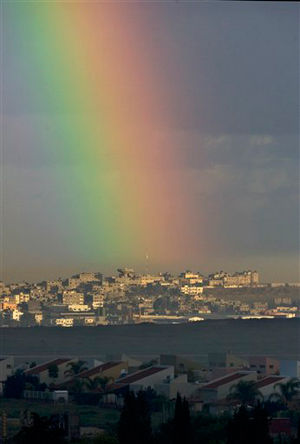
gaza_rainbow1
© AP photo / Sebastian Scheiner

A rainbow, as if projected by the
American media, is seen over the
northern Gaza Strip, from the
Israel-Gaza Border.


The assault on Gaza exposed not only Israel's callous disregard for international law but the gutlessness of the American press. There were no major newspapers, television networks or radio stations that challenged Israel's fabricated version of events that led to the Gaza attack or the daily lies Israel used to justify the unjustifiable. Nearly all reporters were, as during the buildup to the Iraq war, pliant stenographers and echo chambers. If we as journalists have a product to sell, it is credibility. Take that credibility away and we become little more than propagandists and advertisers. By refusing to expose lies we destroy, in the end, ourselves.

All governments lie in wartime. Israel is no exception. Israel waged an effective war of black propaganda. It lied craftily with its glib, well-rehearsed government spokespeople, its ban on all foreign press in Gaza and its confiscation of cell phones and cameras from its own soldiers lest the reality of the attack inadvertently seep out. It was the Arabic network al-Jazeera, along with a handful of local reporters in Gaza, which upheld the honor of our trade, that of giving a voice to those who without our presence would have no voice, that of countering the amplified lies of the powerful with the faint cries and pain of the oppressed. But these examples of journalistic integrity were too few and barely heard by us.

We retreated, as usual, into the moral void of American journalism, the void of balance and objectivity. The ridiculous notion of being unbiased, outside of the flow of human existence, impervious to grief or pain or anger or injustice, allows reporters to coolly give truth and lies equal space and airtime. Balance and objectivity are the antidote to facing unpleasant truths, a way of avoidance, a way to placate the powerful. We record the fury of a Palestinian who has lost his child in an Israeli airstrike in Gaza but make sure to mention Israel's "security needs," include statements by Israeli officials who insist there was firing from the home or the mosque or the school and of course note Israel's right to defend itself. We do this throughout the Middle East. We record the human toll in Iraq, caused by our occupation, but remind everyone that "Saddam killed his own people." We write about the deaths of families in Afghanistan during an airstrike but never forget to mention that the Taliban "oppresses women." Their crimes cancel out our crimes. It becomes a moral void. And above all we never forget to mention the "war on terror." We ask how and who but never, never do we ask why. As long as we speak in the cold, dead language of those in power, the language that says a lie is as valid as a fact, the language where one version of history is as good as another, we are part of the problem, not the solution.

"Bombs and rockets are flying between Israel and Palestinians in Gaza, and once again, The Times is caught in a familiar crossfire, accused from all sides of unfair and inaccurate coverage," New York Times public editor Clark Hoyt breezily began in writing his assessment of the paper's coverage, going on to conclude "though the most vociferous supporters of Israel and the Palestinians do not agree, I think The Times, largely barred from the battlefield and reporting amid the chaos of war, has tried its best to do a fair, balanced and complete job - and has largely succeeded."

The cliché that Israel had a right to defend itself from Hamas rocket attacks - that bombs and rockets were "flying between Israel and Palestinians in Gaza" - was accepted in the press as an undisputed truth. It became the starting point for every hollow discussion of the Israeli attack. It left pundits and columnists chattering about "proportionality," not legality. Israel was in open violation of international law, specifically Article 33 of the Fourth Geneva Convention, which calls on an occupying power to respect the safety of occupied civilians. But you would not know this from the press reports. The use of attack aircraft and naval ships, part of the world's fourth-largest military power, to level densely packed slums of people who were hungry, without power and often water, people surrounded on all sides by the Israeli army, was fatuously described as a war. The news coverage held up the absurd notion that a few Hamas fighters with light weapons and no organization were a counterforce to F-16 fighter jets, tank battalions, thousands of Israeli soldiers, armored personnel carriers, naval ships and Apache attack helicopters. It fit the Israeli narrative. It may have been balanced and objective. But it was not true..

The Hamas rockets are crude, often made from old pipes, and largely ineffectual. The first homemade Qassam rocket was fired across the Israeli border in October 2001. It was not until June 2004 that Israel suffered its first fatality. There are 24 Israelis who have been killed by Hamas rocket fire, compared with 5,000 Palestinian dead, more than half of them in Gaza, at least a third of them children. This does not absolve Hamas from firing rockets at civilian areas, which is a war crime, but it does raise questions about the story line swallowed without reflection by the press. I covered the Kosovo Albanians' desperate attempts to resist the Serbs, which resulted in a handful of Serb casualties, but no one ever described the lopsided Serbian butchery in Kosovo as a war. It was called genocide, and it led to NATO intervention to halt it.

It was Israel, not Hamas, which violated the truce established last June. This was never made clear in any of the press reports. Hamas agreed to halt rocket fire into Gaza in exchange for an Israeli promise to ease the draconian siege that made the shipment of vital material and food into Gaza nearly impossible. And once the agreement was reached, the Hamas rocket fire ended. Israel, however, never upheld its end of the agreement. It increased the severity of the siege. U.N. agencies complained. International relief organizations condemned the Israeli blockade. And there were even rumblings inside Israel. Shmuel Zakai, an Israeli brigadier general who resigned as commander of the Israel Defense Forces' Gaza Division and was forcibly discharged from the military amid allegations that he leaked information to the media, told the Israeli newspaper Haaretz on Dec. 22 that the Israeli government had made a "central error" during the tahdiyeh, the six-month period of relative truce, by failing "to take advantage of the calm to improve, rather than markedly worsen, the economic plight of the Palestinians of the Strip. ... [W]hen you create a tahdiyeh, and the economic pressure on the Strip continues," Zakai said, "it is obvious that Hamas will try to reach an improved tahdiyeh, and that their way to achieve this is resumed Qassam fire. ... You cannot just land blows, leave the Palestinians in Gaza in the economic distress they're in, and expect that Hamas will just sit around and do nothing."

Israel, we know from papers such as Haaretz, started planning this assault last March. The Israeli army deliberately broke the truce when it carried out an attack on Nov. 4 that killed six Hamas fighters. It timed the attack, the heavy air and naval bombardment and the invasion of Gaza to coincide with the waning weeks of the Bush administration. Israel knew it would be given carte blanche by the White House. Hamas responded to the Nov. 4 provocation in the way Israel anticipated. It fired Qassam rockets and Grad missiles into Israel to retaliate. But even then Hamas offered to extend the truce if Israel would lift the blockade. Israel refused. Operation Cast Lead was unleashed.
,
Henry Siegman, the director of the U.S./Middle East Project at the Council of Foreign Relations, noted correctly that Israel "could have met its obligation to protect its citizens by agreeing to ease the blockade, but it didn't even try. It cannot be said that Israel launched its assault to protect its citizens from rockets. It did so to protect its right to continue the strangulation of Gaza's population."

There were a few flashes of integrity in the American press. The Wall Street Journal ran a thoughtful piece, "How Israel Helped to Spawn Hamas," on Jan. 24 that was unusual in view of the acceptance in U.S. press coverage that Hamas is nothing more than an Islamo-fascist organization that understands only violence. And some journalists from news organizations such as the BBC did a good job once they were finally permitted to enter Gaza. Jimmy Carter wrote an Op-Ed article in The Washington Post detailing his and the Carter Center's efforts to prevent the conflict. This article was an important refutation of the Israeli argument, although it was ignored by the rest of the media. But these were isolated cases. The publishers, news executives and editors largely accepted without any real protest Israel's ban on coverage and allowed Israeli officials to fill their news pages and airtime with fabrications and distortions. And this made the war crimes carried out by the Israeli army easier to commit and prolong.

Prime Minister Ehud Olmert, who is acutely aware of Israel's violations of international law, has already begun to reassure his commanders that they will be protected from war crimes prosecution.

"The commanders and soldiers that were sent on the task in Gaza should know that they are safe from any tribunal and that the State of Israel will assist them in this issue and protect them as they protected us with their bodies during the military operation in Gaza," he said.

Hamas is an unsavory organization. It has made life miserable for many in Gaza and carried out a series of death-squad-style executions of alleged opponents. But Hamas, elected to power in 2006, also brought effective civil control to Gaza. Gaza, ruled by warring factions, warlords, clans, kidnapping rings and criminal gangs, had descended into chaos under Mahmoud Abbas' corrupt Fatah-led government. Hamas, once it assumed power, halted suicide bombing attacks on Israel. It ended rocket fire into Israel for almost a year. It upheld its agreement with Israel. Hamas' willingness to negotiate with Israel, albeit through Egyptian intermediaries, led al-Qaida, which has been working to make inroads among the Palestinians, to condemn the Hamas leadership as collaborators.

Israel and the United States carried out an abortive and desperate attempt to overthrow Hamas by arming and backing a Fatah putsch in June 2007. They wanted to install the pliant Abbas in power. Hamas resisted, often with violent brutality, and expelled Abbas and the Fatah leadership from Gaza to the West Bank. Israel has now decided to do the dirty job itself. It will not work. Israel broke and discredited Yasser Arafat and Fatah in much the same manner. Abbas and Fatah have no authority or credibility left. Abbas is seen by most Palestinians as a pliant Israeli stooge. Israel is now destroying Hamas. Radical Islamic groups, such as al-Qaida, far more violent and irrational, stand poised to replace Hamas. And Israel will one day look wistfully at Hamas just as it does now at Fatah. But by then, with Israel surrounded by radical Islamic regimes in Egypt, Syria, Lebanon and even Jordan, as well as fighting a homegrown al-Qaida movement among the Palestinians, it may be too late.

The Israeli government bears the responsibility for its crimes. But by giving credibility to the lies and false narratives Israel uses to justify wholesale slaughter we empower not only Israel's willful self-destruction but our own. The press, as happened during the buildup to the Iraq war, was again feckless and gutless. It bent to the will of the powerful. It abandoned its sacred contract with its readers, listeners and viewers to always tell the truth. It chattered about nothing. It obscured the facts. It did this while hundreds of women and children were torn to shreds by iron fragmentation bombs in a flagrant violation of international law. And as it failed it lauded itself for doing "a fair, balanced and complete job."

Monday, January 26, 2009

Gaza - Border crossing spin

Background: The Inside Story of Gaza's Blighted Border Crossings

© Unknown

How to help the Palestinians in Gaza has lately been reduced to the realm of simple slogans aimed at Israel, such as "end the blockade" or "open the crossings."

When uttered by activists or international politicians and officials, it sounds as if all that's needed is for Israel to open some mythical gate to the 360-square kilometer area wedged between Israel and Egypt.

They ignore the fact that Egypt shares a border with Gaza, too, which it is also keeping closed. And they do not take into account the difficulties posed in running the crossings since Hamas kicked out the Palestinian Authority - which operated these passages - from Gaza during a violent coup in June 2007.

When Israel left Gaza in the summer of 2005, a detailed arrangement called "Agreement on Movement and Access" was made with the PA for the passage of goods and people in and out of the area.

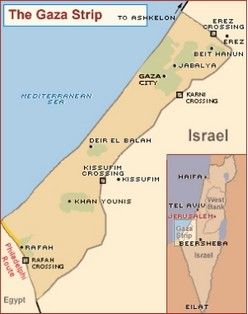
On the Israeli side, people were to move in and out of Erez in the north and commercial goods were to go through Karni in the center. On the Egyptian side in the south, the Rafah border crossing was designated for the passage of people and goods, but an agreement for the passage of people was finalized.

In addition, on the Israeli side, two minor crossing points, Kerem Shalom and Sufa, were set up to operate as backups to Karni, and fuel could go through Nahal Oz.

Since operating the three major crossings - Erez, Karni and Rafah - needed serious coordination on both sides of the border, the PA manned them on the Gaza side. A special EU team was also established to monitor the Rafah crossing.

In the midst of Israel's Gaza withdrawal in 2005, Interior Ministry officials held a press conference at the Erez crossing, at which they earnestly explained that in the peace that would descend within two years, it would be possible to replace the soldiers at the crossing points with trained professional staff so that they would look like any other international border terminal.

Discussions were even launched on operating the Gaza airport and a seaport.

But these plans, along with the elaborate crossing arrangements, were destroyed by the Hamas coup. After that, the PA was no longer able to monitor the crossings, which were also damaged on the Gaza side during the fighting and have yet to be repaired.

Though there were some reports over the weekend of a new willingness to cooperate, Hamas to date has not agreed to allow the PA to return. Since the coup, no solution been found that would place, as an alternative to the PA, a team of Palestinians on the Gaza side to coordinate the movement of goods and people.

[Perhaps Hamas has seen how 'effective' the PA has been in protecting the rights of Palestinians in the West Bank, and knows they are useless.]

Therefore, it is not been possible to fully operate the Erez, Karni and Rafah crossings at the pre-June 2007 level.

To be clear, as long as Hamas remains in power and holds IDF soldier Gilad Schalit captive, Israel won't fully reopen the passages to a level that would allow the free movement of people or enable a flourishing economy in the Gaza Strip.

But even if it wanted to do so, as long as Israel and Hamas refuse to coordinate with each other on the crossings and as long as no alternative body can do so, opening them remains technically impossible, from both a security and logistical perspective.

In the interim, the Erez crossing has been open in a limited fashion to people, mostly diplomats, international aid workers and medical cases.

Israel remained committed to providing humanitarian aid and limited commercial imports via the smaller crossings at Sufa and Kerem Shalom and the fuel depot at Nahal Oz.

For international aid organizations over the past 18 months - mostly the UN, which provides basic food supplies to 1.1 million out of the 1.4 million people who live in Gaza - these two passages have served as temporary portals.

But Hamas has intermittently attacked these passages and as a result, Sufa has been closed for security reasons, leaving only Kerem Shalom.

At Kerem Shalom, Israeli trucks unload their goods in a concrete lot and then pull away. The gate to the lot is then closed on the Israeli side and Palestinian trucks drive in to load the goods and take them into Gaza.

This system can handle a smaller amount of goods than Karni, where the transfer is faster and also cheaper.

International aid organizations have found, for example, that Kerem Shalom cannot process the amount of grain needed to feed both people and livestock in Gaza. As a result, Israel has opened the wheat chute at Karni, which can be operated without much coordination on the other side.

According to Maj. Peter Lerner, the spokesman for the IDF Coordinator of Government Activities in the Territories, last week some 1,006 trucks loaded with 27,650 tons of humanitarian aid and goods went into Gaza through Kerem Shalom, including grain chuted through Karni.

[How kind. After destroying all the tons of food UNWRA had in place with white phosphorus shells, they are allowing a small fraction in now]

In addition, he said, 1,940,000 liters of fuel for the Gaza power station went in through Kerem Shalom and Nahal Oz, along with 766 tons of cooking gas.

Overall, he said, since the start of Israel's military operation in Gaza four weeks ago, 2,361 trucks of supplies have gone in with 60,000 tons of goods, as well as 5.5 million liters of fuel for the power plant.

International aid organizations, including the UN, have said that Gaza needs an even greater level of humanitarian assistance. They have called on Israel to allow more goods to pass through both Kerem Shalom and Karni.

Lerner said that capacity is increasing and this week could be up to 250 trucks a day. He added that he is unaware of any unmet humanitarian needs.

During a brief visit to the region this week, UN Undersecretary-General for Humanitarian Affairs and Emergency Relief Coordinator John Holmes called on Israel to do more than just increase the flow of humanitarian goods into Gaza.

Kerem Shalom, he said, provides only a fraction of what is needed in Gaza.

He was not daunted, he said, by the diplomatic failure to date to return the PA to the crossings at Rafah, Karni and Erez.

While Hamas has focused on the need to open Rafah, Holmes said his goal was to see Karni fully reopened at a level that would enable the Gaza economy to flourish.

It is possible, he told The Jerusalem Post, to reopen Karni by placing an acceptable international coordinating body at that crossing, possibly drawn from the European Union or Turkey.

It is particularly important to do so if Israel and Egypt succeed in closing the tunnels under Rafah, which Palestinians have used to smuggle goods into Gaza from Sinai, Holmes said.

Most of that activity is commercial, he said, and if the tunnel route is closed down, it is important open up another avenue for the flow of goods.

Holmes added that he is not willing to join the "council of despair" that claims that Karni cannot be reopened.

What should be paramount in everyone's mind at this point, he said, "is the welfare of the people in Gaza."

Wednesday, January 14, 2009

Voices of the Elders - Expulsion from Palestine

Read carefully. This old man remembers a time when Jew, Christian and Muslim lived in harmony in Palestine. Then the snake of Zionism struck, shattering a peaceful co-existence. The media will tell you that it was war always, but this is not true. What else is not true?

Blue Ibis
**********************************************************************

What It Was Like Being Forced to Leave Palestine 60 Years Ago

As Told to Suzanne Manneh
New America Media
Mon, 12 Jan 2009 23:14 UTC

The current conflict between Hamas forces and Israel has rekindled memories among many Palestinian expats of a time more than six decades ago when they were forced to flee their homeland as violence erupted there. A 78-year-old Palestinian expat, who wants to remain anonymous, shares some of those memories with New America Media reporter Suzanne Manneh.

Daly City, Calif. -- It's been 61 years since I've seen my homeland of Palestine. I'm one of many Palestinian elders living in exile. And sadly, one of many who may not live to see home again.

I left Jaffa, Palestine, now part of Israel, when I was 17. It was a violent time in Palestine, leading up to the Nakba, Arabic for catastrophe, the expulsion of Palestinians from Palestine, and the creation of Israel.

My family and I fled on April 27, 1948. My cousin, who lived a block away from me, was severely injured from a missile attack on our neighborhood, but survived. The next day, Jewish defense forces said we had to leave or die, so we packed whatever we could, as fast as we could, and left for Jordan, hoping for a more peaceful, stable life. But an unstable Jordanian economy in the 1970's ended that dream and started another, in the United States.

When I came to the United States, I hid the fact that I was Palestinian, or even Arab. I said I was Greek. I was worried Americans would call me a terrorist and reject me. I surrendered my homeland and my identity as well. Some found out I was Palestinian and insulted me.

In the last two weeks, I've been glued to my television set, watching from my home here in California the fighting between Hamas and Israel in Gaza. And as I watch, I cry. Watching this is the closest I think I can get to home.

My last memories of home are like this. Chaos. Death. Blood. Tears. Fear. Anger. Screaming. And above all sadness, so much sadness. One minute you're enjoying a meal with your family and boom! you're uprooted.

One afternoon, at the end of January 1948, I was riding my bicycle home from my father's taxicab business. I was in downtown Jaffa and saw one of my uncles riding his bike. "Hurry on home!" he yelled, "I hear this area is next to get bombed!"

I didn't believe him, but I didn't want to take any chances. I rode toward my house and he toward his. Seconds later, I heard a huge explosion. I saw buildings go up in smoke and fires behind me. Hundreds of people were running in the streets, screaming. I was shaking uncontrollably when I got home. I learned that my uncle had died in the explosion.

The violence escalated in the following days. My Jewish friends were shocked. They couldn't believe what was happening. There had been riots before, a little violence, but never like this. Each day there were more attacks. Palestinians felt they had to retaliate, so it became violence against violence.

The Jewish defense forces began forcing people to leave their homes. If they didn't, they would kill everyone, they said. I remember Palestinian girls getting raped. I saw three sisters from my neighborhood jump into a well because the defense forces tried to rape them.

Many families who didn't have cars in which to escape scrambled to find a family that did. They squished into them, 12 to15 people to a car.

Others managed to take boats north into Lebanon. Some fled by foot. Many of them died of dehydration and exhaustion while escaping. We were lucky. We had a cab from my father's taxicab company at home and we drove off in it, leaving everything else behind.

The other day, I saw a close-up of a little girl's face on my TV screen. She was four, maybe five, years old. Her eyes were swollen from crying. She was screaming, "Mommy! Daddy! Mommy! Where are you? I need you!" Her parents had been killed in missile attacks.

When I saw her eyes, I remembered a little girl from 1948 in my neighborhood. She too had eyes swollen from crying. She found her parents shot dead in front of her home. They hadn't cooperated when they were told to leave. The little girl was still asleep inside the house.

In that violence, over 750,000 Palestinians were forced out. But today I see cruelty that cannot compare to 1948. This is worse than a slaughterhouse. I see fields of human bodies with arms and legs missing. I see dead bodies lying on top of each other in pools of blood, injured people, homes turned to rubble.

I see children in the streets all alone. I see people crying. They have been without food, water, medicine and electricity for weeks.

In 1948, I thought the Palestinian issue was just a Palestinian issue, but this current conflict has become a global humanitarian crisis. International human rights are being violated. Palestinians deserve a home, deserve peace, just like everyone else.

Growing up in Palestine, I had many Jewish, Muslim and Christian friends. You could sense the harmony between us. I remember many of them visiting me in Jaffa. I, in turn, would visit them in Gaza, an hour's drive away. I still remember the smell of fresh citrus and wild flowers in the air.

I haven't seen or heard from them since I came to the United States. I'm not sure if they're okay, or even if they're still alive. I have no way of finding out. When I fled Palestine, I was lucky to have my parents, brothers, sisters and a few other immediate relatives to stay with. It was impossible to keep track of everyone else you knew when you were ripped apart from everything and everyone.

After the state of Israel was created, the Israeli government made it difficult for Palestinians to return to their homeland. If I had to go back, I would first need to complete forms and be investigated before I am given permission. Imagine needing permission to go home. It's like someone ripping my heart out, stepping on it and feeding it to the lions. If there had been peace in Palestine, I would have preferred to be there now, even if it meant living like a peasant.

I cried and prayed for peace in 1948, and every time a fresh outbreak of violence erupted. For too long I have been hearing the terms, "cease fire" and "peace talks." But historically, that part of the world has been an unending cycle of violence and ceasefire. I don't want to see this cycle continue. There must be peace, real peace, and equality.

The only thing I can do now as a 78-year-old man is to pray. Pray for my people. Pray for everyone. Pray for peace.

Friday, January 09, 2009

The brutal face of Israel's "total war" on Gaza

The humane world is running out of words to express outrage at the cruelty of the Israeli assault on Gaza. Perhaps the words of those who are living it will be more powerful.

Blue Ibis
****************************************************************
The brutal face of Israel's "total war" on Gaza

Bill Van Auken
World Socialist Web Site
Fri, 09 Jan 2009 18:34 UTC


© WSWS

B'Tselem, the Israeli group that monitors human rights in the occupied territory, spoke to 19-year-old Meysa a-Samuni, a young woman with an infant daughter, who witnessed the massacre of much of her family in the Zeitun neighborhood south of Gaza City. They were killed when Israeli troops shelled a house which they and others had been ordered to enter.

She told B'Tselem: "On Sunday [4 January], around 9 a.m., soldiers came to the house of my father-in-law, Rashed a-Samuni, which is located next to a concrete engineering company. We were 14 people in the house, all of us from a-Samuni family: me, my husband, Tawfiq, 21, our infant, Jumana, nine months old, my father-in-law, Rashed, 41, my mother-in-law, Rabab, 38, and my husband's brothers, Musa, 19, Walid, 17, Halmi, 14, Zeineb, 12, Muhammad, 11, Shaban, 9, Issa, 7, Islam, 12, Israa, 2.

"The soldiers came to the house on foot and knocked on the door. We opened and then, threatening us with weapons, they forced us to leave the house. They had bulletproof vests on and had automatic weapons. Their faces were painted black. We left the house. Walid ran from another door of the house, but the soldiers caught him.

"The soldiers led us by foot to the house of my father-in-law's brother, Talal Halmi a-Samuni, 50, about 20 meters away. In the house were already about 20 people, and together we were 35. The soldiers left us, apparently to search my father-in-law's house.

"About an hour later, the soldiers came back and ordered us to go with them to the house of Wail a-Samuni, 40. His house is a kind of concrete warehouse, about 200 square meters big, about 20 meters from Talal's house, where we were. We reached Wail's house at 11:00 a.m. There were already 35 people there, so now we were about 70 in total. We stayed there until the next morning. We didn't have food or drink.

"Around six o'clock in the morning [Monday, 5 January], it was quiet in the area. One of the men in the family, Adnan a-Samuni, 20, said that he wanted to go and bring his uncle and family so they could be with us. My father-in law and his nephew, Salah Talal a-Samuni, 30, and his cousin Muhammad Ibrahim a-Samuni, 27, were standing at the door of the house and planned on going together to bring them. The moment they left the house, a missile or shell hit them. Muhammad was killed on the spot and the others were injured from the shrapnel. My husband went over to them to help, and then a shell or missile was fired onto the roof of the warehouse. Based on the intensity of the strike, I think it was a missile from an F-16.

"When the missile stuck, I lay down with my daughter under me. Everything filled up with smoke and dust, and I heard screams and crying. After the smoke and dust cleared a bit, I looked around and saw 20-30 people who were dead, and about 20 who were wounded. Some were severely wounded and some lightly.

"The persons killed around me were my husband, who was hit in the back, my father-in-law, who was hit in the head and whose brain was on the floor, my mother-in-law Rabab, my father-in-law's brother Talal, and his wife Rhama Muhammad a-Samuni, 45, Talal's son's wife, Maha Muhammad a-Samuni, 19, and her son, Muhammad Hamli a-Samuni, five months, whose whole brain was outside his body. Razqa Muhammad a-Samuni, 50, Hanan Khamis a-Samuni, 30, and Hamdi Majid a-Samuni, 22.

"My husband's brother, Musa, and I were lightly injured. Musa was injured in the shoulder and my left hand was injured. My daughter was injured in the left hand. Her thumb, second finger, and third finger had been cut off. I took a kerchief and wrapped her hand to stop the bleeding. The wounded who lay on the floor cried for help and couldn't move. The small children and my husband's grandmother, Shifaa a-Samuni, 70, were crying.

"About 15 minutes after the second strike, Musa said that it would be better to escape and go to the house of his uncle, Assad a-Samuni, about 20 meters away. We ran and knocked on the gate, but nobody answered. Musa jumped over the gate and opening it and we went inside. We were me, my daughter, Musa, and his little sisters Islam, five, and Isra, two. There were 40-50 soldiers in the house, and more people were gathered in one of the rooms. There were about 30 people, 7-10 of them men. The men were blindfolded.

"One of the soldiers came to me and gave me and my daughter first-aid. He bandaged our hands and checked our pulse. Then the soldiers tied Musa and blindfolded him.

"The soldiers told us that they would release us and leave only Musa and his uncle 'Emad in case Hamas came. I understood that they intended to use them as 'human shields.' They ordered us to leave the house, and we walked along the street about 400-500 meters until we found an ambulance, which took me and my daughter to a-Shifa Hospital. The others from my family continued to walk in the street. Later, some of them also arrived at the hospital.

"As far as I know, the dead and wounded who were under the ruins are still there. I didn't see that any of them had been brought to the hospital."

In another testimony gathered by B'Tselem, Abdallah Tawfiq Hamdan Kashku, a 44-year-old policeman with four children living in Gaza City, recounted:

"My family lives in a three-storey house in al-Zeitun, Gaza City. On Sunday [28 December], around 7 p.m., I was sitting with nine members of my family around a bonfire in the yard. It was cold, and we didn't have electricity to heat the house. I turned on the generator to turn on the light. Then we heard the sound of planes in the sky. I heard a buzz and within a few seconds, I found myself under the rubble. I didn't know what happened to me or to my family. I began to cry for help. The smoke was thick. I couldn't see any of my family, who had been sitting with me a few moments earlier.

"It took a few moments before I realized the house had collapsed because of the bomb. Neighbors rushed to pull us from the rubble. People took my family to the hospital, some by car and some by ambulance. I was taken to al-Shifa Hospital where the doctors treated me. I was slightly wounded in the leg. I asked my relatives and the doctors where the rest of my family was. They told me my wife had a broken pelvis and that the others had suffered light wounds but that they hadn't found my little daughter, Ibtihal. I felt horrible, worrying so much about her.

"Early the next morning, my brothers went home to look for Ibtihal. They looked under the ruins and found her body in the kitchen on the second floor.

"Our house was in a quiet area. I don't think there are military targets in the area. We don't have relatives or neighbors who are wanted. I am still in shock. In a few minutes, the life of my family was turned completely upside down."

Yusef 'Abd al-Karim Barakeh Abu Hajaj, a resident of Juhar a-Dik, an agricultural area in the center of the Gaza Strip, described a January 4 attack on his home where 15 members of his family were staying:

"Around 7 a.m., an Israeli tank fired at our house. We decided to leave, and went to our neighbor, Hussein al-'Aydi. A little while later, we heard that the army told people to leave the houses in the area, and we decided to go to another place. We left together with the neighbor's family. Together, we were 25 persons.

"When we went outside, we held up white cloth, so the soldiers would know we were civilians. We were afraid they would shoot us, but we walked anyway, having no alternative. Women and small children were in our group. When we got to a point opposite the tanks, they opened fire at us. My mother was hit and fell down. Then my sister Majda was hit in the back. Both were killed. We ran back, toward Hussein al-'Ayadi's house. Mother and Majda remained lying on the ground.

"We immediately called the Red Crescent and the Red Cross to ask them to remove the bodies. Because of the shelling, nobody could get there. The next day, we realized we had to leave the area, and we fled.

"Now I'm living in the school in Nuseirat. We didn't manage to coordinate removal of the bodies of Mother and Majda, and they are apparently still outside. We don't know when we can move them. It is very crowded in the school, so some of my family went to stay in other places."

Hussein al-'Ayadi, 60, also from Juhar a-Dik, spoke to B'Tselem on January 7:

"My house is made of concrete, which is why my brothers came to live with me when the fighting began," he said.

"Saturday night [3 January], there was lots of tank fire and aerial bombing, and we all went into the main room, which is more secure. A shell fell on the roof of the house, tearing a hole into the ceiling and injuring a few of us lightly. We all went to the ground floor and then a tank fired another shell, which hit the house, injuring eight people in my family: Nur Hussein al-'Ayadi, 16, Wa'ed Adnan al-'Ayadi, 13, Raghda Adnan, 17, Hind Adnan, 14, Walid Adnan, 6, Kamela Hashem al-'Ayadi , 80, Doha Hassan al-'Ayadi, 80, and Doa'a Farid al-'Ayadi , 18. All were lightly injured.

"With the house damaged, we are now hiding in a small room in the yard. We have been in contact with all kinds of people in an attempt to get the army to let us take out the injured without getting fired at, but without success. The Red Cross told us that the army claims that nobody is trapped in our area, and is not willing to let them enter.

"We called Physicians for Human Rights and contacted Knesset members. Lots of people are trying to help us, but nothing has happened so far.

"We are eating what remained in the house and vegetation from the yard, which we cook, but we are a large number of people, and the food is beginning to run out."

And the Reuters news agency carried the tragic account given by Dr. Awni Al-Jaru, a surgeon at the Shifa Hospital, Gaza's largest medical facility, whose house in the Tuffah neighborhood of north Gaza was fired on by an Israeli tank Thursday.

"I was sitting inside the room when there was a boom and I ran out to the hall and saw my son Abdel-Rahim. I asked him where was his mother and brother Youssef.

"I found my wife Albina cut in two parts and my son Youssef completely blown apart. I could only recognize him from his teeth," said the doctor.

Dr. Jaru's wife was Ukrainian-born and could have left Gaza with other foreign-born residents before Israel unleashed its full fury against Gaza, but she refused to go. Their son Youssef was 18 months old.B'Tselem, the Israeli group that monitors human rights in the occupied territory, spoke to 19-year-old Meysa a-Samuni, a young woman with an infant daughter, who witnessed the massacre of much of her family in the Zeitun neighborhood south of Gaza City. They were killed when Israeli troops shelled a house which they and others had been ordered to enter.

She told B'Tselem: "On Sunday [4 January], around 9 a.m., soldiers came to the house of my father-in-law, Rashed a-Samuni, which is located next to a concrete engineering company. We were 14 people in the house, all of us from a-Samuni family: me, my husband, Tawfiq, 21, our infant, Jumana, nine months old, my father-in-law, Rashed, 41, my mother-in-law, Rabab, 38, and my husband's brothers, Musa, 19, Walid, 17, Halmi, 14, Zeineb, 12, Muhammad, 11, Shaban, 9, Issa, 7, Islam, 12, Israa, 2.

"The soldiers came to the house on foot and knocked on the door. We opened and then, threatening us with weapons, they forced us to leave the house. They had bulletproof vests on and had automatic weapons. Their faces were painted black. We left the house. Walid ran from another door of the house, but the soldiers caught him.

"The soldiers led us by foot to the house of my father-in-law's brother, Talal Halmi a-Samuni, 50, about 20 meters away. In the house were already about 20 people, and together we were 35. The soldiers left us, apparently to search my father-in-law's house.

"About an hour later, the soldiers came back and ordered us to go with them to the house of Wail a-Samuni, 40. His house is a kind of concrete warehouse, about 200 square meters big, about 20 meters from Talal's house, where we were. We reached Wail's house at 11:00 a.m. There were already 35 people there, so now we were about 70 in total. We stayed there until the next morning. We didn't have food or drink.

"Around six o'clock in the morning [Monday, 5 January], it was quiet in the area. One of the men in the family, Adnan a-Samuni, 20, said that he wanted to go and bring his uncle and family so they could be with us. My father-in law and his nephew, Salah Talal a-Samuni, 30, and his cousin Muhammad Ibrahim a-Samuni, 27, were standing at the door of the house and planned on going together to bring them. The moment they left the house, a missile or shell hit them. Muhammad was killed on the spot and the others were injured from the shrapnel. My husband went over to them to help, and then a shell or missile was fired onto the roof of the warehouse. Based on the intensity of the strike, I think it was a missile from an F-16.

"When the missile stuck, I lay down with my daughter under me. Everything filled up with smoke and dust, and I heard screams and crying. After the smoke and dust cleared a bit, I looked around and saw 20-30 people who were dead, and about 20 who were wounded. Some were severely wounded and some lightly.

"The persons killed around me were my husband, who was hit in the back, my father-in-law, who was hit in the head and whose brain was on the floor, my mother-in-law Rabab, my father-in-law's brother Talal, and his wife Rhama Muhammad a-Samuni, 45, Talal's son's wife, Maha Muhammad a-Samuni, 19, and her son, Muhammad Hamli a-Samuni, five months, whose whole brain was outside his body. Razqa Muhammad a-Samuni, 50, Hanan Khamis a-Samuni, 30, and Hamdi Majid a-Samuni, 22.

"My husband's brother, Musa, and I were lightly injured. Musa was injured in the shoulder and my left hand was injured. My daughter was injured in the left hand. Her thumb, second finger, and third finger had been cut off. I took a kerchief and wrapped her hand to stop the bleeding. The wounded who lay on the floor cried for help and couldn't move. The small children and my husband's grandmother, Shifaa a-Samuni, 70, were crying.

"About 15 minutes after the second strike, Musa said that it would be better to escape and go to the house of his uncle, Assad a-Samuni, about 20 meters away. We ran and knocked on the gate, but nobody answered. Musa jumped over the gate and opening it and we went inside. We were me, my daughter, Musa, and his little sisters Islam, five, and Isra, two. There were 40-50 soldiers in the house, and more people were gathered in one of the rooms. There were about 30 people, 7-10 of them men. The men were blindfolded.

"One of the soldiers came to me and gave me and my daughter first-aid. He bandaged our hands and checked our pulse. Then the soldiers tied Musa and blindfolded him.

"The soldiers told us that they would release us and leave only Musa and his uncle 'Emad in case Hamas came. I understood that they intended to use them as 'human shields.' They ordered us to leave the house, and we walked along the street about 400-500 meters until we found an ambulance, which took me and my daughter to a-Shifa Hospital. The others from my family continued to walk in the street. Later, some of them also arrived at the hospital.

"As far as I know, the dead and wounded who were under the ruins are still there. I didn't see that any of them had been brought to the hospital."

In another testimony gathered by B'Tselem, Abdallah Tawfiq Hamdan Kashku, a 44-year-old policeman with four children living in Gaza City, recounted:

"My family lives in a three-storey house in al-Zeitun, Gaza City. On Sunday [28 December], around 7 p.m., I was sitting with nine members of my family around a bonfire in the yard. It was cold, and we didn't have electricity to heat the house. I turned on the generator to turn on the light. Then we heard the sound of planes in the sky. I heard a buzz and within a few seconds, I found myself under the rubble. I didn't know what happened to me or to my family. I began to cry for help. The smoke was thick. I couldn't see any of my family, who had been sitting with me a few moments earlier.

"It took a few moments before I realized the house had collapsed because of the bomb. Neighbors rushed to pull us from the rubble. People took my family to the hospital, some by car and some by ambulance. I was taken to al-Shifa Hospital where the doctors treated me. I was slightly wounded in the leg. I asked my relatives and the doctors where the rest of my family was. They told me my wife had a broken pelvis and that the others had suffered light wounds but that they hadn't found my little daughter, Ibtihal. I felt horrible, worrying so much about her.

"Early the next morning, my brothers went home to look for Ibtihal. They looked under the ruins and found her body in the kitchen on the second floor.

"Our house was in a quiet area. I don't think there are military targets in the area. We don't have relatives or neighbors who are wanted. I am still in shock. In a few minutes, the life of my family was turned completely upside down."

Yusef 'Abd al-Karim Barakeh Abu Hajaj, a resident of Juhar a-Dik, an agricultural area in the center of the Gaza Strip, described a January 4 attack on his home where 15 members of his family were staying:

"Around 7 a.m., an Israeli tank fired at our house. We decided to leave, and went to our neighbor, Hussein al-'Aydi. A little while later, we heard that the army told people to leave the houses in the area, and we decided to go to another place. We left together with the neighbor's family. Together, we were 25 persons.

"When we went outside, we held up white cloth, so the soldiers would know we were civilians. We were afraid they would shoot us, but we walked anyway, having no alternative. Women and small children were in our group. When we got to a point opposite the tanks, they opened fire at us. My mother was hit and fell down. Then my sister Majda was hit in the back. Both were killed. We ran back, toward Hussein al-'Ayadi's house. Mother and Majda remained lying on the ground.

"We immediately called the Red Crescent and the Red Cross to ask them to remove the bodies. Because of the shelling, nobody could get there. The next day, we realized we had to leave the area, and we fled.

"Now I'm living in the school in Nuseirat. We didn't manage to coordinate removal of the bodies of Mother and Majda, and they are apparently still outside. We don't know when we can move them. It is very crowded in the school, so some of my family went to stay in other places."

Hussein al-'Ayadi, 60, also from Juhar a-Dik, spoke to B'Tselem on January 7:

"My house is made of concrete, which is why my brothers came to live with me when the fighting began," he said.

"Saturday night [3 January], there was lots of tank fire and aerial bombing, and we all went into the main room, which is more secure. A shell fell on the roof of the house, tearing a hole into the ceiling and injuring a few of us lightly. We all went to the ground floor and then a tank fired another shell, which hit the house, injuring eight people in my family: Nur Hussein al-'Ayadi, 16, Wa'ed Adnan al-'Ayadi, 13, Raghda Adnan, 17, Hind Adnan, 14, Walid Adnan, 6, Kamela Hashem al-'Ayadi , 80, Doha Hassan al-'Ayadi, 80, and Doa'a Farid al-'Ayadi , 18. All were lightly injured.

"With the house damaged, we are now hiding in a small room in the yard. We have been in contact with all kinds of people in an attempt to get the army to let us take out the injured without getting fired at, but without success. The Red Cross told us that the army claims that nobody is trapped in our area, and is not willing to let them enter.

"We called Physicians for Human Rights and contacted Knesset members. Lots of people are trying to help us, but nothing has happened so far.

"We are eating what remained in the house and vegetation from the yard, which we cook, but we are a large number of people, and the food is beginning to run out."

And the Reuters news agency carried the tragic account given by Dr. Awni Al-Jaru, a surgeon at the Shifa Hospital, Gaza's largest medical facility, whose house in the Tuffah neighborhood of north Gaza was fired on by an Israeli tank Thursday.

"I was sitting inside the room when there was a boom and I ran out to the hall and saw my son Abdel-Rahim. I asked him where was his mother and brother Youssef.

"I found my wife Albina cut in two parts and my son Youssef completely blown apart. I could only recognize him from his teeth," said the doctor.

Dr. Jaru's wife was Ukrainian-born and could have left Gaza with other foreign-born residents before Israel unleashed its full fury against Gaza, but she refused to go. Their son Youssef was 18 months old.