Showing posts with label National Security State. Show all posts

Wednesday, June 04, 2008

The Corporate State and the Subversion of Democracy

The author below is painfully rediscovering the concepts described by Lobaczewski over five decades ago. The "hollowing out" of respected institutions perfectly outlined in his book Political Ponerology:
"In order to have a chance to develop into a large ponerogenic association, however, it suffices that some human organization, characterized by social or political goals and an ideology with some creative value, be accepted by a larger number of normal people before it succumbs to a process of ponerogenic malignancy. The primary tradition and ideological values may then for a long time protect a union which has succumbed to ponerization process from the healthy common sense of society, especially its less critical components. When the ponerogenic process touches such a human organization, which emerged and acted in the name of political or social goals whose causes were conditioned in history and the social situation, the original group’s primary values will nourish and protect such a union, in spite of the fact that those primary values succumb to characteristic degeneration, the practical function becoming completely different from the primary one, because the names and symbols are retained. Individual and social “common sense” thereby uncovers its weakest spots.

This is reminiscent of a situation psychopathologists know well: a person who enjoyed trust and respect in their circles starts behaving with preposterous arrogance and hurting others, allegedly in the name of his known convictions, which succumb to an invisible process rendering them primitive but emotionally dynamic. However, his old acquaintances do not believe the injured parties and are prepared to denigrate them morally. This adds insult to their injury and pushes an already unreasonable person to commit further hurtful acts; as a rule, such a situation lasts until the person’s madness becomes obvious."
***********************************************************************************
The Corporate State and the Subversion of Democracy

Chris Hedges
TruthDig
Sat, 31 May 2008 21:19 EDT
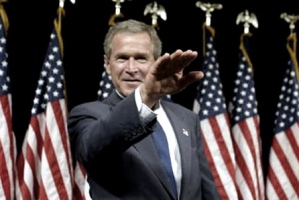
Fascist Bush
©Unknown

Chris Hedges gave this keynote address on Wednesday, May 28, in Furman University's Younts Conference Center. The address was part of protests by faculty and students over the South Carolina college's decision to invite George W. Bush to give the May 31 commencement address.

When it was announced in May that President Bush would deliver the commencement address, 222 students and faculty signed and posted on the school's Web site a statement titled "We Object." The statement cites the war in Iraq and the administration's "obstructing progress on reducing greenhouse gases while favoring billions in tax breaks and subsidies to oil companies that are earning record profits."

"We are ashamed of the actions of this administration. The war in Iraq has cost the lives of over 4,000 brave and honorable U.S. military personnel," the statement read. "Because we love this country and the ideals it stands for, we accept our civic responsibility to speak out against these actions that violate American values."

------

I used to live in a country called America. It was not a perfect country, God knows, especially if you were African-American or Native American or of Japanese descent in World War II or poor or gay or a woman or an immigrant, but it was a country I loved and honored. This country gave me hope that it could be better. It paid its workers wages that were envied around the world. It made sure these workers, thanks to labor unions and champions of the working class in the Democratic Party and the press, had health benefits and pensions. It offered good public education. It honored basic democratic values and held in regard the rule of law, including international law, and respect for human rights. It had social programs from Head Start to welfare to Social Security to take care of the weakest among us, the mentally ill, the elderly and the destitute. It had a system of government that, however flawed, was dedicated to protecting the interests of its citizens. It offered the possibility of democratic change. It had a media that was diverse and endowed with the integrity to give a voice to all segments of society, including those beyond our borders, to impart to us unpleasant truths, to challenge the powerful, to explain ourselves to ourselves.

I am not blind to the imperfections of this America, or the failures to always meet these ideals at home and abroad. I spent 20 years of my life in Latin America, Africa, the Middle East and the Balkans as a foreign correspondent reporting in countries where crimes and injustices were committed in our name, whether during the Contra war in Nicaragua or the brutalization of the Palestinians by Israeli occupation forces. But there was much that was good and decent and honorable in our country. And there was hope.

The country I live in today uses the same words to describe itself, the same patriotic symbols and iconography, the same national myths, but only the shell remains.

America, the country of my birth, the country that formed and shaped me, the country of my father, my father's father, and his father's father, stretching back to the generations of my family that were here for the country's founding, is so diminished as to be nearly unrecognizable. I do not know if this America will return, even as I pray and work and strive for its return.

The "consent of the governed" has become an empty phrase. Our textbooks on political science are obsolete. Our state, our nation, has been hijacked by oligarchs, corporations and a narrow, selfish political elite, a small and privileged group which governs on behalf of moneyed interests. We are undergoing, as John Ralston Saul wrote, "a coup d'etat in slow motion." We are being impoverished - legally, economically, spiritually and politically. And unless we soon reverse this tide, unless we wrest the state away from corporate hands, we will be sucked into the dark and turbulent world of globalization where there are only masters and serfs, where the American dream will be no more than that - a dream, where those who work hard for a living can no longer earn a decent wage to sustain themselves or their families, whether in sweat shops in China or the decaying rust belt of Ohio, where democratic dissent is condemned as treason and ruthlessly silenced.

I single out no party. The Democratic Party has been as guilty as the Republicans. It was Bill Clinton who led the Democratic Party to the corporate watering trough. Clinton argued that the party had to ditch labor unions, no longer a source of votes or power, as a political ally. Workers, he insisted, would vote Democratic anyway. They had no choice. It was better, he argued, to take corporate money. By the 1990s, the Democratic Party, under Clinton's leadership, had virtual fundraising parity with the Republicans. Today the Democrats get more. In political terms, it was a success. In moral terms, it was a betrayal.

The North American Free Trade Agreement was sold to the country by the Clinton White House as an opportunity to raise the incomes and prosperity of the citizens of the United States, Canada and Mexico. NAFTA would also, we were told, staunch Mexican immigration into the United States.

"There will be less illegal immigration because more Mexicans will be able to support their children by staying home," President Clinton said in the spring of 1993 as he was lobbying for the bill.

But NAFTA, which took effect in 1994, had the curious effect of reversing every one of Clinton's rosy predictions. Once the Mexican government lifted price supports on corn and beans for Mexican farmers, they had to compete against the huge agribusinesses in the United States. The Mexican farmers were swiftly bankrupted. At least 2 million Mexican farmers have been driven off their land since 1994. And guess where many of them went?

This desperate flight of poor Mexicans into the United States is now being exacerbated by large-scale factory closures along the border as manufacturers pack up and leave Mexico for the cut-rate embrace of China's totalitarian capitalism.

But we were assured that goods would be cheaper. Workers would be wealthier. Everyone would be happier. I am not sure how these contradictory things were supposed to happen, but in a sound-bite society, reality no longer matters. NAFTA was great if you were a corporation. It was a disaster if you were a worker.

Clinton's welfare reform bill, which was signed on Aug. 22, 1996, obliterated the nation's social safety net. It threw 6 million people, many of them single mothers, off the welfare rolls within three years. It dumped them onto the streets without child care, rent subsidies and continued Medicaid coverage. Families were plunged into crisis, struggling to survive on multiple jobs that paid $6 or $7 an hour, or less than $15,000 a year. But these were the lucky ones. In some states, half of those dropped from the welfare rolls could not find work.

Clinton slashed Medicare by $115 billion over a five-year period and cut $25 billion in Medicaid funding. The booming and overcrowded prison system handled the influx of the poor, as well as our abandoned mentally ill. And today we stand in shame with 2.3 million of our citizens behind bars, most for nonviolent drug offenses. More than one in 100 adults in the United States is incarcerated and one in nine black men ages 20 to 34 is behind bars. The United States, with less than 5 per cent of the global population, has almost 25 percent of the world's prisoners.

The growing desperation across the United States is unleashing not simply a recession - we have been in a recession for some time now - but the possibility of a depression unlike anything we have seen since the 1930s. This desperation has provided a pool of broken people willing to work for low wages and without unions or benefits. This is good news if you are a corporation. It is very bad news if you work for a living.

For the bottom 90 percent of Americans, annual income has been on a slow, steady decline for three decades. The majority's income peaked at $33,000 in 1973. By 2005, according to New York Times reporter David Cay Johnston in his book Free Lunch, it had fallen to a bit more than $29,000, this despite three decades of economic expansion.

And where did that money go? Ask ExxonMobil, the biggest U.S. oil and gas company, which made a $10.9-billion profit in the first quarter of this year, leaving us to pay close to $4 a gallon to fill up our cars. Or better yet, ask Exxon Mobil Corp Chief Executive Rex Tillerson, whose compensation rose nearly 18 percent to $21.7 million in 2007, when the oil company pulled in the largest profit ever for a U.S. company. His take-home pay package included $1.75 million in salary, a $3.36-million bonus, and $16.1 million of stock and option awards, according to a company filing with the U.S. Securities and Exchange Commission. He also received nearly $430,000 of other compensation, including $229,331 for personal security and $41,122 for use of the company aircraft. In addition to his pay package, Tillerson, 56, received more than $7.6 million from exercising options and stock awards during the year. Exxon Mobil earned $40.61 billion in 2007, up 3 percent from the previous year. But Tillerson's 2007 pay was not even the highest mark for the U.S. oil and gas industry. Occidental Petroleum Corp. CEO Ray Irani made $33.6 million and Anadarko Petroleum Corp. chief James Hackett took in $26.7 million over the same period.

For each dollar earned in 2005, the top 10 percent got 48.5 cents. That was the top 10th's greatest share of the income pie, Johnston writes, since 1929, just before the Roaring '20s collapsed in the Great Depression. And within the top 10 percent, those who made more than $100,000, nearly all the gains went to the top 10th of 1 percent, people like Tillerson, or Irani or Hackett, who made at least $1.7 million that year. And until we have real election reform, until we make it possible to run for national office without candidates kissing the rings of Tillersons, Iranis and Hacketts to get hundreds of millions of dollars, this rape of America will continue.

While the Democrats have been very bad, George W. Bush has been even worse. Let's set aside Iraq - the worst foreign policy blunder in American history. George Bush has also done more to dismantle our Constitution, ignore or revoke our statutes and reverse regulations that protected American citizens from corporate abuse than any other president in recent American history.

The president, as the Boston Globe reported, has claimed the authority, through "signing statements," to disobey more than 750 laws enacted since he took office, asserting that he has the power to set aside any statute passed by Congress when it conflicts with his interpretation of the Constitution.

Among the laws Bush said he can ignore are military rules and regulations, affirmative-action provisions, requirements that Congress be told about immigration services problems, ''whistle-blower" protections for nuclear regulatory officials, and safeguards against political interference in federally funded research.

The Constitution is clear in assigning to Congress the power to write the laws and to the president a duty ''to take care that the laws be faithfully executed." George Bush, however, has repeatedly declared that he does not need to ''execute" a law he believes is unconstitutional.

The Bush administration has gutted environmental, food and product safety, and workplace safety standards along with their enforcement. And this is why coal mines collapse, the housing bubble has blown up in our face and we are sold lead-contaminated toys imported from China.

Bush has done more than any president to hand our government directly over to corporations, which now get 40 percent of federal discretionary spending. Over 800,000 jobs once handled by government employees have been outsourced to corporations, a move that has not only further empowered our shadow corporate government but helped destroy federal workforce unions. Everything from federal prisons, the management of regulatory and scientific reviews, the processing or denial of Freedom of Information requests, interrogating prisoners and running the world's largest mercenary army in Iraq has become corporate. And these corporations, in a perverse arrangement, make their money off of the American citizen.

Halliburton in 2003 was given a no-bid and non-compete $7-billion contract to repair Iraq's oil fields, as well as the power to oversee and control Iraq's entire oil production. This has now become $130 billion in contract awards to Halliburton. And flush with taxpayer dollars, what has Haliburton done? It has made sure only 36 of its 143 subsidiaries are incorporated in the United States and 107 subsidiaries (or 75 percent) are incorporated in 30 different countries. Halliburton is able through this arrangement to lower its tax liability on foreign income by establishing a "controlled foreign corporation" and subsidiaries inside low-tax, or no-tax, countries known as a "tax havens." They take our money. They squander it. And our corporate government not only funds them but protects them. Halliburton - and Halliburton is just one example - is the engine of our new, rogue corporate state, serviced by people like George Bush and Dick Cheney, once the company's CEO.

The disparity between our oligarchy and the working class has created a new global serfdom. Credit Suisse analysts estimates that the number of subprime foreclosures in the United States over the next two years will total 1,390,000 and that by the end of 2012, 12.7 percent of all residential borrowers in the United States will be forced out of their homes.

The corporate state, which as an idea is an abstraction to many Americans, is very real when the pieces are carefully put together and linked to a system of corporate power that has made this poverty, the denial of our constitutional rights and a state of permanent war inevitable.

The assault on the American working class - an assault that has devastated members of my own family - is nearly complete. The U.S. economy has 3.2 million fewer jobs today than it did when George Bush took office, including 2.5 million fewer manufacturing jobs. In the past three years, nearly one in five U.S. workers was laid off. Among workers laid off from full-time work, roughly one-fourth were earning less than $40,000 annually. A total of 15 million U.S. workers are unemployed, underemployed or too discouraged to job hunt, according to the Labor Department.

There are whole sections of the United States which now resemble the developing world. There has been a Weimarization of the American working class. And the assault on the middle class is now under way. Anything that can be put on software - from finance to architecture to engineering - can and is being outsourced to workers in countries such as India or China who accept a fraction of the pay and work without benefits. And both the Republican and Democratic parties, beholden to corporations for money and power, allow this to happen.

Take a look at our government departments. Who runs the Defense Department? The Department of Interior? The Department of Agriculture? The Food and Drug Administration? Who runs the Department of Labor? Corporations. And in an election year where we are numbed by absurdities we hear nothing about this subordinating of the American people to corporate power. The political debates, which have become popularity contests, are ridiculous and empty. They do not confront the real and advanced destruction of our democracy. They do not confront the takeover of our electoral processes.

We have watched over the past few decades the rise of a powerful web of interlocking corporate entities, a network of arrangements within subsectors, industries or other partial jurisdictions to diminish and often abolish outside control and oversight. These corporations have neutralized national, state and judicial authority. They dominate, for example, a bloated and wasteful defense industry which has become sacrosanct and beyond the reach of politicians, most of whom are left defending military projects in their districts, no matter how redundant, because they provide jobs. This has permitted a military-industrial complex, which contributes lavishly to political campaigns, to spread across the country with virtual impunity.

Defense-related spending for fiscal 2008 will exceed $1 trillion for the first time in history. The U.S. has become the largest single seller of arms and munitions on the planet. The defense budget for fiscal 2008 is the largest since the Second World War even as we have more than $400 billion in annual deficits. More than half of federal discretionary spending goes to defense. This will not end when Bush leaves office. And so we build Cold War relics like $ 3.4-billion submarines and stealth fighters to evade radar systems the Soviets never built and spend $ 8.9 billion on ICBM missile defense that will be useless in stopping a shipping container concealing a dirty bomb.

The defense industry is able to monopolize the best scientific and research talent and squander the nation's resources and investment capital. These defense industries produce nothing that is useful for society or the national trade account. Melman, like President Eisenhower, saw the defense industry as viral, something that, as it grew, destroyed a healthy economy. And so we produce sophisticated fighter jets while Boeing is unable to finish its new commercial plane on schedule, and our automotive industry tanks. We sink money into research and development of weapons systems and starve technologies to fight against global warming and renewable energy. Universities are awash in defense-related cash and grants, and struggle to find money for environmental studies. This massive military spending, aided by this $3-trillion war, is hollowing us out from the inside. Our bridges and levees collapse, our schools decay and our safety net is taken away.

The corporate state, begun under Ronald Reagan and pushed forward by every president since, has destroyed the public and private institutions that protected workers and safeguarded citizens.

Only 7.8 per cent of workers in the private sector are unionized. This is about the same percentage as in the early 1900s. There are 50 million Americans in real poverty and tens of millions of Americans in a category called "near poverty." Our health care system is broken. Eighteen thousand people die in this country, according to the Institute of Medicine, every year because they can't afford health care. That is six times the number of people who died in the 9/11 attacks, and these unnecessary deaths continue year after year.

But we do not hear these stories of pain and dislocation. We are diverted by bread and circus. News reports do little more than report on trivia and celebrity gossip. The FCC, in an example of how far our standards have fallen, defines shows like Fox's celebrity gossip program "TMZ" and the Christian Broadcast Network's "700 Club" as "bona fide newscasts." The economist Charlotte Twight calls this vast corporate system of spectacle and democratic collapse "participatory fascism."

How did we get here? How did this happen?

In a word, deregulation - the systematic dismantling of the managed capitalism that was the hallmark of the American democratic state. Our political decline came about because of deregulation, the repeal of antitrust laws, and the radical transformation from a manufacturing economy to a capital economy. This understanding led Franklin Delano Roosevelt on April 29, 1938, to send a message to Congress titled "Recommendations to the Congress to Curb Monopolies and the Concentration of Economic Power." In it, he wrote:

"The first truth is that the liberty of democracy is not safe if the people tolerate the growth of power to a point where it becomes stronger than the democratic state itself. That, in its essence, is Fascism - ownership of Government by an individual, by a group, or by any other controlling private power. The second truth is that the liberty of a democracy is not safe if its business system does not provide employment and produce and distribute goods in such a way to sustain an acceptable standard of living."

The rise of the corporate state has grave political consequences, as we saw in Italy and Germany in the early part of the 20th century. Antitrust laws not only regulate and control the marketplace, they serve as bulwarks to protect democracy. And now that they are gone, now that we have a state that is run by and on behalf of corporations, we must expect inevitable and perhaps terrifying political consequences.

I spent two years traveling the country to write a book on the Christian right called American Fascists: The Christian Right and the War on America. In depressed former manufacturing towns from Ohio to Kentucky it was the same. There are tens of millions of Americans for whom the end of the world is no longer an abstraction. They have lost hope. Fear and instability has plunged the working class into personal and economic despair, and not surprisingly into the arms of the demagogues and charlatans of the radical Christian right who offer a belief in magic, miracles and the fiction of a utopian Christian nation. And unless we re-enfranchise these Americans back into the economy, unless we give them hope, our democracy is doomed.

As the pressure mounts, as this despair and desperation reaches into larger and larger segments of the American populace, the mechanisms of corporate and government control are being bolstered to prevent civil unrest and instability. It is not accidental that with the rise of the corporate state comes the rise of the security state. This is why the Bush White House has pushed through the Patriot Act (and its renewal), the suspension of habeas corpus, the practice of "extraordinary rendition," the warrantless wiretapping on American citizens and the refusal to ensure free and fair elections with verifiable ballot-counting. It is part of a package. It comes together. It is not about terrorism or national security. It is about control. It is about their control of us.

Sen. Frank Church, as chairman of the Select Committee on Intelligence in 1975, investigated the government's massive and highly secretive National Security Agency. He wrote:

"That capability at any time could be turned around on the American people and no American would have any privacy left, such is the capability to monitor everything: telephone conversations, telegrams, it doesn't matter. There would be no place to hide. If this government ever became a tyranny, if a dictator ever took charge in this country, the technological capacity that the intelligence community has given the government could enable it to impose total tyranny, and there would be no way to fight back, because the most careful effort to combine together in resistance to the government, no matter how privately it was done, is within the reach of the government to know. Such is the capability of this technology. ... I don't want to see this country ever go across the bridge. I know the capability that is there to make tyranny total in America, and we must see to it that this agency and all agencies that possess this technology operate within the law and under proper supervision, so that we never cross over that abyss. That is the abyss from which there is no return. ..."

When Sen. Church made this statement the NSA was not authorized to spy on American citizens. Today it is.

In a military brig in Charleston an American citizen, Ali Saleh Kahlah al-Marri, is being held in a black hole set up on American soil. He was stripped on June 23, 2003, by George Bush of his constitutional rights and declared an "enemy combatant." He is being detained without charge, interrogated without a lawyer and held indefinitely.

Lawyers for the Bush administration claim that the president can send the military into any neighborhood, any town or suburb, capture a citizen and hold him or her in prison without charge. They base this claim on the Authorization for Use of Military Force, passed by Congress after 9/11, that gives President Bush the power to "use all necessary and appropriate force" against anyone involved in planning, aiding or carrying out the attacks.

But Al-Mari was not captured in Afghanistan or Iraq. He was arrested in Peoria, Ill., in December 2001. And if the president can declare American citizens living inside the United States to be enemy combatants and order them stripped of constitutional rights, what does this mean for us? How long can we be held without charge? Without lawyers? Without access to the outside world? Maybe Al-Mari is, as the government claims, a terrorist. I don't know. But I do know that if this becomes a precedent, if it is not overturned by the courts, habeas corpus, the most important bulwark of our democratic state, will be dead.

We are fed lie after lie to mask the destruction the corporate state has wrought in our lives. The consumer price index, for example, used by the government to measure inflation, has become meaningless. To keep the official inflation figures low the government has been substituting basic products they once measured to check for inflation with ones that do not rise very much in price. This trick has kept the cost-of-living increases tied to the CPI artificially low.

The disconnect between what we are told and what is actually true is worthy of the old East German state. The New York Times' consumer reporter, W.P. Dunleavy, wrote that her groceries now cost $587 a month, up from $400 a year earlier. This is a 40 percent increase. California economist John Williams, who runs an organization called Shadow Statistics, contends that if Washington still used the CPI measurements applied back in the 1970s, inflation would be in the 10 percent range. The advantage to the corporations is huge.

A false inflation rate, one far lower than the real rate, keeps equitable interest payments on bank accounts and certificates of deposit down. It masks the deterioration of the American economy. The Potemkin statistics allow corporations and the corporate state to walk away from obligations tied to real adjustments for inflation. These statistics mean that less is paid out in Social Security and pensions. It has reduced the interest on the multitrillion-dollar debt. Corporations never have to pay real cost-of-living increases to their employees.

The term "unemployment" has also been steadily redefined. This has rendered official data on employment worthless. In real terms about 10 percent of the working population is unemployed, a figure that is, over the long run, unsustainable.

The economy, despite the official statistics, is not growing. It is shrinking. And as the nation crumbles we are awash with the terrible simplicity of false statistics. We confuse our emotional responses, carefully manipulated by advertisers, pundits, spin doctors, television hosts, political consultants and focus groups, with knowledge. It is how we elect presidents and those we send to Congress, how we make decisions, even decisions to go to war. It is how we view the world. Four media giants - AOL-Time Warner, Viacom, Disney, and Rupert Murdoch's NewsGroup - control nearly everything we read, see and hear. This growing disconnect with reality is the hallmark of a totalitarian state.

"Before they seize power and establish a world according to their doctrines," Hannah Arendt wrote, "totalitarian movements conjure up a lying world of consistency which is more adequate to the needs of the human mind than reality itself; in which, through sheer imagination, uprooted masses can feel at home and are spared the never-ending shocks which real life and real experiences deal to human beings and their expectations. The force possessed by totalitarian propaganda - before the movements have the power to drop iron curtains to prevent anyone's disturbing, by the slightest reality, the gruesome quiet of an entirely imaginary world - lies in its ability to shut the masses off from the real world."

So what do we do? Voting is not enough. If voting was that effective, to quote the activist Philip Berrigan, it would be illegal. And voting in an age when elections are stolen by rigged ballot machines and a stacked Supreme Court willing to overturn all legal precedent to make George Bush president, will not work.

I am not saying do not vote. We should all vote. But that has to be the starting point if we want to reclaim America. We must lobby, organize and advocate for the dissolution of the World Trade Organization and NAFTA. The WTO and NAFTA have handcuffed workers, consumers and stymied our efforts to create clean environments. These agreements are beyond the control of our courts and have crippled our weakened regulatory agencies. The WTO forces our working class to compete with brutalized child and prison labor overseas, to be reduced to this level of slave labor or to go without meaningful work. We need to repeal the anti-worker Taft-Hartley law of 1947. The act obstructs the organization of unions. We need to transfer control of pension funds from management to workers. If these pension funds, worth trillions of dollars, were in the hands of workers the working class would own a third of the New York Stock Exchange.

The working class has every right to be, to steal a line from Obama, bitter with liberal elites. I am bitter. I have seen what the loss of manufacturing jobs and the death of the labor movement did to my relatives in the former mill towns in Maine. Their story is the story of tens of millions of Americans who can no longer find a job that supports a family and provides basic benefits. Human beings are not commodities. They are not goods. They grieve, and suffer and feel despair. They raise children and struggle to maintain communities. The growing class divide is not understood, despite the glibness of many in the media, by complicated sets of statistics or the absurd, utopian faith in unregulated globalization and complicated trade deals. It is understood in the eyes of a man or woman who is no longer making enough money to live with dignity and hope.

George Bush, who will be here on Saturday, has done more to shred, violate or absent the government from its obligations under domestic and international law. He has refused to sign the Kyoto Protocol, backed out of the Anti-Ballistic Missile Treaty, tried to kill the International Criminal Court, walked out on negotiations on chemical and biological weapons, and defied the Geneva Convention and human rights law. He has set up offshore penal colonies where we deny detainees basic rights and openly engage in torture. He launched an illegal war in Iraq based on fabricated evidence we now know had been discredited even before it was made public. And if we as citizens do not hold him accountable for these crimes, if we allow the Democratic majority in Congress to get away with its refusal to begin the process of impeachment, which appears likely, we will be complicit in the codification of a new world order, one that will have terrifying consequences. For a world without treaties, statutes and laws is a world where any nation, from a rogue nuclear state to a great imperial power, will be able to invoke its domestic laws to annul its obligations to others.

This new order will undo five decades of international cooperation - largely put in place by the United States - destroy our own constitutional rights and thrust us into a Hobbesian nightmare. We are one, maybe two, terrorist attacks away from a police state. Time is running out.

We must not allow international laws and treaties - ones that set minimum standards of behavior and provide a framework for competing social, political, economic and religious groups and interests to resolve differences - to be discarded. The exercise of power without law is tyranny. And the consequences of George Bush's violation of the law, his creation of legal black holes that can swallow American citizens along with those outside our borders, run in a direct line from the White House to Abu Ghraib, Guantanamo and military brigs in cities such as Charleston.

George Bush - we now know from the leaked Downing Street memo - fabricated a legal pretext for war. He decided to charge Saddam Hussein with the material breach of the resolution passed in the wake of the 1991 Gulf War. He had no evidence that Saddam Hussein was in breach of this resolution. And so he and his advisers manufactured reports of weapons of mass destruction and disseminated them to a frightened and manipulated press and public. In short, he lied. He lied to us and to the rest of the world. There are tens of thousands, perhaps a few hundred thousand people, who have been killed and maimed in a war that has no legal justification, a war waged in violation of international law, a war that under the post-Nuremberg laws is defined as "a criminal war of aggression."

We have blundered into nations we know little about. We are caught between bitter rivalries and competing ethnic groups and leaders we do not understand. We are trying to transplant a modern system of politics invented in Europe characterized, among other things, by the division of earth into independent secular states based on national citizenship in a land where the belief in a secular civil government is an alien creed. Iraq was a cesspool for the British when they occupied it in 1917. It will be a cesspool for us as well. We can either begin an orderly withdrawal or watch the mission collapse.

A rule-based world matters. The creation of international bodies and laws, the sanctity of our constitutional rights, have allowed us to stand pre-eminent as a nation - one that seeks at its best to respect and defend the rule of law. If we demolish the fragile and delicate domestic and international order, if we permit George Bush to create a world where diplomacy, broad cooperation, democracy and law are worthless, if we allow these international and domestic legal safeguards to unravel, our moral and political authority will plummet. We will erode the possibility of cooperation between nation-states, including our closest allies. We will lose our country. And we will, in the end, see visited upon us the evils we visit on others.

Read Antigone, when the king imposes his will without listening to those he rules or Thucydides' history. Read how Athens' expanding empire saw it become a tyrant abroad and then a tyrant at home. How the tyranny the Athenian leadership imposed on others it finally imposed on itself. This, Thucydides wrote, is what doomed Athenian democracy; Athens destroyed itself. For the primary instrument of tyranny and empire is war and war is a poison, a poison which at times we must ingest just as a cancer patient must ingest a poison to survive. But if we do not understand the poison of war - if we do not understand how deadly that poison is - it can kill us just as surely as the disease.

Hope, St. Augustine wrote, has two beautiful daughters. They are anger and courage. Anger at the way things are and the courage to see they do not remain the way they are.

We stand at the verge of a massive economic dislocation, one forcing millions of families from their homes and into severe financial distress, one that threatens to rend the fabric of our society. We are waging a war that devours lives and capital, and that cannot ultimately be won. We are told we need to give up our rights to be safe, to be protected. In short, we are made afraid.

We are told to hand over all that is best about our nation to those like George Bush and Dick Cheney who seek to destroy our nation. A state of fear only engenders cruelty; cruelty, fear, insanity, and then paralysis. In the center of Dante's circle the damned remained motionless.

If we do not become angry, if we do not muster within us the courage, indeed the militancy, to challenge those in the Democratic and Republican parties who herd us towards the corporate state, we will have squandered our courage and our integrity when we need it most.

Thursday, October 18, 2007

The Cult of the Plausible Lie

One of the best SOTT Focus articles published to date. If you've ever wondered how thing things you know are "off" or wrong, still "legally" happen, here's how things can be put over on a society. Add this to the knowledge of psychopathy and you may have a fighting chance in this world.

Blue Ibis
************************************************

Laura Knight-Jadczyk
Signs Of The Times
Fri, 09 Jun 2006 12:00 EDT


©Signs of the Times
"Never ascribe to malice those things which may be explained by stupidity." That is an important phrase, and a necessary one; it keeps people from being paranoid. However, it has a corollary most people don't know: "One MAY ascribe to malice those things which stupidity cannot explain." Robert Canup

As the mail continues to come in on the COINTELPRO issue, a number of questions have been raised - mainly about how to tell the difference between Truth and Lies - and I thought I would take some time this morning to try to cover a few aspects of this issue.

I've covered many aspects of this issue here and there on our websites, but since google manages to ensure that we are suppressed on search results, many people have not yet discovered these collections of observation, evidence, and supporting material. (Regarding google, we have been collecting data and making experiments for over a year now and will soon publish some of the results, but don't expect to them to be trumpeted by google!)

The primary problem that I see humanity struggling with today is precisely delineated by psychologist Andrew Lobaczewski: it is an almost total lack of adequate psychological knowledge on the part of the masses of humanity - the population of ordinary, normal people.

Ever since ancient times, philosophers and religious thinkers representing various attitudes in different cultures have been searching for the truth as regards moral values, attempting to find criteria for what is right, what constitutes good advice. They described the virtues of human character and suggested these be acquired. They created a heritage ... which contains centuries of experience and reflections. In spite of the obvious differences among attitudes, the similarity or complementarity of the conclusions reached by famous ancients are striking, even though they worked in widely divergent times and places. After all, whatever is valuable is conditioned and caused by the laws of nature acting upon the personalities of both individual human beings and collective societies.

It is equally thought-provoking, however, to see how relatively little has been said about the opposite side of the coin; the nature, causes, and genesis of evil. These matters are usually cloaked behind the above generalized conclusions with a certain amount of secrecy. Such a state of affairs can be partially ascribed to the social conditions and historical circumstances under which these thinkers worked. Their modus operandi may have been dictated at least in part by personal fate, inherited traditions, or even prudishness. After all, justice and virtue are the opposites of force and perversity, the same applies to truthfulness vs. lies, similarly like health is the opposite of an illness.

The character and genesis of evil thus remained hidden in discreet shadows, leaving it to playwrights to deal with the subject in their highly expressive language, but that did not reach the primeval source of the phenomena. A certain cognitive space thus remains uninvestigated, a thicket of moral questions which resists understanding and philosophical generalizations. [...]

From time immemorial, man has dreamed of a life in which his efforts to accumulate benefits can be punctuated by rest during which time he enjoys those benefits. He learned how to domesticate animals in order to accumulate more benefits, and when that no longer met his needs, he learned to enslave other human beings simply because he was more powerful and could do it.

Dreams of a happy life of "more accumulated benefits" to be enjoyed, and more leisure time in which to enjoy them, thus gave rise to force over others, a force which depraves the mind of its user. That is why man's dreams of happiness have not come true throughout history: the hedonistic view of "happiness" contains the seeds of misery. Hedonism, the pursuit of the accumulation of benefits for the sole purpose of self-enjoyment, feeds the eternal cycle where good times lead to bad times.

During good times, people lose sight of the need for thinking, introspection, knowledge of others, and an understanding of life. When things are "good," people ask themselves whether it is worth it to ponder human nature and flaws in the personality (one's own, or that of another). In good times, entire generations can grow up with no understanding of the creative meaning of suffering since they have never experienced it themselves. When all the joys of life are there for the taking, mental effort to understand science and the laws of nature - to acquire knowledge that may not be directly related to accumulating stuff - seems like pointless labor. Being "healthy minded," and positive - a good sport with never a discouraging word - is seen as a good thing, and anyone who predicts dire consequences as the result of such insouciance is labeled a wet-blanket or a killjoy.

Perception of the truth about reality, especially a real understanding of human nature in all it's ranges and permutations, ceases to be a virtue to be acquired. Thoughtful doubters are "meddlers" who can't leave well enough alone. "Don't fix it if it ain't broke." This attitude leads to an impoverishment of psychological knowledge including the capacity to differentiate the properties of human nature and personality, and the ability to mold healthy minds creatively.

The cult of power thus supplants the mental and moral values so essential for maintaining peace by peaceful means. A nation's enrichment or involution as regards its psychological world-view could be considered an indicator of whether its future be good or bad.

During good times, the search for the meaning of life, the truth of our reality, becomes uncomfortable because it reveals inconvenient factors. Unconscious elimination of data which are, or appear to be, inexpedient, begins to be habitual, a custom accepted by entire societies. The result is that any thought processes based on such truncated information cannot bring correct conclusions. This then leads to substitution of convenient lies to the self to replace uncomfortable truths thereby approaching the boundaries of phenomena which should be viewed as psychopathological. [...]

When bad times arrive and people are overwhelmed by an excess of evil, they must gather all their physical and mental strength to fight for existence and protect human reason. The search for some way out of difficulties and dangers rekindles long-buried powers or discretion. Such people have the initial tendency to rely on force in order to counteract the threat; they may, for instance, become "trigger happy" or dependent upon armies. Slowly and laboriously, however, they discover the advantages conferred by mental effort; improved understanding of psychological situations in particular, better differentiation of human characters and personalities, and finally, comprehension of one's adversaries. During such times, virtues which former generations relegated to literary motifs regain their real and useful substance and become prized for their value. A wise person capable of furnishing sound advice is highly respected.

It seems that there have been many such "bad times" in the course of human history, and it was during such times that the great systems of ethics were developed. Unfortunately, during "good times," nobody wants to hear about it. They want to "enjoy" things, to have pleasure and pleasant experiences, and so any literature that relates to such times is lost, forgotten, suppressed, or otherwise ignored. This leads to further debasing of the intellectual currency and opens the gap for bad times to come once again. [Andrew Lobaczewski, Ph.D. Political Ponerology: The Science of Evil Adjusted for Political Purposes]

The facts are that "good times" for one group of people have been historically rooted in some injustice to other groups of people. In such a society, where all the hidden truths lurk below the surface like an iceberg, disaster is just around the corner.

It is clear that America has experienced a long period of "good times" for most of its existence, (no matter how many people they had to oppress or kill to do so), but particularly so during the 50 years preceding September 11, 2001. During that 50 years, several generations of children were born, and the ones that were born at the beginning of that time, who have never known "bad times," are now at an age where they want to "enjoy" the benefits they have accumulated. Unfortunately, it doesn't look like that is going to happen; 9/11 has changed everything so profoundly that it looks like there will be no enjoyment by anyone for a very, very long time.

How could this happen?

The answer is that a few generation's worth of "good times" results in the above described societal deficits regarding psychological skills and moral criticism. Long periods of preoccupation with the self and "accumulating benefits" for the self, diminish the ability to accurately read the environment and other people. But the situation is more serious than just a generalized weakness of a society that could be "toughened up" with a little "hard times".

Lobaczewski writes: The psychological features of each such crisis are unique to the culture and the time, but one common denominator that exists at the beginning of all such "bad times" is an exacerbation of society's hysterical condition. The emotionalism dominating in individual, collective, and political life, combined with the subconscious selection and substitution of data in reasoning, lead to individual and national egotism. The mania for taking offense at the drop of a hat provokes constant retaliation, taking advantage of hyperirritability and hypocriticality on the part of others. It is this feature, this hystericization of society, that enables pathological plotters, snake charmers, and other primitive deviants to act as essential factors in the processes of the origination of evil on a macro-social scale. [Andrew Lobaczewski, Ph.D. Political Ponerology: The Science of Evil Adjusted for Political Purposes]

We can conjecture that if one psychologist knows the above, a few others must know it as well. And maybe some of them work for the government that has taken such advantage of 911? If we think about it, it becomes quite logical that, if they know these things then they may very wll have been complicit in 911 for the very purpose of "exacerbating society's hysterical condition." As Lobaczewski notes, it is the hysterization of society that enables pathological plotters to basically take over.

Who, exactly, are the "pathological plotters," and what can motivate such individuals during times that are generally understood by others as "good" to do things that will bring on "bad times." If times are "good," why does anyone want to plot and generate evil? Especially since it is obvious to anyone with two neurons firing that such activity will (and has historically) lead to the destruction of the plotters themselves?

Well, certainly, the current US administration has come up with an answer: "They hate us because of our freedoms." This is a prime example of "selection and substitution of data in reasoning" which is willingly and gladly accepted as an explanation by the public because of their deficits of psychological skills and moral criticism. The truth is somewhat different.

Unfortunately, after so long a time of being subjected to lies and disinformation, the likelihood of society being able to overcome the social and cultural programming is difficult, but not impossible. And that is where things like COINTELPRO come into play: psyops agents are masters of triggering emotional programs that put people back to sleep. As a student on the subject, Robert Canup, has said, 99% of all of the problems confronting mankind can be traced to a single cause: the problem of the plausible lie. And the plausible lie is what COINTELPRO is all about.

Plausible lies are monstrous things propagated by evil people for the express purpose of deceiving good people into doing the will of those who do not have their best interests at heart. It's that simple. The most powerful of these lies are so plausible that nobody even dreams about questioning their validity. Allow me to quote Richard Dolan on this point:

Some will dismiss this as one of the many conspiracy theories dotting America's landscape. The very label serves as an automatic dismissal, as though no one ever acts in secret. Let us bring some perspective and common sense to this issue.

The United States comprises large organizations - corporations, bureaucracies, "interest groups," and the like - which are conspiratorial by nature. That is, they are hierarchical, their important decisions are made in secret by a few key decision-makers, and they are not above lying about their activities. Such is the nature of organizational behavior. "Conspiracy," in this key sense, is a way of life around the globe.

Within the world's military and intelligence apparatuses, this tendency is magnified to the greatest extreme. [...]

Anyone who has lived in a repressive society knows that official manipulation of the truth occurs daily. But societies have their many and their few. In all times and all places, it is the few who rule, and the few who exert dominant influence over what we may call official culture. - All elites take care to manipulate public information to maintain existing structures of power. It's an old game.

America is nominally a republic and free society, but in reality an empire and oligarchy, vaguely aware of its own oppression, within and without. I have used the term "national security state" to describe its structures of power. It is a convenient way to express the military and intelligence communities, as well as the worlds that feed upon them, such as defense contractors and other underground, nebulous entities. Its fundamental traits are secrecy, wealth, independence, power, and duplicity.

Nearly everything of significance undertaken by America's military and intelligence community in the past half-century has occured in secrecy. The undertaking to build an atomic weapon, better known as the Manhattan Project, remains the great model for all subsequent activities. For more than two years, not a single member of Congress even knew about it although its final cost exceeded two billion dollars.

During and after the Second World War, other important projects, such as the development of biological weapons, the importation of Nazi scientists, terminal mind-control experiments, nationwide interception of mail and cable transmissions of an unwitting populace, infiltration of the media and universities, secret coups, secret wars, and assassinations all took place far removed not only from the American public, but from most members of Congress and a few presidents. Indeed, several of the most powerful intelligence agencies were themselves established in secrecy, unknown by the public or Congress for many years.

Since the 1940s, the US Defense and Intelligence establishment has had more money at its disposal than most nations. In addition to official dollars, much of the money is undocumented. From its beginning, the CIA was engaged in a variety of off-the-record "business" activities that generated large sums of cash. The connections of the CIA with global organized crime (and thus de facto with the international narcotics trade) has been well established and documented for many years. - Much of the original money to run the American intelligence community came from very wealthy and established American families, who have long maintained an interest in funding national security operations important to their interests.

In theory, civilian oversight exists over the US national security establishment. The president is the military commander-in-chief. Congress has official oversight over the CIA. The FBI must answer to the Justice Department. In practice, little of this applies. One reason has to do with secrecy. [...]

A chilling example of such independence occurred during the 1950s, when President Eisenhower effectively lost control of the US nuclear arsenal. The situation deteriorated so much that during his final two years in office, Eisenhower asked repeatedly for an audience with the head of Strategic Air Command to learn what America's nuclear retaliatory plan was. What he finally learned in 1960, his final year in office, horrified him: half of the Northern Hemisphere would be obliterated.

If a revered military hero such as Eisenhower could not control America's nuclear arsenal, nor get a straight answer from the Pentagon, how on earth could Presidents Truman, Kennedy, Johnson, or Nixon regarding comparable matters?

Secrecy, wealth and independence add up to power. Through the years, the national security state has gained access to the world's most sophisticated technology, sealed off millions of acres of land from public access or scrutiny, acquired unlimited snooping ability with US borders and beyond, conducted overt or clandestine actions against other nations, and prosecuted wars without serious media scrutiny. Domestically, it maintains influence over elected officials and communities hoping for some of the billions of defense dollars.

Deception is the key element of warfare, and when winning is all that matters, the conventional morality held by ordinary people becomes an impediment. When taken together, the examples of official duplicity form a nearly single totality. They include such choice morsels as the phony war crisis of 1948, the fabricated missile gap claimed by the air force during the 1950s, the carefully managed events leading to the Gulf of Tonkin resolution...

The secrecy stems from a pervasive and fundamental element of life in our world, that those who are at the top of the heap will always take whatever steps are necessary to maintain the status quo.

[S]keptics often ask, "Do you really think the government could hide something like this for so long?" The question itself reflects ignorance of the reality that secrecy is a way of life in the National Security State. Actually though, the answer is yes, and no.

Yes, in that cover-ups are standard operating procedure, frequently unknown to the public for decades, becoming public knowledge by a mere roll of the dice. But also no, in that ... information has leaked out from the very beginning. It is impossible to shut the lid completely. The key lies in neutralizing and discrediting unwelcomed information, sometimes through official denial, other times through proxies in the media.

[E]vidence [of the true nature of the nature of National Security State and how it really operates] derived from a grass roots level is unlikely to survive its inevitable conflict with official culture, [created by COINTELPRO]. [Richard Dolan, UFOs and the National Security State]

Now, even though I know I am little more than a David against the Goliath of the well-funded arms of the National Security State, such as the many diverse and often contradictory sources of information and disinformation, including the mainstream media, many alternative media sources, so-called "Truth seeking groups" of all kinds, so-called New Age and Alternative writers and Impresarios of all shapes and sizes, (most of whom are COINTELPRO bogus organizations), I will continue to point out what can be observed if your eyes are open and your neurons are firing, and what can be asserted with some certainty based on collections of evidence, both material and circumstantial. Having said that, let me ask this: If there is such a thing as a plausible lie, is it not also possible that there might be such a thing as an implausible truth?

Using Canup's example: Suppose that tomorrow when you walk out of your house, an alien spacecraft lands in front of you. Aliens get out and assault you, leaving physical traces. Next, imagine that this is not a hallucination, it is not dream; it really happens. You are now in possession of an implausible truth. What chance is there of you being able to convince anyone else of what happened to you? You know it is the truth, but no one will believe you. And the root of the problem is the fact that truth generally has a feeling of reality to it. However, that feeling of reality which makes truth generally plausible is NOT the same thing as the truth itself. Others who have not experienced aliens landing and assaulting them do not have the same feeling of reality about what you are telling them. If everyone else had experienced a similar event, with the attendant feeling of reality, the truth of that event would be accepted immediately.

In short, people believe what is "familiar," or what is part of a careful, long term program of familiarization of lies that become plausible simply because they are familiar.

When science first discovered that solid matter was mostly empty space, many people reacted to this truth - this unfamiliar fact of our reality - with outrage. Debates over the "solidity" of matter and "kicking rocks" raged for years. It took a very long time, and a lot of work to gradually make others aware of this truth in order to make this "implausible" fact part of our awareness.

Learning about evil in our society, how it operates on the macro-social scale, is considered by many to be "unpleasant." They don't want to go there. It is too disturbing and even frightening. More than that, talking about these things as I am here is not familiar. To talk about evil as though it were a REAL concept is something we have been programmed to NOT do! As psychologist George Simon says:

...[W]e've been pre-programmed to believe that people only exhibit problem behaviors when they're "troubled" inside or anxious about something. We've also been taught that people aggress only when they're attacked in some way. So, even when our gut tells us that somebody is attacking us and for no good reason, we don't readily accept the notion. We usually start to wonder what's bothering the person so badly "underneath it all" that's making them act in such a disturbing way. We may even wonder what we may have said or done that "threatened" them. We almost never think that they might be fighting simply to get something, have their way, or gain the upper hand. So, instead of seeing them as merely fighting, we view them as primarily hurting in some way. [...] The legacy of Sigmund Freud's work has a lot to do with this. Freud's theories (and the theories of others who built upon his work) heavily influenced the psychology of personality for a long time. Elements of the classical theories of personality found their way into many disciplines other than psychology as well as into many of our social institutions and enterprises. [...]

The malignant impact of overgeneralizing Freud's observations about a small group of overly inhibited individuals into a broad set of assumptions about the causes of psychological ill-health in everyone cannot be overstated.[...]

We need a completely different theoretical framework if we are to truly understand, deal with, and treat the kinds of people who fight too much as opposed to those who cower or "run" too much. [George K. Simon, Jr., "In Sheep's Clothing"]

We clearly need to study this problem of macro-social evil in our world in a systematic and scientific way. And we need to get over the idea that thinking only good thoughts, thinking about happy and "nice" things is the way to good psychological health.

If physicians behaved like ethicists and failed to study diseases because they were only interested in studying questions of health, there would be no such thing as modern medicine. [...] Physicians were correct in their emphasis on studying disease above all in order to discover the causes and biological properties of illnesses, and then to understand the pathodynamics of their courses. A comprehension of the nature of a disease, and the course it runs, after all, enables the proper curative means to be elaborated and employed.[...]

The question thus arises: could some analogous modus operandi not be used to study the causes and genesis of other kinds of evil scourging human individuals, families, societies? Experience has taught the author that evil is similar to disease in nature, although possibly more complex and elusive to our understanding. [...]

Considerable moral, intellectual, and practical advantages can be gleaned from an understanding of the genesis of Evil thanks to the objectivity required to study it dispassionately. The human heritage of ethics is not destroyed by taking such an approach: it is actually strengthened because the scientific method can be utilized to confirm the basic values of moral teachings.

Understanding the nature of macro-social pathology helps us to find a healthy attitude and thus protects our minds from being controlled or poisoned by the diseased contents and influence of their propaganda.

We can only conquer this huge, contagious social cancer if we comprehend its essence and its etiological causes.

Such an understanding of the nature of the phenomena leads to the logical conclusion that the measures for healing and reordering the world today should be completely different from the ones heretofore used for solving international conflicts. It is also true that, merely having the knowledge and awareness of the phenomena of the genesis of macro-social Evil can begin healing individual humans and help their minds regain harmony. [Andrew Lobaczewski, Ph.D. Political Ponerology: The Science of Evil Adjusted for Political Purposes]

Now, let me recommend new readers to take a look at my post on "How to Spot a COINTELPRO Agent." Keep in mind that the booklet I am quoting from there was compiled by activists from earlier days that had direct experiences where they were able to see only afterward how they had been duped and sidelined. My grandmother always said: "A smart man learns from his mistakes; a genius learns from the mistakes of others." In the case of COINTELPRO, some of those activists were smart, but not geniuses. Most of them got "taken out", and some of them literally had their lives completely destroyed because they were sincere and stubborn. The material in that booklet is priceless today because those who compiled it paid a high price to learn those things. Let's try to be geniuses here.

As Robert Canup writes, we face a particular, even monstrous, problem in our world: that most of what we know or think we know is based on plausible lies. A person who is sincere and speaks the truth really has almost no chance against a plausible liar. Yes, I know that goes against everything we have been taught from childhood in the "Land of the Free and Home of the Brave," but it is all too sadly true. We have been taught that "the Truth will always win" and that "anybody who believes a lie about you wasn't your friend to begin with", and a whole host of other platitudes that actually would work in a different world: a world run by people who tell the truth!

But since our world is run by people who lie for a living, you might expect that they have set things up so that liars will always win. And that is, oh so sadly, the case.

"Our culture agrees on the signs of lying. Ask anyone how to tell if someone is lying and they will tell you that they can tell by "lack of eye contact, nervous shifting, or picking at one's clothes." Psychologist Anna Salter writes with dry humor: "This perception is so widespread I have had the fantasy that, immediately upon birth, nurses must take newborns and whisper in their ears, "Eye contact. It's a sign of truthfulness." [Anna C. Salter, Ph.D.]

The problem is, if there is a psychopath - or those with related characteropathies - who doesn't know hot to keep good eye contact when lying, they haven't been born. Eye contact is "universally known" to be a sign of truth-telling. The problem is liars will fake anything that it is possible to fake, so in reality, eye contact is absolutely NOT a sign of truth telling. Anna Salter writes:

The man in front of me is a Southern good-ole-boy, the kind of man I grew up with and like. If anything, I have a weakness for the kind of Southern male who can "Sam Ervin" you, the Southern lawyer who wears red suspenders in court along with twenty-five-year-old cowboy boots and who turns his accent up a notch when he sees the northern expert witness coming. A "northern city slicker" on the witness stand will elicit the same kind of focused interest that a deer will in hunting season. You can have some very long days in court with men who wear red suspenders and start by telling you how smart you are and how simple and dumb they are.

I survey the man in front of me. I am not in court; I am in prison, and he is not an attorney but a sex offender, and he has bright eyes along with that slow, sweet drawl. He is a big man, slightly balding, and he has - I have to admit there is such a thing - an innocent face. ...

My Southern good-ole-boy certainly knows eye contact is considered a sign of truthfulness. He describes his manner in getting away with close to 100 rapes of adults and children.

The manner that I use when I was trying to convince somebody - even though I knew I was lying - I'd look them in the eye, but I wouldn't stare at them. Staring makes people uncomfortable and that tends to turn them away, so I wouldn't stare at them. But look at them in a manner that, you know, "look at this innocent face. How can you believe that I would do something like that?" It helps if you have a good command of the vocabulary where you can explain yourself in a way that is easily understood. Dress nice. Use fluent hand gestures that are not attacking in any way.

It's a whole combination of things. It's not any one thing that you can do. It's a whole combination of things that your body gestures and things that say "Look, I'm telling you the truth, and I don't know what these people are trying to pull. I don't know what they're trying to prove, but I haven't done any of this. I don't know why they're doing this. You can check my records. I've got a good record. I've never been in any trouble like this. And I don't know what's going on. I'm confused."...

As if reading my thoughts, he breaks off: "You don't get this, Anna, do you?" he says. "You think that when I'm asked, "Did I do it?" that's when I lie. But I've been lying every day for the last twenty-five years."

The practiced liar: a category of liar that even experts find it difficult to detect.

Problem is, even when dealing with people who are not practiced liars, such as college students who have volunteered for a research study of lying, most observers are not as good as they think in detecting deception. The research shows consistently that most people - even most professional groups such as police and psychologists - have no better than a chance ability to detect deception. Flipping a coin would serve as well.

"If you want to deny something, make sure you've got an element of truth in it. It sounds like its true, and there are elements of it that are very true that can be checked out, and try to balance it so that it has more truth than lie, so that when it is checked out, even if the lie part does come out, there's more truth there than lie."

This man was good enough that once he got away with stomping out of court in a huff. He was accused by his sister of raping her and molesting her daughter on the same day. He played it as a preposterous charge. His sister, he told the court, had once accused his uncle of abuse. She was well known in the family for making up crazy charges like this. He said he wasn't going to put up with such nonsense and walked out. No one stopped him, and no one ever called him back. The charge just disappeared somehow. He now admits that both charges were true.

It is likeability and charm that he wields as weapons.

The double life is a powerful tactic. There is the pattern of socially responsible behavior in public that causes people to drop their guard, and to turn a deaf ear to disclosures. The ability to charm, to be likeable, to radiate sincerity and truthfulness, is crucial to the successful liar - and they practice assiduously.

"Niceness is a decision," writes Gavin De Becker in "The Gift of Fear. It is a strategy of social interaction; it is not a character trait.

Despite the decades of research that have demonstrated that people cannot reliably tell whose lying and who isn't, most people believe they can. There is something so fundamentally threatening about the notion that we cannot really know whether or not to trust someone that it is very difficult to get anyone - clinicians, citizens, even police - to take such results seriously.

I stare at the child's statement in front of me. It is a report by a social worker of a four-year-old's account of sexual abuse by her father... [excerpts of actual report not included; read the book]

I consider the report carefully. It is filled with detail. The words are a child's words, the description exact. It is clear this child knows what oral sex is. It shows no signs of coaching. But why was this report sent to me with all the personal names and identifying information removed?

This report, I learn, surfaced in the middle of a custody fight. Dad was a wealthy businessman, successful, well respected, and well liked. Mom was an inpatient in a drug unit. My heart sinks. It does not matter how realistic this report is, how many signs of credibility, how few signs of coaching: In our system of justice, lawyers are for sale. Dad's money is going to buy some very good lawyers indeed. It isn't clear that Mom has either the money or the will to oppose him. And the child: she'll be lucky to be represented at all.

I've thought many times that if I were accused of a crime, I'd rather have the better lawyer than be innocent.

But it seems that the court responds appropriately and appoints two independent psychologists to make a recommendation. Two independent chances to get it right. Two people who are not beholden to either side and who can ask for any test, even a polygraph, as part of their decision-making. Two people whose job it is to know something about deception and to sort out the true from the false.

But both psychologists opt instead for what is termed and "interactional assessment." They simply watch the father interact with his daughter, looking for signs of bonding or, conversely, fear. They believe if he abused her, she will be afraid of him; if she loves him, he is innocent. [Anna C. Salter, Ph.D., Predators, Pedophiles, Rapists, and Other Sex Offenders]

There is no research or theory to support this approach. Sex offenders are notorious for bonding with a child and using that relationship to manipulate the child into having sex with them. In addition, a child might be afraid for very different reasons; the man may have struck her mother, but never laid a hand on her, sexually or otherwise. What justification is there for believing that one can tell from the interaction between child and alleged perpetrator whether the abuse has occurred or no?

Anna Salter stood up at a conference to challenge the "interactional assessment" approach and was silenced.

In this child's case, the alleged perpetrator is her father. Surely she loves him, even if he did what she has disclosed. He has not used violence. She does not know that there is anything wrong with what he is doing. She is four years old.

One of the evaluators notes: "Observations of father and daughter indicate a very happy, spontaneous and positive relationship."

I sigh. As if that had anything to do with anything. The fact that she loves him doesn't mean that he's innocent or guilty. Then I find something in the case file that makes me sit up straight. Of concern are the admissions by Mr. Jones that earlier in his life he had engaged in sexually inappropriate behavior with three children... These were the children of the woman he was living with at the time.

I stare at the note. This psychologist knew he'd done it before - in identical circumstances. It is a damning admission and surely means the psychologist should take this latest disclosure seriously. But he does not. Mr. Jones, it seems, is too charming, too rich, too respected. Despite knowing he is an admitted child-molester, both psychologists recommend that full custody go to Dad.

And there the story ends - in most cases.

But, in this case, the father's attorney, so convinced that his client was innocent, sent him to a polygrapher. I know he thought he was innocent because he sent him to a very good polygrapher, not the one to whom an attorney would knowingly send a guilty client. This polygrapher is an unusually good interrogator and has a 98 % confession rate. He tells his clients:

Now the problem with the polygraph is that it can't tell the difference between a big lie and a little lie and I would hate, I would truly hate for you to mess up your polygraph with something little that don't amount to a hill of beans. So if there is anything, anything at all that you want to tell me before the polygraph, now's the time so we can get it out of the way.

Under these instructions, the polygrapher found that Mr. Jones had quite a few things to say:

[I'm not including most of the confessions of this man, just selected and highly edited excerpts.]

They shower together and fondle one another. Sometimes he masturbates while they are in the shower and he encourages the child to "assist," saying that this is 'educational" for her. They sleep nude together and "sometimes things happen." This man bought a vibrator for his four-year-old daughter. And so on.

All of these confessions were made BEFORE the polygraph. What is astonishing is that he fails the polygraph because he was withholding information on oral sex with his daughter.

I find a handwritten note from the polygrapher in the file. He faxed the report to the attorney for the father. It was a private polygraph, after all, requested by the father's attorney and not one required by either of the independent evaluators (though they COULD have asked for it.] Within five minutes of faxing the report, the phone rang, "I've worked with you for twenty years, "the attorney said to him. "I hope I don't have to remind you what privileged communication means."

What privileged communication means is that this report fell under attorney-client privilege and therefore was suppressed. What is means is that the father's attorney was under no requirement whatsoever to release the report to the court, and, by law, the polygrapher could not. "

What it means is that the only reports the court saw in this case were by the two psychologists who thought they could tell whether the father way lying by interviewing him and that they could tell if the child was abused by seeing if she loved her father. What it means is that, in 1996, full custody of this child went to her father where it has remained ever since.

The polygrapher, anguished by the outcome, sent the case to me after removing the real names, with the hope that I can use it for "educational purposes."

Mr. Jones was a well-respected member of the community with a crazy wife. And he was so sincere. Clearly, the child loved him dearly. Such a man is hardly likely to be a child molester, now is he? [Anna C. Salter]

Another similar case has a report about the father:

Since the father denied the allegations, it is difficult to determine the identity of the perpetrator. In support of the father's truthfulness... he was very forthright during the interview and testing procedures. For example, he acknowledged having difficulty in his sexual relations at time, and he openly admitted that he had a possible drinking problem...

Because he admitted some problems, the psychologist concluded that he would not lie about other, more serious problems! Because he admitted problems that were legal, she concluded he would not lie about activity that was illegal! That is just rationalization; the truth is that the psychologist just simply believed the lies.

One clinical evaluator noted in a report about a sexual predator that he "stayed back to close one of the doors, a very solicitous gesture that, as it turned out, is consistent with his general pattern of behavior." The report went on to describe him as "kind, thoughtful, and considerate, a person who seemed to take pleasure in helping and caring."

Instead of concluding that the man was good at creating a front, the psychologist concluded that the man was not a brutal, violent, serial rapist. Fortunately, there was considerable evidence that he was, and he was convicted. In this case, the court got it right even if the psychologist was out to lunch.

In another case, a very well known psychologist evaluated a three month old infant with bite marks all over him. Only two people had the opportunity to inflict the bite marks in the specific time frame, and they were the parents. Suspicion centered on the father. The psychologist who was asked to evaluate him reported how tenderly he wiped the infant's nose in the evaluation, how carefully he held the baby. Based on the man's behavior in the interview, she exonerated him and recommended custody remain with the parents. Two years later, he killed the infant. [From Predators, Pedophiles, Rapists, and Other Sex Offenders by Anna C. Salter]

This is an issue that will never die. It seems impossible to convince people that private behavior cannot be predicted from public behavior. Kind, nonviolent individuals behave well in public, but so do predators, rapists, murderers, pedophiles and COINTELPRO agents who help to shape the culture in which we live. No, they weren't always called COINTELPRO, but the principle is the same. It has been used since time immemorial. The earliest written records we have are of "clappers" in the audiences of theaters in ancient Greece. What do you think the term "Greek Chorus" means? We have exactly that in the present day in the form of the mainstream media. Did you think that, with the power of the internet to reach millions of people that the "powers that be" would have ignored the necessity of installing a "Greek Chorus" on the net? "The chorus offered background and summary information to help the audience follow the performance, commented on main themes, and showed how an ideal audience might react to the drama as it was presented. They also represent the general populace of any particular story." Discussion boards are ideal formats for "Greek Choruses" as they can be vectored to "show how the ideal audience ought to react," and to "represent the general populace." In this way, the illusion can be created of a consensus when, in fact, such a consensus may not exist.

Polls are another example of Greek Choruses or Clappers.

Consider our legal system. Here you first have to ask yourself just what kind of people were in charge of the creation and shaping of our "social norms." Now sure, everybody will agree with the sayings that "you can't trust a politician," or "power corrupts" and so on, but have you ever really stopped to think about that and what it must really mean?

Most people have heard of Ted Bundy; the serial killer who was executed in Florida several years ago. Not many people are aware of the fact that Bundy was studying to become a prosecutor, and that eventually he hoped to become a judge. Those that do know that fact see it as some strangely ironic twist - an inexplicable quirk in Bundy's bizarre makeup. It never seems to occur to most people that the perfect place for a psychopathic serial killer to hide in society is as a prosecutor or a judge; but I assure you that it occurs to the Psychopaths of the world. I would estimate that about 10% of the prosecutors and judges in the United States are in fact, S.A.Ps. The ONLY difference between them and Ted Bundy is that they were able to control outward signs of their Psychopathy until they achieved their goal of being in a position of authority. [...]

John had one overriding dream; to become a judge. Here was the greatest reward possible for a psychopath: to put on the royal robes of the judiciary - to become a demigod - to have others plead to Him and beg His indulgence, to have everyone rise in awe and respect when He entered the room, for His word to literally be law, to be able to create an almost endless amount of human misery, just because He could, to punish summarily anyone who, quite correctly, displayed contempt for Him, to have the power of life and death over people, to be granted the only royal title available in the United States: "Your Honor".

How brilliant of his predecessors to slip that one past the watchful eyes of the founding fathers - who sought to establish an egalitarian society free of the mental disease of royalty. There are, he reflected, no "Your Majesties" or "Your Excellencies" in this country, but we quietly fooled everyone into accepting "Your Honors".

'John House slept soundly. In his dreams he and his kind had finally succeeded in reshaping the world into the image they wanted: the dark ages had returned. Once more the plague swept unchallenged over the country side. John could hear the voice crying out in the mud street in front of his hovel: "Bring out your dead!"

John was in his glory. This was life the way it was supposed to be. He was the new Torquemada: randomly selecting anyone who was unscarred by smallpox for a session on the rack; since anyone who had escaped disfigurement had obviously signed a pact with the devil. Here at last was an era where John and his kind could feel good by comparison: with so much misery around him John knew he was better off than those he could see dying in squalor and ignorance. John reveled in the suffering of all about him. He did what he could to make that suffering worse; no agony was so great that John House could not add to it.'

It is difficult to believe that huge parts of society have been built with the guidance of the mentally ill; but they have been. The average person is heavily invested in doing things the way Psychopaths want them done, and is unaware that the things that the S.A.Ps have them doing are psychopathic. [Robert Canup, The Socially Adept Psychopath]

Richard Dolan has pointed out that those at the top will ALWAYS take whatever measures necessary to stay at the top, and when knowledge is power, that means that they will make sure that they are in control of what people know or think they know. The sad fact is that as a society gets larger and more competitive, individuals become more anonymous and more Machiavellian. Social stratification and segregation leads to feelings of inferiority, pessimism and depression among the have-nots, and this promotes the use of "cheating strategies" in life which then makes the environment more adaptive for psychopathy in general. Such individuals may begin their lives in the lower socio-economic levels, but they often rise to the top. Psychopathic behavior seems to be on the rise because of the very nature of American capitalistic society. The great hustlers, charmers, and self-promoters in the sales fields are perfect examples of where the psychopath can thrive. The entertainment industry, the sports industry, the corporate world in a Capitalistic system, are all areas where psychopaths naturally rise to the top. Psychopaths seek power over others, it's that simple, and they gravitate to any field where there is power: medicine, law, industry, politics. It has always been that way; this is nothing new. Indeed, they comprise a very small segment of the population with an extremely large influence. It is due to this influence and the plausible lie that they can magnetize normal, decent people to follow them. They can make social conditions bad so that people feel oppressed and abused, and then they can easily blame it on someone else and agitate the people to go after and kill others based on such lies. Machiavelli discussed this sort of system plainly and openly and it has been the system of power since Cain killed Abel.

So, consider the idea that the ideas behind our social and cultural systems - including the legal system - were created by people whose agenda was to control society so that they could stay on top. And think about all the many ways they might go about doing that.

These are the same people who set up the legal system so that people would "get what they deserved".

Now, just think about that for a moment.

Imagine that you are a person at the top of the heap who knows that if you really set up a system where people got what they really deserved, you, yourself, would be instantly replaced - out the door in an instant! And so, if you are not just intent on staying on top and holding power, but cunning also, you will do everything in your power to insure that you and your kind are in charge of setting up that system, and that you remain in charge of it. You would make certain that evil was blended into the social and cultural concepts so seamlessly that nobody would ever notice.

And that is, quite literally, what happened. The individuals "at the top of the heap," who had gotten there by being the most vile and rapacious, then set about figuring out ways to deceive the masses all the while keeping their favor and adulation. They knew they had to make laws to keep order, and they knew they had to make those laws seem fair and reasonable to the masses of people or they would lose control. Losing control was the thing to be feared as anyone who has read The Prince by Machiavelli realizes.

And so, Machiavellian manipulators at the top of the heap were deeply involved in the formation of our cultural and social norms, including our legal system.

In the earliest days of this "legal system" there was a form of "justice" called "trial by ordeal". An example of trial by ordeal was holding a red hot iron to a defendant's tongue. The plausible lie used to justify this behavior was: if the defendant was telling a lie they would have a dry mouth and would be burned by the iron - while a truthful person would have a moist mouth and would be protected.

The fact is a NORMAL person who is telling the truth would most definitely have a dry mouth from fear, while a psychopath, who is incapable of feeling fear, would be the one with the moist mouth!!!

Now, just think about that for a few minutes.

(You might want to read my article on Ponerology and other articles on psychopathy, which quote extensively from several clinical psychologists on the subject of psychopathy just to get a real handle on the issue we are facing.)

Now, our current legal system is descended from "trial by ordeal" - and really isn't much different though it is much cleverer and simply not as obviously evil as that one was. You have already read a few examples above of just how the system works. As Anna Salter said, if she was accused of a crime, she would rather have a good lawyer than be innocent. That is a truly sad statement on our reality. Here's a simple way to understand our legal system, adapted from the writings of Robert Canup:

Suppose that you are on a team that is engaged in a game and you discover that:

The other team gets to make up the rules. The referee plays for the other team. One of the rules is that you are not allowed to score - the other team is at no risk Only you can be scored against.

That is precisely how our social, cultural, and legal systems operate.

The conditions of our world are designed to create the maximum chance that evil will prevail and the good people will be punished by being good and telling the truth.

Punishing normal, decent, good people involves more than just creating a social system that acts against them. The system is designed to insure that these good people are subjected to as much pain as possible for the simple fact of being good and honest. An obvious example of punishing the innocent may be found in the way the victim in a rape case is treated; their reputations are dragged through the dirt - all in the name of justice of course. Note the case quoted above, of the fellow who raped his sister and her daughter and walked out of court after accusing her of being a mental case.

The system that controls our thinking is set up like the legal system. People are taught to assume that, in any conflict, one side is lying one way, and the other is lying the other way, and people can just form opinions about which side is telling the truth. They are taught that the truth will lie somewhere between two extremes.

That is a wonderfully plausible lie.

Canup suggests that, to see the evil behind that plausible lie, we must make a different assumption: let us assume that in such cases, one side is innocent, honest, and tells the truth. It is obvious that lying does an innocent defendant no good; what lie can he tell? If he is innocent, the only lie he can tell is to falsely confess "I did it."

On the other hand, lying is nothing but good for the liar. He can declare that "I didn't do it" and accuse another of doing it; all the while the innocent person is saying "I didn't do it" and is telling the truth.

The truth - when twisted by good liars, can always make an innocent person look bad - especially if he is honest and admits that he has faults. If someone is telling the simple truth, and the other side is lying through their teeth, the basic assumption that the truth lies between the testimony of the two sides always shifts the advantage to the lying side and away from the side telling the truth. Under most circumstances, this shift put together with the fact that the truth is going to also be twisted in such a way as to bring detriment to the innocent person, results in the advantage always resting in the hands of liars.

Canup points out that, even the simple act of giving testimony under oath is useless. If a person is a liar, swearing an oath means nothing to that person. However, swearing an oath acts strongly on a serious, truthful witness. Again, the advantage is placed on the side of the liars.

Proof is a familiar concept to those used to conventional logical thinking. However what passes for proof in cultural, social, and even legal terms often bears only a superficial resemblance to what would be considered proof by those who really use their minds to think.

For example: in formal mathematics, proof rules are established - postulates are set out and a structure is built based on the postulates and the theorem. Mathematical proof is pretty much inarguable: once a proof is accepted as true it is added to the pool of known truths.

In legal proof there is a set of rules and a theory which the prosecution presents, and attempts to prove the theory by clever argumentation rather than facts. Truth is not the objective. Getting other people to believe the theory IS the objective. However, the prosecution's theory is whatever the prosecutor believes that he can get away with based on what is known about the case, or what he can PREVENT from being known. What legal 'proof' does is serve as a structure for convincing a group of people of the guilt of a person, about whom they know nothing.

There is another significant difference: Mathematical proofs are judged by experts in the particular case who are free to study any and all information about the case. Legal 'proof' is judged by people who are guaranteed to be ignorant of the case, who are only allowed to study the information presented during the formal trial, and who are not even allowed to consult the texts for what the rules say.

Our culture is so permeated with this "legal argument" system that it extends into our daily experience: the one who is the slickest at using the structure for convincing a group of people of something, is the one who is believed. Very few people take the time to obtain hard facts by carefully studying any and all information about a situation.

What we see something here that is set up to deceive people by presenting a familiar structure which, upon examination, is a sham. And again, the advantages fall to the hands of the liars.

As Canup points out, in a courtroom, juries are prohibited by law from knowing anyone involved in the trial. If the defendant is a good person who is being set up and framed, people who know him well and who have had much opportunity to interact with him over a long period of time and observe him would have much more trouble accepting lies told about him. If the jurors knew the prosecutor and knew him to be a bullying liar, they might have trouble believing the lies he was telling. If the jurors knew the defendant, and know him to be a trouble making villain they might be more likely to convict him.

By the same standards, if a person who is guilty is accused of a crime that he DID commit, as we have seen above, it is all too easy to get off. Corrupt lawyers, ignorant "experts," and blind judges let guilty people literally get away with murder all the time.

But, none of the conditions conducive to finding the TRUTH prevail in a courtroom even if we have been brainwashed to think that we have the "best legal system in the world." It is not much different than "Trial by Ordeal," only the hot poker has been replaced by a system that works as effectively to the advantage of liars.

Here then we see the worst feature of the law: it is designed to make the world safe for evil people. In effect the law serves to take the horns away from the bulls, while leaving the lions their teeth and claws. Massive, overwhelming, advantage is placed in the hands of liars. Indeed, without the legal system insuring their safety, the world would be a much more difficult place for evil people.

Everyone knows somewhere deep inside, that there is something not right about our world. In fact, at the present moment, it could hardly be worse. But most people spend their lives avoiding that fact at all cost. The brutal truth is that the our social, cultural, and legal systems are all about making people helpless then hammering them without mercy - all the while involving everyone in the illusion that right prevails.

This is an issue that will never die. It seems impossible to convince people that private behavior cannot be predicted from public behavior. Kind, nonviolent individuals behave well in public, but so do predators, rapists, murderers, pedophiles, and COINTELPRO agents who operate largely to shape and vector "social norms," or "official culture."