Showing posts with label Taft-Hartley. Show all posts

Wednesday, June 04, 2008

The Corporate State and the Subversion of Democracy

The author below is painfully rediscovering the concepts described by Lobaczewski over five decades ago. The "hollowing out" of respected institutions perfectly outlined in his book Political Ponerology:
"In order to have a chance to develop into a large ponerogenic association, however, it suffices that some human organization, characterized by social or political goals and an ideology with some creative value, be accepted by a larger number of normal people before it succumbs to a process of ponerogenic malignancy. The primary tradition and ideological values may then for a long time protect a union which has succumbed to ponerization process from the healthy common sense of society, especially its less critical components. When the ponerogenic process touches such a human organization, which emerged and acted in the name of political or social goals whose causes were conditioned in history and the social situation, the original group’s primary values will nourish and protect such a union, in spite of the fact that those primary values succumb to characteristic degeneration, the practical function becoming completely different from the primary one, because the names and symbols are retained. Individual and social “common sense” thereby uncovers its weakest spots.

This is reminiscent of a situation psychopathologists know well: a person who enjoyed trust and respect in their circles starts behaving with preposterous arrogance and hurting others, allegedly in the name of his known convictions, which succumb to an invisible process rendering them primitive but emotionally dynamic. However, his old acquaintances do not believe the injured parties and are prepared to denigrate them morally. This adds insult to their injury and pushes an already unreasonable person to commit further hurtful acts; as a rule, such a situation lasts until the person’s madness becomes obvious."
***********************************************************************************
The Corporate State and the Subversion of Democracy

Chris Hedges
TruthDig
Sat, 31 May 2008 21:19 EDT
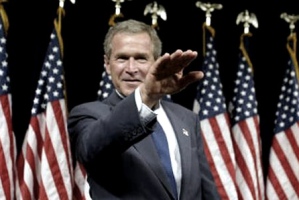
Fascist Bush
©Unknown

Chris Hedges gave this keynote address on Wednesday, May 28, in Furman University's Younts Conference Center. The address was part of protests by faculty and students over the South Carolina college's decision to invite George W. Bush to give the May 31 commencement address.

When it was announced in May that President Bush would deliver the commencement address, 222 students and faculty signed and posted on the school's Web site a statement titled "We Object." The statement cites the war in Iraq and the administration's "obstructing progress on reducing greenhouse gases while favoring billions in tax breaks and subsidies to oil companies that are earning record profits."

"We are ashamed of the actions of this administration. The war in Iraq has cost the lives of over 4,000 brave and honorable U.S. military personnel," the statement read. "Because we love this country and the ideals it stands for, we accept our civic responsibility to speak out against these actions that violate American values."

------

I used to live in a country called America. It was not a perfect country, God knows, especially if you were African-American or Native American or of Japanese descent in World War II or poor or gay or a woman or an immigrant, but it was a country I loved and honored. This country gave me hope that it could be better. It paid its workers wages that were envied around the world. It made sure these workers, thanks to labor unions and champions of the working class in the Democratic Party and the press, had health benefits and pensions. It offered good public education. It honored basic democratic values and held in regard the rule of law, including international law, and respect for human rights. It had social programs from Head Start to welfare to Social Security to take care of the weakest among us, the mentally ill, the elderly and the destitute. It had a system of government that, however flawed, was dedicated to protecting the interests of its citizens. It offered the possibility of democratic change. It had a media that was diverse and endowed with the integrity to give a voice to all segments of society, including those beyond our borders, to impart to us unpleasant truths, to challenge the powerful, to explain ourselves to ourselves.

I am not blind to the imperfections of this America, or the failures to always meet these ideals at home and abroad. I spent 20 years of my life in Latin America, Africa, the Middle East and the Balkans as a foreign correspondent reporting in countries where crimes and injustices were committed in our name, whether during the Contra war in Nicaragua or the brutalization of the Palestinians by Israeli occupation forces. But there was much that was good and decent and honorable in our country. And there was hope.

The country I live in today uses the same words to describe itself, the same patriotic symbols and iconography, the same national myths, but only the shell remains.

America, the country of my birth, the country that formed and shaped me, the country of my father, my father's father, and his father's father, stretching back to the generations of my family that were here for the country's founding, is so diminished as to be nearly unrecognizable. I do not know if this America will return, even as I pray and work and strive for its return.

The "consent of the governed" has become an empty phrase. Our textbooks on political science are obsolete. Our state, our nation, has been hijacked by oligarchs, corporations and a narrow, selfish political elite, a small and privileged group which governs on behalf of moneyed interests. We are undergoing, as John Ralston Saul wrote, "a coup d'etat in slow motion." We are being impoverished - legally, economically, spiritually and politically. And unless we soon reverse this tide, unless we wrest the state away from corporate hands, we will be sucked into the dark and turbulent world of globalization where there are only masters and serfs, where the American dream will be no more than that - a dream, where those who work hard for a living can no longer earn a decent wage to sustain themselves or their families, whether in sweat shops in China or the decaying rust belt of Ohio, where democratic dissent is condemned as treason and ruthlessly silenced.

I single out no party. The Democratic Party has been as guilty as the Republicans. It was Bill Clinton who led the Democratic Party to the corporate watering trough. Clinton argued that the party had to ditch labor unions, no longer a source of votes or power, as a political ally. Workers, he insisted, would vote Democratic anyway. They had no choice. It was better, he argued, to take corporate money. By the 1990s, the Democratic Party, under Clinton's leadership, had virtual fundraising parity with the Republicans. Today the Democrats get more. In political terms, it was a success. In moral terms, it was a betrayal.

The North American Free Trade Agreement was sold to the country by the Clinton White House as an opportunity to raise the incomes and prosperity of the citizens of the United States, Canada and Mexico. NAFTA would also, we were told, staunch Mexican immigration into the United States.

"There will be less illegal immigration because more Mexicans will be able to support their children by staying home," President Clinton said in the spring of 1993 as he was lobbying for the bill.

But NAFTA, which took effect in 1994, had the curious effect of reversing every one of Clinton's rosy predictions. Once the Mexican government lifted price supports on corn and beans for Mexican farmers, they had to compete against the huge agribusinesses in the United States. The Mexican farmers were swiftly bankrupted. At least 2 million Mexican farmers have been driven off their land since 1994. And guess where many of them went?

This desperate flight of poor Mexicans into the United States is now being exacerbated by large-scale factory closures along the border as manufacturers pack up and leave Mexico for the cut-rate embrace of China's totalitarian capitalism.

But we were assured that goods would be cheaper. Workers would be wealthier. Everyone would be happier. I am not sure how these contradictory things were supposed to happen, but in a sound-bite society, reality no longer matters. NAFTA was great if you were a corporation. It was a disaster if you were a worker.

Clinton's welfare reform bill, which was signed on Aug. 22, 1996, obliterated the nation's social safety net. It threw 6 million people, many of them single mothers, off the welfare rolls within three years. It dumped them onto the streets without child care, rent subsidies and continued Medicaid coverage. Families were plunged into crisis, struggling to survive on multiple jobs that paid $6 or $7 an hour, or less than $15,000 a year. But these were the lucky ones. In some states, half of those dropped from the welfare rolls could not find work.

Clinton slashed Medicare by $115 billion over a five-year period and cut $25 billion in Medicaid funding. The booming and overcrowded prison system handled the influx of the poor, as well as our abandoned mentally ill. And today we stand in shame with 2.3 million of our citizens behind bars, most for nonviolent drug offenses. More than one in 100 adults in the United States is incarcerated and one in nine black men ages 20 to 34 is behind bars. The United States, with less than 5 per cent of the global population, has almost 25 percent of the world's prisoners.

The growing desperation across the United States is unleashing not simply a recession - we have been in a recession for some time now - but the possibility of a depression unlike anything we have seen since the 1930s. This desperation has provided a pool of broken people willing to work for low wages and without unions or benefits. This is good news if you are a corporation. It is very bad news if you work for a living.

For the bottom 90 percent of Americans, annual income has been on a slow, steady decline for three decades. The majority's income peaked at $33,000 in 1973. By 2005, according to New York Times reporter David Cay Johnston in his book Free Lunch, it had fallen to a bit more than $29,000, this despite three decades of economic expansion.

And where did that money go? Ask ExxonMobil, the biggest U.S. oil and gas company, which made a $10.9-billion profit in the first quarter of this year, leaving us to pay close to $4 a gallon to fill up our cars. Or better yet, ask Exxon Mobil Corp Chief Executive Rex Tillerson, whose compensation rose nearly 18 percent to $21.7 million in 2007, when the oil company pulled in the largest profit ever for a U.S. company. His take-home pay package included $1.75 million in salary, a $3.36-million bonus, and $16.1 million of stock and option awards, according to a company filing with the U.S. Securities and Exchange Commission. He also received nearly $430,000 of other compensation, including $229,331 for personal security and $41,122 for use of the company aircraft. In addition to his pay package, Tillerson, 56, received more than $7.6 million from exercising options and stock awards during the year. Exxon Mobil earned $40.61 billion in 2007, up 3 percent from the previous year. But Tillerson's 2007 pay was not even the highest mark for the U.S. oil and gas industry. Occidental Petroleum Corp. CEO Ray Irani made $33.6 million and Anadarko Petroleum Corp. chief James Hackett took in $26.7 million over the same period.

For each dollar earned in 2005, the top 10 percent got 48.5 cents. That was the top 10th's greatest share of the income pie, Johnston writes, since 1929, just before the Roaring '20s collapsed in the Great Depression. And within the top 10 percent, those who made more than $100,000, nearly all the gains went to the top 10th of 1 percent, people like Tillerson, or Irani or Hackett, who made at least $1.7 million that year. And until we have real election reform, until we make it possible to run for national office without candidates kissing the rings of Tillersons, Iranis and Hacketts to get hundreds of millions of dollars, this rape of America will continue.

While the Democrats have been very bad, George W. Bush has been even worse. Let's set aside Iraq - the worst foreign policy blunder in American history. George Bush has also done more to dismantle our Constitution, ignore or revoke our statutes and reverse regulations that protected American citizens from corporate abuse than any other president in recent American history.

The president, as the Boston Globe reported, has claimed the authority, through "signing statements," to disobey more than 750 laws enacted since he took office, asserting that he has the power to set aside any statute passed by Congress when it conflicts with his interpretation of the Constitution.

Among the laws Bush said he can ignore are military rules and regulations, affirmative-action provisions, requirements that Congress be told about immigration services problems, ''whistle-blower" protections for nuclear regulatory officials, and safeguards against political interference in federally funded research.

The Constitution is clear in assigning to Congress the power to write the laws and to the president a duty ''to take care that the laws be faithfully executed." George Bush, however, has repeatedly declared that he does not need to ''execute" a law he believes is unconstitutional.

The Bush administration has gutted environmental, food and product safety, and workplace safety standards along with their enforcement. And this is why coal mines collapse, the housing bubble has blown up in our face and we are sold lead-contaminated toys imported from China.

Bush has done more than any president to hand our government directly over to corporations, which now get 40 percent of federal discretionary spending. Over 800,000 jobs once handled by government employees have been outsourced to corporations, a move that has not only further empowered our shadow corporate government but helped destroy federal workforce unions. Everything from federal prisons, the management of regulatory and scientific reviews, the processing or denial of Freedom of Information requests, interrogating prisoners and running the world's largest mercenary army in Iraq has become corporate. And these corporations, in a perverse arrangement, make their money off of the American citizen.

Halliburton in 2003 was given a no-bid and non-compete $7-billion contract to repair Iraq's oil fields, as well as the power to oversee and control Iraq's entire oil production. This has now become $130 billion in contract awards to Halliburton. And flush with taxpayer dollars, what has Haliburton done? It has made sure only 36 of its 143 subsidiaries are incorporated in the United States and 107 subsidiaries (or 75 percent) are incorporated in 30 different countries. Halliburton is able through this arrangement to lower its tax liability on foreign income by establishing a "controlled foreign corporation" and subsidiaries inside low-tax, or no-tax, countries known as a "tax havens." They take our money. They squander it. And our corporate government not only funds them but protects them. Halliburton - and Halliburton is just one example - is the engine of our new, rogue corporate state, serviced by people like George Bush and Dick Cheney, once the company's CEO.

The disparity between our oligarchy and the working class has created a new global serfdom. Credit Suisse analysts estimates that the number of subprime foreclosures in the United States over the next two years will total 1,390,000 and that by the end of 2012, 12.7 percent of all residential borrowers in the United States will be forced out of their homes.

The corporate state, which as an idea is an abstraction to many Americans, is very real when the pieces are carefully put together and linked to a system of corporate power that has made this poverty, the denial of our constitutional rights and a state of permanent war inevitable.

The assault on the American working class - an assault that has devastated members of my own family - is nearly complete. The U.S. economy has 3.2 million fewer jobs today than it did when George Bush took office, including 2.5 million fewer manufacturing jobs. In the past three years, nearly one in five U.S. workers was laid off. Among workers laid off from full-time work, roughly one-fourth were earning less than $40,000 annually. A total of 15 million U.S. workers are unemployed, underemployed or too discouraged to job hunt, according to the Labor Department.

There are whole sections of the United States which now resemble the developing world. There has been a Weimarization of the American working class. And the assault on the middle class is now under way. Anything that can be put on software - from finance to architecture to engineering - can and is being outsourced to workers in countries such as India or China who accept a fraction of the pay and work without benefits. And both the Republican and Democratic parties, beholden to corporations for money and power, allow this to happen.

Take a look at our government departments. Who runs the Defense Department? The Department of Interior? The Department of Agriculture? The Food and Drug Administration? Who runs the Department of Labor? Corporations. And in an election year where we are numbed by absurdities we hear nothing about this subordinating of the American people to corporate power. The political debates, which have become popularity contests, are ridiculous and empty. They do not confront the real and advanced destruction of our democracy. They do not confront the takeover of our electoral processes.

We have watched over the past few decades the rise of a powerful web of interlocking corporate entities, a network of arrangements within subsectors, industries or other partial jurisdictions to diminish and often abolish outside control and oversight. These corporations have neutralized national, state and judicial authority. They dominate, for example, a bloated and wasteful defense industry which has become sacrosanct and beyond the reach of politicians, most of whom are left defending military projects in their districts, no matter how redundant, because they provide jobs. This has permitted a military-industrial complex, which contributes lavishly to political campaigns, to spread across the country with virtual impunity.

Defense-related spending for fiscal 2008 will exceed $1 trillion for the first time in history. The U.S. has become the largest single seller of arms and munitions on the planet. The defense budget for fiscal 2008 is the largest since the Second World War even as we have more than $400 billion in annual deficits. More than half of federal discretionary spending goes to defense. This will not end when Bush leaves office. And so we build Cold War relics like $ 3.4-billion submarines and stealth fighters to evade radar systems the Soviets never built and spend $ 8.9 billion on ICBM missile defense that will be useless in stopping a shipping container concealing a dirty bomb.

The defense industry is able to monopolize the best scientific and research talent and squander the nation's resources and investment capital. These defense industries produce nothing that is useful for society or the national trade account. Melman, like President Eisenhower, saw the defense industry as viral, something that, as it grew, destroyed a healthy economy. And so we produce sophisticated fighter jets while Boeing is unable to finish its new commercial plane on schedule, and our automotive industry tanks. We sink money into research and development of weapons systems and starve technologies to fight against global warming and renewable energy. Universities are awash in defense-related cash and grants, and struggle to find money for environmental studies. This massive military spending, aided by this $3-trillion war, is hollowing us out from the inside. Our bridges and levees collapse, our schools decay and our safety net is taken away.

The corporate state, begun under Ronald Reagan and pushed forward by every president since, has destroyed the public and private institutions that protected workers and safeguarded citizens.

Only 7.8 per cent of workers in the private sector are unionized. This is about the same percentage as in the early 1900s. There are 50 million Americans in real poverty and tens of millions of Americans in a category called "near poverty." Our health care system is broken. Eighteen thousand people die in this country, according to the Institute of Medicine, every year because they can't afford health care. That is six times the number of people who died in the 9/11 attacks, and these unnecessary deaths continue year after year.

But we do not hear these stories of pain and dislocation. We are diverted by bread and circus. News reports do little more than report on trivia and celebrity gossip. The FCC, in an example of how far our standards have fallen, defines shows like Fox's celebrity gossip program "TMZ" and the Christian Broadcast Network's "700 Club" as "bona fide newscasts." The economist Charlotte Twight calls this vast corporate system of spectacle and democratic collapse "participatory fascism."

How did we get here? How did this happen?

In a word, deregulation - the systematic dismantling of the managed capitalism that was the hallmark of the American democratic state. Our political decline came about because of deregulation, the repeal of antitrust laws, and the radical transformation from a manufacturing economy to a capital economy. This understanding led Franklin Delano Roosevelt on April 29, 1938, to send a message to Congress titled "Recommendations to the Congress to Curb Monopolies and the Concentration of Economic Power." In it, he wrote:

"The first truth is that the liberty of democracy is not safe if the people tolerate the growth of power to a point where it becomes stronger than the democratic state itself. That, in its essence, is Fascism - ownership of Government by an individual, by a group, or by any other controlling private power. The second truth is that the liberty of a democracy is not safe if its business system does not provide employment and produce and distribute goods in such a way to sustain an acceptable standard of living."

The rise of the corporate state has grave political consequences, as we saw in Italy and Germany in the early part of the 20th century. Antitrust laws not only regulate and control the marketplace, they serve as bulwarks to protect democracy. And now that they are gone, now that we have a state that is run by and on behalf of corporations, we must expect inevitable and perhaps terrifying political consequences.

I spent two years traveling the country to write a book on the Christian right called American Fascists: The Christian Right and the War on America. In depressed former manufacturing towns from Ohio to Kentucky it was the same. There are tens of millions of Americans for whom the end of the world is no longer an abstraction. They have lost hope. Fear and instability has plunged the working class into personal and economic despair, and not surprisingly into the arms of the demagogues and charlatans of the radical Christian right who offer a belief in magic, miracles and the fiction of a utopian Christian nation. And unless we re-enfranchise these Americans back into the economy, unless we give them hope, our democracy is doomed.

As the pressure mounts, as this despair and desperation reaches into larger and larger segments of the American populace, the mechanisms of corporate and government control are being bolstered to prevent civil unrest and instability. It is not accidental that with the rise of the corporate state comes the rise of the security state. This is why the Bush White House has pushed through the Patriot Act (and its renewal), the suspension of habeas corpus, the practice of "extraordinary rendition," the warrantless wiretapping on American citizens and the refusal to ensure free and fair elections with verifiable ballot-counting. It is part of a package. It comes together. It is not about terrorism or national security. It is about control. It is about their control of us.

Sen. Frank Church, as chairman of the Select Committee on Intelligence in 1975, investigated the government's massive and highly secretive National Security Agency. He wrote:

"That capability at any time could be turned around on the American people and no American would have any privacy left, such is the capability to monitor everything: telephone conversations, telegrams, it doesn't matter. There would be no place to hide. If this government ever became a tyranny, if a dictator ever took charge in this country, the technological capacity that the intelligence community has given the government could enable it to impose total tyranny, and there would be no way to fight back, because the most careful effort to combine together in resistance to the government, no matter how privately it was done, is within the reach of the government to know. Such is the capability of this technology. ... I don't want to see this country ever go across the bridge. I know the capability that is there to make tyranny total in America, and we must see to it that this agency and all agencies that possess this technology operate within the law and under proper supervision, so that we never cross over that abyss. That is the abyss from which there is no return. ..."

When Sen. Church made this statement the NSA was not authorized to spy on American citizens. Today it is.

In a military brig in Charleston an American citizen, Ali Saleh Kahlah al-Marri, is being held in a black hole set up on American soil. He was stripped on June 23, 2003, by George Bush of his constitutional rights and declared an "enemy combatant." He is being detained without charge, interrogated without a lawyer and held indefinitely.

Lawyers for the Bush administration claim that the president can send the military into any neighborhood, any town or suburb, capture a citizen and hold him or her in prison without charge. They base this claim on the Authorization for Use of Military Force, passed by Congress after 9/11, that gives President Bush the power to "use all necessary and appropriate force" against anyone involved in planning, aiding or carrying out the attacks.

But Al-Mari was not captured in Afghanistan or Iraq. He was arrested in Peoria, Ill., in December 2001. And if the president can declare American citizens living inside the United States to be enemy combatants and order them stripped of constitutional rights, what does this mean for us? How long can we be held without charge? Without lawyers? Without access to the outside world? Maybe Al-Mari is, as the government claims, a terrorist. I don't know. But I do know that if this becomes a precedent, if it is not overturned by the courts, habeas corpus, the most important bulwark of our democratic state, will be dead.

We are fed lie after lie to mask the destruction the corporate state has wrought in our lives. The consumer price index, for example, used by the government to measure inflation, has become meaningless. To keep the official inflation figures low the government has been substituting basic products they once measured to check for inflation with ones that do not rise very much in price. This trick has kept the cost-of-living increases tied to the CPI artificially low.

The disconnect between what we are told and what is actually true is worthy of the old East German state. The New York Times' consumer reporter, W.P. Dunleavy, wrote that her groceries now cost $587 a month, up from $400 a year earlier. This is a 40 percent increase. California economist John Williams, who runs an organization called Shadow Statistics, contends that if Washington still used the CPI measurements applied back in the 1970s, inflation would be in the 10 percent range. The advantage to the corporations is huge.

A false inflation rate, one far lower than the real rate, keeps equitable interest payments on bank accounts and certificates of deposit down. It masks the deterioration of the American economy. The Potemkin statistics allow corporations and the corporate state to walk away from obligations tied to real adjustments for inflation. These statistics mean that less is paid out in Social Security and pensions. It has reduced the interest on the multitrillion-dollar debt. Corporations never have to pay real cost-of-living increases to their employees.

The term "unemployment" has also been steadily redefined. This has rendered official data on employment worthless. In real terms about 10 percent of the working population is unemployed, a figure that is, over the long run, unsustainable.

The economy, despite the official statistics, is not growing. It is shrinking. And as the nation crumbles we are awash with the terrible simplicity of false statistics. We confuse our emotional responses, carefully manipulated by advertisers, pundits, spin doctors, television hosts, political consultants and focus groups, with knowledge. It is how we elect presidents and those we send to Congress, how we make decisions, even decisions to go to war. It is how we view the world. Four media giants - AOL-Time Warner, Viacom, Disney, and Rupert Murdoch's NewsGroup - control nearly everything we read, see and hear. This growing disconnect with reality is the hallmark of a totalitarian state.

"Before they seize power and establish a world according to their doctrines," Hannah Arendt wrote, "totalitarian movements conjure up a lying world of consistency which is more adequate to the needs of the human mind than reality itself; in which, through sheer imagination, uprooted masses can feel at home and are spared the never-ending shocks which real life and real experiences deal to human beings and their expectations. The force possessed by totalitarian propaganda - before the movements have the power to drop iron curtains to prevent anyone's disturbing, by the slightest reality, the gruesome quiet of an entirely imaginary world - lies in its ability to shut the masses off from the real world."

So what do we do? Voting is not enough. If voting was that effective, to quote the activist Philip Berrigan, it would be illegal. And voting in an age when elections are stolen by rigged ballot machines and a stacked Supreme Court willing to overturn all legal precedent to make George Bush president, will not work.

I am not saying do not vote. We should all vote. But that has to be the starting point if we want to reclaim America. We must lobby, organize and advocate for the dissolution of the World Trade Organization and NAFTA. The WTO and NAFTA have handcuffed workers, consumers and stymied our efforts to create clean environments. These agreements are beyond the control of our courts and have crippled our weakened regulatory agencies. The WTO forces our working class to compete with brutalized child and prison labor overseas, to be reduced to this level of slave labor or to go without meaningful work. We need to repeal the anti-worker Taft-Hartley law of 1947. The act obstructs the organization of unions. We need to transfer control of pension funds from management to workers. If these pension funds, worth trillions of dollars, were in the hands of workers the working class would own a third of the New York Stock Exchange.

The working class has every right to be, to steal a line from Obama, bitter with liberal elites. I am bitter. I have seen what the loss of manufacturing jobs and the death of the labor movement did to my relatives in the former mill towns in Maine. Their story is the story of tens of millions of Americans who can no longer find a job that supports a family and provides basic benefits. Human beings are not commodities. They are not goods. They grieve, and suffer and feel despair. They raise children and struggle to maintain communities. The growing class divide is not understood, despite the glibness of many in the media, by complicated sets of statistics or the absurd, utopian faith in unregulated globalization and complicated trade deals. It is understood in the eyes of a man or woman who is no longer making enough money to live with dignity and hope.

George Bush, who will be here on Saturday, has done more to shred, violate or absent the government from its obligations under domestic and international law. He has refused to sign the Kyoto Protocol, backed out of the Anti-Ballistic Missile Treaty, tried to kill the International Criminal Court, walked out on negotiations on chemical and biological weapons, and defied the Geneva Convention and human rights law. He has set up offshore penal colonies where we deny detainees basic rights and openly engage in torture. He launched an illegal war in Iraq based on fabricated evidence we now know had been discredited even before it was made public. And if we as citizens do not hold him accountable for these crimes, if we allow the Democratic majority in Congress to get away with its refusal to begin the process of impeachment, which appears likely, we will be complicit in the codification of a new world order, one that will have terrifying consequences. For a world without treaties, statutes and laws is a world where any nation, from a rogue nuclear state to a great imperial power, will be able to invoke its domestic laws to annul its obligations to others.

This new order will undo five decades of international cooperation - largely put in place by the United States - destroy our own constitutional rights and thrust us into a Hobbesian nightmare. We are one, maybe two, terrorist attacks away from a police state. Time is running out.

We must not allow international laws and treaties - ones that set minimum standards of behavior and provide a framework for competing social, political, economic and religious groups and interests to resolve differences - to be discarded. The exercise of power without law is tyranny. And the consequences of George Bush's violation of the law, his creation of legal black holes that can swallow American citizens along with those outside our borders, run in a direct line from the White House to Abu Ghraib, Guantanamo and military brigs in cities such as Charleston.

George Bush - we now know from the leaked Downing Street memo - fabricated a legal pretext for war. He decided to charge Saddam Hussein with the material breach of the resolution passed in the wake of the 1991 Gulf War. He had no evidence that Saddam Hussein was in breach of this resolution. And so he and his advisers manufactured reports of weapons of mass destruction and disseminated them to a frightened and manipulated press and public. In short, he lied. He lied to us and to the rest of the world. There are tens of thousands, perhaps a few hundred thousand people, who have been killed and maimed in a war that has no legal justification, a war waged in violation of international law, a war that under the post-Nuremberg laws is defined as "a criminal war of aggression."

We have blundered into nations we know little about. We are caught between bitter rivalries and competing ethnic groups and leaders we do not understand. We are trying to transplant a modern system of politics invented in Europe characterized, among other things, by the division of earth into independent secular states based on national citizenship in a land where the belief in a secular civil government is an alien creed. Iraq was a cesspool for the British when they occupied it in 1917. It will be a cesspool for us as well. We can either begin an orderly withdrawal or watch the mission collapse.

A rule-based world matters. The creation of international bodies and laws, the sanctity of our constitutional rights, have allowed us to stand pre-eminent as a nation - one that seeks at its best to respect and defend the rule of law. If we demolish the fragile and delicate domestic and international order, if we permit George Bush to create a world where diplomacy, broad cooperation, democracy and law are worthless, if we allow these international and domestic legal safeguards to unravel, our moral and political authority will plummet. We will erode the possibility of cooperation between nation-states, including our closest allies. We will lose our country. And we will, in the end, see visited upon us the evils we visit on others.

Read Antigone, when the king imposes his will without listening to those he rules or Thucydides' history. Read how Athens' expanding empire saw it become a tyrant abroad and then a tyrant at home. How the tyranny the Athenian leadership imposed on others it finally imposed on itself. This, Thucydides wrote, is what doomed Athenian democracy; Athens destroyed itself. For the primary instrument of tyranny and empire is war and war is a poison, a poison which at times we must ingest just as a cancer patient must ingest a poison to survive. But if we do not understand the poison of war - if we do not understand how deadly that poison is - it can kill us just as surely as the disease.

Hope, St. Augustine wrote, has two beautiful daughters. They are anger and courage. Anger at the way things are and the courage to see they do not remain the way they are.

We stand at the verge of a massive economic dislocation, one forcing millions of families from their homes and into severe financial distress, one that threatens to rend the fabric of our society. We are waging a war that devours lives and capital, and that cannot ultimately be won. We are told we need to give up our rights to be safe, to be protected. In short, we are made afraid.

We are told to hand over all that is best about our nation to those like George Bush and Dick Cheney who seek to destroy our nation. A state of fear only engenders cruelty; cruelty, fear, insanity, and then paralysis. In the center of Dante's circle the damned remained motionless.

If we do not become angry, if we do not muster within us the courage, indeed the militancy, to challenge those in the Democratic and Republican parties who herd us towards the corporate state, we will have squandered our courage and our integrity when we need it most.

Saturday, September 01, 2007

Daddy, What Is Labour Day?

Yes, this one is long, but since we are enjoying an extra day of courtesy of our brave forebearers in the workforce, you should have the time. Those before us strove not just for themselves but for the future. How many of us today think like that? Looking around, too few. Thanks to Stephen Lendman for this timely survey, seen at Signs of the Times.

We only borrow the world from our children.

Blue Ibis
***********************************************************

Stephen Lendman
SJ Lendman Blog
Fri, 31 Aug 2007 09:20 EDT

As Labor Day approaches, what better time to assess the state of working America. It's under assault and weakened by decades of eroding rights in the richest country in the world once regarded as a model democratic state. It's pure nonsense in a nation always dedicated to wealth and power, but don't try finding that discussed in the mainstream. Today, it's truer than ever making the struggle for equity and justice all the harder. That's what ordinary working people now face making beating those odds formidable at the least.

In a globalized world, the law of supply and demand is in play with lots more workers around everywhere than enough jobs for them. It keeps corporate costs low and profits high and growing with Business Week (BW) magazine reporting in its April 9 issue "the share of (US) national income going to corporate profits (compared to labor) is hovering around a 50 year high." BW then quoted Harvard economist Richard Freeman's research paper saying only "a global pandemic that kills millions of people" could cause a labor shortage and elevate worker bargaining power.

There's little in sight, and the result is a huge reserve army of unemployed or underemployed working people creating an inevitable race to the bottom in a corporatized marketplace. It harms workers everywhere, including in developed nations. They're outsourcing good jobs abroad to lower wage countries and pressuring workers to do more for less because they've got little bargaining power to fight back. More on this below.

Organized Labor in the US - Its Rise and Decline

Organized labor's rise began modestly and was fragile in the earliest days of the republic. It gained strength in good economic times, then lost it in downturns like the depression in 1873. By the 1880s, things were better as the nation underwent rapid industrialization. With it came rising prosperity and workers wanting a share of the benefits. They turned to unions for help with skilled artisans leading the way helping the unskilled as well in their efforts to organize.

New labor organizations arose, older ones expanded, and as they did, they grew more active and militant. It led to the "great uprising of labor" in 1886, including the landmark Chicago May 4 Haymarket Riot protesting police violence against strikers the previous day. Its impact was hugely negative at first. It forced organized labor to regroup and settle in for a long period of recovery.

This was at a time the incipient labor movement was over two million and rising beginning with its organizing efforts launching it in the 1870s. By the 1880s, it had enough strength to stage huge strikes for better pay and working conditions like the struggle for an eight hour day that had 80,000 strikers parading peacefully down Chicago's main Michigan Avenue on May 1, 1886 in what's now regarded as the first ever May Day Parade.

Workers were helped from community-based emerging independent political parties sensitive to their rights. That's unheard of today in an age where no effective political party stands for working people despite Democrats and Republicans saying they do. Workers are now on their own. They're left to struggle in a global marketplace with pathetically little help weak unions can provide.

Earlier in the 19th century, the first national union arose as workers began asserting their rights. It was called the National Labor Union (NLU), emerged after the Civil War, but was short-lived. Next came the Knights of Labor in 1869 with a mandate to protect all workers including women and blacks after 1883. They were represented by industry groups rather than trade and skill level that was common until then. Its goals were high but achievements few at a time of widespread worker repression in the 1880s. It led to its decline as a more resilient union emerged the result of disaffection with the Knights.

It was called the American Federation of Labor (AFL) and was founded by Samuel Gompers in 1886 to replace its predecessor, the Federation of Organized Trades and Labor Unions. The ill-fated American Railway Union (ARU) followed in 1893, the largest industrial union of its day for a time, and the Industrial Workers of the World (IWW) that at its peak in the 1920s had 100,000 members.

The Wobblies are still around 102 years after Big Bill Haywood, Eugene Debs and others founded the union in 1905 as a commitment to working people in their struggle with corporate employers. It's motto was "an injury to one is an injury to all," its goal was revolutionary, and it's still true to its root ideology today as stated in the current IWW Constitution:

"The working class and the employing class have nothing in common. There can be no peace so long as hunger and want are found among millions of the working people.....Between (workers and employers) a struggle must go on until the workers of the world organize as a class, take possession of the means of production, abolish the (unfair) wage system, and live in harmony with the Earth....It is the historic mission of the working class to do away with capitalism....By organizing industrially we are forming the structure of the new society within the shell of the old."

That philosophy under dedicated men like Haywood, Debs and others set the Wobblies on a collision course with government and big business that tried to crush it. During WW I in 1917, it was vicious under Woodrow Wilson's Justice Department (DOJ). It used the repressive Espionage and Sedition Acts to raid and disrupt union meeting halls across the country. It's the same tactic used today against Latino immigrants and Muslims in the concocted "war on terrorism" and the one against undocumented workers.

In 1917 and later, Wilson's DOJ acted much the same way arresting 165 Wobbly leaders on the grounds they hindered the war effort by using their First Amendment right to speak out against it. They were tried near war's end in 1918, all convicted, and given long prison terms under a Democrat President thought of reverentially today. Bill Haywood was luckier. After conviction, he was released on bail and fled to the Soviet Union where he remained until his death, but the IWW was never again the same.

They were hammered again from 1918 - 21 during the infamous Palmer Raids under Wilson Attorney General Mitchell Palmer. He targeted radical left wing groups like the Wobblies at the time of the first "Red Scare" after the 1917 Russian Revolution. It launched J. Edgar Hoover's career in the DOJ Bureau of Investigation's new General Intelligence Division that later became the FBI in 1935. The IWW is still around, still dedicated to its founding principles, but it's worldwide membership is only around 2000, mostly in the US.

The AFL fared much better. It became the largest union in the first half of the 20th century even after the founding of the Congress of Industrial Organizations (CIO) in 1935 with which it merged in 1955. Today, it's still the country's largest federation of unions. Its web site claims a membership of around 10 million workers, even after the Service Employees International Union (SEIU), Teamsters, UNITE-HERE and United Food and Commercial Workers (UFCW) broke away from the federation in 2005. The United Brotherhood of Carpenters and Joiners of America (UBC) did as well in 2001, and the Laborers International Union of North America (LIUNA) left in 2006. They formed a new Change to Win federation in September, 2005 representing about 5.5 million workers. It likely left AFL-CIO with fewer members than it claims with its true size closer to 8 million or less.

AFL-CIO's state is a metaphor for the times. Organized labor today is weak in the face of declining membership and corporate dominance with workers losing out in a globalized world. It's fall has been long-term and painful with worker rights hammered since the 1980s. It's a long way today from when the landmark Wagner Act passed in 1935 under Franklin Roosevelt. It established the National Labor Relations Board (NLRB) guaranteeing labor the right to bargain collectively on equal terms with management for the first time ever, but it wasn't an act of kindness.

It came at the height of The Great Depression when those in power feared the worst. FDR and Congress acted to save capitalism at a time they feared mass worker hostility might boil over like it did in 1917 Soviet Russia. Like all other worker victories, this one came through struggle. It was from organizing, pressing their demands, taking to the streets, going on strike, holding boycotts, battling police and National Guard forces supporting management against working people, paying with their blood and lives and finally achieving results. They got an eight-hour day, a living wage, and on-the-job benefits because strong unions went head-to-head with management and won. It's worlds different now with corporate giants in bed with friendly governments, and Democrats and Republicans vying to see which party can be more accommodative.

From the 19th century forward, it was never easy for labor from the height of the movement's strength to the present. Unions were always disadvantaged even at a time of reasonable labor-management harmony. The passage of the harsh 1947 Taft-Hartley Labor-Management Relations Act showed how tenuous their position always was. Harry Truman vetoed the bill but was overridden. He called it a "slave labor bill" and then hypocritically used it 10 times, the most ever by any President to this day. The law throttles organized labor by giving the President power to stop strikes by court-ordered injunction for 80 days. He can claim the national interest, some other one, or none at all that's always the same one - to help corporate management deny workers their rights.

Taft-Hartley is still the law and was last invoked by GW Bush in the summer of 2002 against 10,500 west coast dock workers "locked out" (not striking) by the Pacific Maritime Association representing shipping companies and terminal operators.

Earlier in 2001 and new in office, Bush showed his anti-labor stripes straightaway. He invoked the Railway Labor Act blocking a threatened strike by 10,000 mechanics, cleaners and custodians at Northwest Airlines set for March 12. He acted again against United Airlines' 15,000 mechanics in December. He also took management's side in August, 2006 against Northwest's 8700 flight attendants' planned job action against the bankrupt airline's unfair demands for huge wage cuts and increases in hours worked. Bill Clinton was just as unfriendly invoking the Railway Labor Act against American Airline's pilots and to prevent railroad strikes 13 times.

Laws like these, and Presidents' willingness to use them, crushed the spirit and letter of the Wagner Act. They greatly weakened or revoked hard won provisions, and as a consequence, diminished union clout. Taft-Hartley allows stiff penalties for union violations but minimal ones for companies. It enacted a list of "unfair (union) labor practices" prohibiting jurisdictional strikes (relating to worker job assignments), secondary boycotts (against firms doing business with others being struck), wildcat strikes, sit-downs, slow-downs, mass-picketing against scabs brought it, closed shops (in which employees must join unions), union contributions to federal political campaigns, and more while legalizing employer interventions aimed at preventing unionizing drives.

It began a process of gradual erosion of union power to bargain collectively. That's their weapon now weakened because of devious employer tactics. They can illegally fire union sympathizers (thousands each year) and get away with only minor wrist slap fines after years of expensive litigation to prove wrongdoing. Further, employers can fire workers for any lawful reason like incompetence or no stated reason at all. Even the right to strike is neutralized with employers able to hire replacements or threaten to ship jobs offshore. With government on their side, they're empowered to fire union workers and legally replace them with lower-paid scabs or Latino immigrants.

The Reagan administration marked the beginning of the current trend in its first year. He was contemptuous of organized labor while hypocritically saying "I support unions and the rights of workers to organize and bargain collectively." He showed it in August, 1981 by firing 11,000 striking PATCO air traffic controllers, jailing its leaders, fining the union millions of dollars, and effectively busting it in service to the monied interests backing him. It was a shot across organized labor's bow and a clear message to business and industry of what to expect from a friendly Republican President. Nothing changed since under Democrat or Republican administrations with workers unable to match the power and influence of capital. The toll ever since has been devastating.

Union membership has been in steady decline from its post-war high of 34.7% in the 1950s. It held fairly constant through most of the 1970s at around 24% where it stood in 1979. At the end of the Reagan era, it was down to 16.8% and is currently around 12% overall with about 36% of government workers unionized but only 7.4% of them in the private sector. It's the lowest it's been since the beginning of the mass unionization struggles of the 1930s and in the private sector in over 100 years. It's because of Democrat and Republican antipathy to organized labor and corporate threats to close plants and outsource jobs. It's forced workers to take pay cuts and fewer benefits that are dropping to where they'll be none, and they'll be on their own to live or die by market-based rules rigged against them.

George Bush supports corporate interests aiming to crush unions so they have free reign to treat workers any way they wish or go find other work. In the wake of 9/11, he took on public sector unions straightaway. He denied 170,000 new Department of Homeland Security (DHS) employees their civil service protection and right to bargain collectively. Those affected included Transportation Security Administration (TSA) newly federalized airport screeners. They lost their right to unionize in the name of national security that could as easily been for any reason or none at all. But this was just for starters. Bush also wants federal positions contracted out to private companies. That jeopardizes 850,000 federal employees likely to get lower pay, fewer benefits, loss of other unionized rights, and many of them ending up out of work.

Overall, organized workers always get higher wages and greater benefits, which explains why strong unions are vital. The evidence comes from David Sirota in his his 2006 book, "Hostile Takeover." He showed:

-- 89% of union members have employer-paid health care coverage compared to 67% for nonunion members; as fewer companies now provide it, those numbers are lower; in addition, companies continue making employees pay a greater share of the cost of coverage;

-- employers pay a larger share of union member health care premiums than nonunion members get (but the percentage is falling);

-- over two-thirds of union members have short-term disability insurance compared to about one-third for nonunion workers;

-- union members get about 26% more vacation time and 14% more total paid leave than nonunion workers; and

-- Economic Policy Institute (EPI) data show union influence gets high school graduating members about 8.8% more pay than nonunion workers.

Greater worker clout under unions is why management wants to destroy them. It's to deny working people their right to organize, earn more and get greater benefits corporations don't want to provide. It's happening in the gilded age of George Bush, and a recent example came in a ruling late last year when his administration's NLRB ruled 3-2 against registered nurses' right to union membership if they perform certain minimal supervisory duties.

It was in a case where United Auto Workers (UAW) were trying to organize nurses at a Taylor, Michigan-based hospital. US labor law doesn't guarantee supervisors the right to organize making the NLRB ruling hugely important for up to eight million workers in other trades. It may potentially deny their right henceforth to qualify for union representation if employers want to use this ruling to add enough supervisory responsibilities to employees' job descriptions to throw them into a union-exempt category.

Bush further ended the Clinton administration's regulation requiring federal agencies vet companies' compliance with the law when awarding federal contracts. He also issued harsh anti-union, anti-worker executive orders (EOs) as well as a tsunami of other repressive ones. He barred automatic union-recognition agreements on federally funded construction projects, abolished labor-management cooperation partnerships aimed at improving productivity and working conditions, and mandated contractors henceforth must inform employees they no longer had to join a union without having to tell them it's their legal right.

Just the way Ronald Reagan busted PATCO, George Bush tipped his hand straightaway in office. He's a company man and union-hater, so henceforth it's been open season on workers and their rights under his administration. His policies range from:

-- a one-sided support for management;

-- stripping workers of their right to unionize;

-- cutting pay raises for 1.8 million federal workers on the pretext of a "national emergency;"

-- denying millions overtime pay;

-- appointing anti-union officials;

-- scheming to weaken (and then end) retirement security by replacing Social Security with risky private accounts managed by Wall Street sharks that so far has gotten nowhere because of public opposition to it;

-- weakening environmental regulations and protections; and more in an endless war on workers in service to corporate interests that elected and own him.

The failed "immigration reform" legislation was, in fact, a Trojan Horse. It's down but not dead and remains a thinly veiled scheme targeting all workers. It's a dagger aimed straight at organized labor in a plan to create a workplace of unempowered serfs, a "bracero America," including US citizens having few or no benefits and no security. If this legislation ever becomes law, workers will be at the mercy of business to hire and fire them at will.

Another anti-labor tool is the repressive Department of Homeland Security (DHS) and its Immigration and Customs Enforcement (ICE) arm. It conducts paramilitary border and workplace assaults on undocumented Latino workers as part of a larger agenda to disenfranchise all working Americans and deny them the right to bargain collectively with management through unions. By targeting undocumented workers first, the eventual aim is to create a large exploitable disposable reserve army worker pool; strip all workers of their rights; empower employers to offer low wage, low or no benefit jobs; and pretty much be able to operate as they please.

The Employee Free Choice Act (EFCA) - Some Hope for Worker Rights Now Denied

EFCA was introduced to "amend the (landmark pro-labor) National Labor Relations Act (passed in 1935)" that's been systematically dismembered piece by piece ever since. Its aim was to "establish an efficient system to enable employees to form, join, or assist labor organizations, to provide for mandatory injunctions for unfair labor practices during organizing efforts, and for other purposes." On June 26, Senate Republicans blocked labor's top legislative priority by preventing the bill's supporters from getting the 60 votes needed to end debate and bring it to a vote.

For now the bill is dead, but if it ever passes, it will change federal law on worker rights. They'll henceforth be able to organize by signing cards authorizing union representation, penalize employers violating worker rights to do it, and establish new mediation and arbitration processes for first-contract disputes. It might also end or slow down the firing, demoting, laying off, or suspending without pay of over 20,000 US workers annually because of their union activities.

The bill was introduced in the 108th and 109th Republican-controlled Congresses but failed to pass. It was introduced again in the 110th Congress on February 5, 2007, got 233 co-sponsors by month's end, and passed in the House March 1, 2007 for the first time. On March 2, it was placed on the Senate calendar where leading Democrats expected it to pass despite Republican opposition. They were wrong.

That's bad news for a bill that would have won back some worker rights after decades of losing them. It's backed by over five dozen organizations including the NAACP, United for a Fair Economy, Jobs with Justice and numerous other civil, human and labor rights groups. The US Chamber of Commerce and other organizations joined with big business against the bill. They oppose all worker rights, and their lobbying paid off. They claimed the bill allowed them the right to organize before employers can explain why doing it is not in their best interest. Ignored is that union workers always have more rights that include higher pay, greater benefits and added job security. That's bad for business and why corporate giants fought to kill the bill.

They have a powerful ally in the White House making their job a lot easier. In a mid-February speech before a business lobby group, Dick Cheney announced George Bush would veto EFCA legislation if it passed on his watch. He assured those attending this administration will keep its anti-labor record unblemished on something polls show 77% of working Americans want but won't get as long as George Bush is in office.

Global Unionization - Another Potential Ray of Hope

In April editions of The American Prospect, the Washington Post and ZNet, Harold Meyerson wrote about "a radical new direction for the globalized economy" in his article titled "Unions Gone Global." He noted the United Steel Workers (USW) here are negotiating a merger with two of Britain's largest unions to create "the first genuinely multinational trade union" that with about three million members will be the world's largest. Meyerson reported the goal, as USW's Gerald Fernandez put it, is "to fight financial globalization (by) fight(ing) it globally....by building a global union (in this case a) federation of metal, mining, and general workers."

The partners in this one stated a commitment to "fund human rights and union rights in parts of Africa and Colombia" where more unionists are killed annually than anywhere else, and the country gets billions in US aid each year to help out. They also plan a global effort "to protect employees' retirement benefits" from corporate predators wanting to end them. For now, there's no way to know if the idea behind the merger will spread, whether workers here and abroad will benefit from it, or even if the USW and their British partners will follow through effectively on their committed aims to help win back what unionized workers have been losing for years.

The War on Working Americans - Part II

This article was written to assess the state of working America in the run-up to Labor Day, 2007. Organized labor today is severely weakened following decades of government and business duplicity to crush it. Part I reviewed the labor movement's rise in the 19th century and subsequent decline post-WW II and especially in the last three decades. Hope arose for some change in the Democrat-led 100th Congress. A weak effort emerged, but Senate Republicans killed it.

Organized labor is struggling to remain relevant and claw its way back. The enormous obstacles it faces are reviewed below as well as the condition of working Americans today in a globalized world affecting their lives and welfare heading "south" in the "land of opportunity" offering pathetically little.

The Loss of High-Paying Jobs from Outsourcing Under Globalized Market-Based Rules

World trade isn't new, and the General Agreement on Tariffs and Trade (GATT) was its mid-20th century version after 23 founding nations signed it on October 30, 1947 in Geneva. Earlier in 1946, they drafted the International Trade Organization (ILO) that followed the creation of the IMF and International Bank for Reconstruction (now the World Bank) at Bretton Woods in 1944. Fifty-three nations then signed the GATT in Havana in March, 1948 as the founding international instrument governing world trade.

Subsequent rounds of negotiations followed through number eight launched in Punta del Este, Uruguay (the Uruguay Round) in 1986. It was signed in Marrakesh, Morocco in April, 1994 by most of the 123 participating countries as the updated version of the original 1947 GATT. It was then succeeded by the WTO January 1, 1995, one year to the day after NAFTA took effect as another worker rights legislative weapon of mass job destruction. DR-CAFTA followed next for the Central American countries signing on to it after El Salvador did first in March, 2006.

The WTO is well-seasoned with a corporate-friendly alphabet soup of Uruguay-negotiated agreements like the Agreement on Trade-Related Aspects of Intellectual Property Rights (TRIPS), General Agreement on Trade in Services (GATS), Agreement on Agriculture (AoA), Agreement on Technical Barriers to Trade (TBT), and others all designed for one purpose. It's to override member states' national sovereignty so they're now governed under a uniform set of global market trading rules favoring capital.

They're designed for the Global North, giant corporations and the rich at the expense of Global South developing nations, ordinary people everywhere, concern for environmental standards as well as sanity and public safety. Along with the IMF, World Bank, and other international lending agencies, this entire structure is big capital's neoliberal scheme to commoditize everything, including people and life itself in the human genome, to strip-mine the planet for profit.

Globalized trade has a long history, but the notion of a globalized marketplace came into its own in the 1980s. It was hailed as a western, mainly US, prescription for economic growth and prosperity lifting all boats. In fact, only yachts benefitted by design so the privileged could gain at the expense of all others preyed on.

The UN's International Labour Organization's (ILO) commission on the social dimensions of globalization is comprised of representatives from labor, government and business. In 2004, it issued a damning appraisal of world trade rules harm and the subsequent distress caused by unfair practices. It ranges from how TRIPS prevents affordable generic life-saving drugs being sold in developing countries to the shifting tax burden from business and the rich to workers, and much more.

In the US and West, the damage comes from exporting jobs and offshoring manufacturing and service operations to low-wage countries. It began in the late 1950s when modest numbers of them went to Canada to take advantage of the cost savings there. The pace then quickened in the 1960s and 1970s with the exodus of production jobs in autos, shoes, clothing, cheap electronics, and toys as well as routine service work like credit card receipt processing, airline reservations and basic software code writing.

What started as simple assembly and service work early on, then took off in the 1980s. It spread up and down the value chain and now embraces almost any type good or service not needing a home-based location such as retail clerks, plumbers, and carpenters; top-secret defense research, design and selected types of manufacturing; and certain types of specialized activities companies so far have kept at home. What's moving abroad, however, is big business getting bigger with Gartner Research estimating outsourcing generated $298.5 billion in 2003 global revenues.

The toll adds up to a global race to the bottom in a country where services now account for 84% of the economy. The once bedrock manufacturing portion is just 10% and falling as more good jobs in it are lost in an unending drain. Since the start of 2000 alone, about one in six factory jobs, over three million in total, have been affected. The sector is less than a third of its size 40 years ago and one-fourth the peak it hit during WW II.

It's been devastating for the nation's 130 million working people. No longer are unions strong and workers well-paid with assured good benefits like full health insurance coverage and pensions. Today, all types of financial services comprise the largest economic sector. Much of it is in trillions of dollars of high stakes speculation annually producing wads of cash for elite insiders (when things go as planned) and nothing for the welfare of most others and the good of the country.

Worst of all is the poor and declining quality of most service sector jobs measured by wages, benefits, job security and overall working conditions. It's because fewer good ones exist, unions are weak, and workers are at the mercy of employers indifferent to their plight. People are forced to work longer and harder for less just to stay even. Jobs in this sector are mostly concentrated in unskilled or low-skill areas of retail, health care and temporary services of all kinds. They pay lots less than full-time jobs, and have few or no benefits and little prospect for future improvement. This all happened by design to crush worker rights and commoditize them like all other production inputs.

The Department of Labor now projects job categories with the greatest future expected growth are cashiers; waiters and waitresses; other restaurant-related workers; janitors and cleaning personnel; retail clerks; and child care workers - all low-skill areas. Harvard degrees aren't required. Neither are high school ones.

Most in-demand higher-skilled jobs are projected to be for nurses, post-secondary teachers and sales representatives. There are still plenty of high-tech jobs in areas like network systems and data analysis and software engineering applications and systems. But watch out. They're being lost as well to low-wage countries in an unending domestic job drain affecting all types of work able to be done anywhere. It shows why domestic job growth is stagnant (despite the hype it isn't), eligible workers are dropping out of the work force, and the decline is sure to continue unless legislation stops it. None is in sight or imagined.

The loss of good well-paying jobs means fewer high-end and a range of low-skilled ones are all that remain for vast numbers of young people whose future looks bleak. Two research studies among others highlight the problem. One by University of California staffers in 2004 estimated up to 14 million American jobs are at risk to outsourcing, and another by Gartner Research predicts as many as 30% of high-tech jobs may be lost to low-wage countries by 2015. In addition, writing in the March/April, 2006 issue of Foreign Affairs on what he calls a "third Industrial Revolution," former Federal Reserve vice-chairman Alan Blinder estimated 28 - 42 million American service sector jobs are vulnerable and could be lost to foreign labor.

In low-wage countries, they're done at far less cost to US employers in their company-owned or subcontracted out operations. Blinder added starkly "We have so far barely seen the tip of the offshoring iceberg, the eventual dimensions of which may be staggering." Veteran financial analyst and writer Bob Chapman calls this the "rape of our economy" with enormous, wrenching and destructive consequences to the lives of millions of working people pursuing an illusory American dream.

It affects the skilled and unskilled alike for all types of jobs at risk. Chapman cites India as an example noting once only low-skill and routine programming jobs went there. Now, he says, it's "software aeronautical engineers, banking, insurance, investment banking and drug research" along with many other high-end jobs where companies can hire skilled professionals at a fifth the cost of US and European ones. So why wouldn't they, and more are in a growing trend.

All types of financial jobs at all levels are also being eliminated with financial institutions moving sizeable chunks of investment banking, research, trading operations, and other professional jobs abroad for big cost savings. Deloitte Touche estimates the industry will outsource 20% of its cost base by 2010 with more to come in a continuing job drain for big cost savings abroad. The ones lost will be in financial services and most other sectors in a trend looking like it won't end until the US is as low a wage nation as those now taking our jobs.

An Unprecedented Fall in Workers' Standard of Living

Over the past 30 years, most people have seen an unprecedented fall in their standard of living. Adjusted for inflation, the average American worker now earns less than in the mid-1970s with the minimum wage unchanged at $5.15 an hour since 1997 until the 110th Congress raised it in pathetically small steps to a wholly inadequate top level. Beginning July 24, it rose to $5.85, will go to $6.55 July 24, 2008 and to $7.25 July 24, 2009. Until the increase, minimum worker pay was at the lowest point relative to average wages since 1949. It got many states, comprising over half the population, to raise their own, but it's not enough.

A recent study released by the Center for Economic Policy Research (CEPR) shows the dire state of things. It reported about one in three jobs in the country, about 47 million of them, pay low wages (defined as two-thirds the median wage or $11.11 per hour or less) with few or no benefits like health insurance, pensions or retirement accounts. It's barely enough for a family of two adults and two children to exceed the official understated poverty level of $20,444 in 2006 (or $9.83 an hour), and by this definition one in four workers (35 million) only earned poverty-level wages. But millions of others fall below it because official statistics way understate the problem, and workers earning around $11.11 an hour in cities like New York, Chicago, Los Angeles and other large ones can't get by if they have to support a family on it.

These growing millions now comprise a permanent underclass in a nation unwilling to admit what census data and private research now show. America is a rigid class society by design with extreme wealth at the top, a declining (maybe dying) middle class, and a growing underclass of low-paid workers and poor, many desperately so.

Following the inequalities of the 1920s, the nation experienced what economic historians Claudia Goldin and Robert Margo called "the Great Compression." Income gaps narrowed from the positive effects of New Deal and Great Society programs, strong unions, and an equitable tax system for individuals and corporations. From then to now, call it "the Great Expansion" of inequality with the gap between rich and most others the greatest it's been since the Gilded Age of the "robber barons" and getting worse.

Business Week magazine highlighted the trend in December, 2003 and accompanying research. It showed a decline in social mobility over the past few decades. The article was called "Waking Up from the American Dream - Meritocracy and Equal Opportunity Are Fading Fast." It noted the "Wal-Martization" of the country corporate America embraces to control labor costs by outsourcing jobs, de-unionizing, hiring temps and part-timers, and dismantling internal career ladders to boost profits at the expense of people. What's left is a proliferation of dead-end, low-wage jobs with public policy skewed to keep it that way. It needs stressing again. This didn't happen by chance. It was by design to destroy organized labor, and so far it's working.

In its most recent State of Working America - 2006/2007, the Economic Policy Institute (EPI) reports the official poverty level in 2004 stood at 12.7% or 37 million people, including 13 million children. It also showed for the first time ever, poverty in the country grew in the first three years of an economic recovery. In its study, EPI cited factors today they call "historically unique:"

-- increased globalized trade;

-- low union membership;

-- more low-skilled and high-skilled immigration; and

-- fewer favorable social norms guiding employer behavior to provide "adequate safety nets, pensions, and health care arrangements."

EPI noted the biggest challenge in today's "new economy" isn't (macro) growth but how benefits get distributed with such a high proportion skewed upward.

Left out entirely are the 16 million 2005 census figures show are on the very bottom living in "extreme" poverty that's defined as a family of four with an annual income of $9903 or less. Even more disturbing is how fast the poverty rate is increasing. The numbers of those worst off grew by 26% from 2000 - 2005 or 56% faster than for the total poverty population. Further, it happened mostly in years of economic expansion after the 2001 recession ended late that year. Notable also is the disturbing decline in higher-paying jobs leaving what's left for unskilled or low-skill workers. They pay pitiful wages and few, if any, benefits with crumbling social safety net protection left to pick up the slack.

The Oakland Institute policy think tank promotes social and economic justice. It recently reported its disturbing assessment of things saying 10% of the US population (around 30 million) "experiences hunger or is at risk of going hungry." A December, 2006 Helsinki-based World Institute for Development Economics Research of the UN University study also reported disturbing findings. They showed the richest 1% of adults owned 40% of global assets in 2000, and the richest 10% held 85% of them.

EPI reported the top 1% controls more than one-third of America's wealth, the bottom 80% has 15.3%, and the top 20% holds 84.7% of it. In contrast, the poorest 20% are in debt and owe more than they own. Globalization, automation, outsourcing, the shift from manufacturing to services, weak unions, deregulation, and other harmful economic factors all add to the problem.

Other data show an astonishing generational shift of well over $1 trillion of national wealth annually from 90 million US working class households to for-profit corporations and the richest 1% of the population. It created what economist Paul Krugman calls an unprecedented wealth disparity getting worse that shames the nation and is destroying the bedrock middle class without which democracy can't survive.

A similar conclusion also came from an analysis of income tax data by Professor Emmanuel Saez of the University of California-Berkeley and Professor Thomas Piketty of the Paris School of Economics. Both men are noted for their work on income inequality. Their research found the top 1% of Americans in 2005 (about 3 million people) got their largest share of national income since 1928 - 21.8%, up from 19.8% a year ago or a 10% gain. Further, the top 10% received 48.5% of all reported income in 2005, also the highest level since 1928, up 2% from 2004, and one-third since the late 1970s.

The top one-tenth of 1% (about 300,000 people) did best of all, to no surprise. It got as much income in total as the bottom 150 million Americans combined. In addition, while total reported income rose almost 9% in 2005, average incomes for the bottom 90% of the population dropped .6% from the previous year.

Further, the Bush administration tax cuts for the wealthy greatly widened the income gap between rich and poor that was the whole idea behind them with a healthy piece of the benefits going to big corporations. In the 1950s, they contributed an average of 28% to federal revenues. That dropped to 21% in the 1960s and about 10% and falling since the 1980s. It's happening with the corporate tax rate at 35%, but few of the giants pay it. According to the Government Accountability Office (GAO), 94% of major corporations now pay less than 5% of their income in taxes, and corporate tax payments overall are at their lowest level in 60 years. In addition, many large companies pay no tax, and some end up with sizable rebates on top of huge corporate welfare subsidies under a system of socialism for big corporations and the rich and "free market" capitalism for the rest of us.

Saez and Piketty also reported their findings may be understated because the wealthy are more likely to file late tax returns so those who did weren't included in the study. Also, the IRS acknowledges it can account for only about 70% of business and investment income, most, of course, going to high-income earners. What's missing is $300 - $400 billion a year that adds up to trillions of untaxed dollars for the rich with the rest of us having to make up for it.

Recent US Commerce Department data is also disturbing. It shows the share of national income going to wages and salaries the lowest on record with their data going back to 1929. And the Center on Budget and Policy Priorities (CBPP) finds wage and salary growth in the current recovery growing at half the average rate for post-recessionary periods since the end of WW II while corporate profits in the current period grew over 50% more than the post-WW II average. It's the first time on record, corporate profits got a larger share of income growth in a recovery than wages and salaries - 46% to 34%.

The Growth and Shredding of Social Services in America

The golden age of social service benefits and worker protections emerged during The Great Depression, but they didn't begin then. An obligation was felt to help the needy as early as colonial times but without an organized effort to do it. Back then, local towns and villages did it through the poor relief system and almshouses. That began changing as the nation became less agrarian and more industrial when a number of states added services like cash allowances, mothers' pensions and by the mid-1920s old age assistance for the blind. Also, then and earlier, the Federal government and States began recognizing the need for public welfare social insurance financed through contributions guaranteeing protection for all rather than public assistance for the needy alone.

The first instance of it began in 1908 with a Federal workers' compensation law covering some government workers. States then added their own, and by 1929 all of them had it except four holdouts. Other efforts followed including State and local retirement plans and Federal benefits and services for veterans. Even the private sector added their own with token amounts of health care, pensions, life insurance and sick pay.

The Great Depression hard times of the 1930s changed everything creating a golden age for worker rights and benefits mentioned above. It followed the roaring 1920s era of anything goes corporate greed and loose regulation. It ushered in the Roosevelt administration's New Deal to aid the needy and reform the economy when 25% of the working public had no job in 1933. Those in power feared the worst knowing they had to act to save capitalism at a time of mass hostility to it they feared might erupt in a Russian-style 1917 revolution.

They did it then like never before or since starting by passing the National Industrial Recovery Act in 1933. It was based on a "bubble up" theory of recovery to raise wages and thereby stimulate consumer purchasing power hoping it would lead to increased production and new investment. Despite good intentions, things go as planned. The Depression dragged on until the 1939 early WW II build-up began ending it. It packed greater economic punch than in earlier public sector spending. Those efforts were less for reform and more for what John Maynard Keynes recommended - upgrading infrastructure to revive durable goods production that, in turn, would revive the economy.

Still New Deal policies were remarkable in how mirror opposite they were to what's been enacted since 1980 and especially in the gilded age of George Bush. There were stimulative loans and grants to the States and landmark measures like the FDIC insuring bank deposits, the SEC regulating financial markets, and the NLRB through the Wagner Act explained above. Most important was a broad array of social programs. They included Federal emergency relief, public works and others under an alphabet soup of initiatives. They were way inadequate, but, nonetheless, tried to jump-start a moribund economy by providing substantial work and relief for the unemployed and needy.

The high water mark came in 1935 with the passage of the landmark Social Security Act. To this day, it's still the single most important piece of social legislation in our history. More than any other government program, it's the one most responsible for keeping vast numbers of elderly people out of poverty as well as providing other essential services and benefits for the needy and disabled. Other important social legislation came out as well including Unemployment Insurance with the Federal government partnered with States; the Railroad Retirement System; Public Housing; and Social Security Old-Age and Survivors Insurance.

Post-WW II there was lots more:

-- the National School Lunch Program (established in 1946);

-- Aid to the Permanently and Totally Disabled (APTD - in 1950) that later became Supplemental Security Income (SSI) in 1972;

-- Social Security Disability Insurance (SSDI);

-- Medical Assistance for the Aged (preceding Medicare);

-- Aid to Families with Dependent Children (AFDC - 1960);

--the Food Stamp Program (1964);

-- the School Breakfast Program (1966);

-- the WIC food assistance program (1972);

-- Earned Income Tax Credit (EITC - 1975);

-- Low Income Home Energy Assistance; and

-- Temporary Assistance for Needy Families (TANF - 1997 successor to AFDC that was a huge step backwards explained below), among others.

Lyndon Johnson's Great Society earlier saw other landmark social legislation with the establishment of Medicare and Medicaid in 1965. It guaranteed the elderly and indigent health care coverage at affordable, minimal or no cost when they needed it most.

That was the good news, but it changed with the election of Ronald Reagan in 1980. Mark Weisbrot from the Center for Economic and Policy Research (CEPR) called his administration's rollback of social services his "project of building a bridge to the 19th century in areas of social policy." It was that and more, but despite it, the dominant media shamelessly exalted him in life (see Mark Hertsgaard 1989 book "On Bended Knee: The Press and the Reagan Presidency") and practically deified him following his death on June 4, 2004. Left out of the eulogies was the true scorched earth legacy he left behind. His "war on international terrorism" was a devastating precursor to its updated version under the current administration. This article, however, only addresses his domestic damage on people least able to handle it.

The Reagan administration instituted a generational decline of worker rights and vital social programs. It allowed them to erode through higher payroll taxes, raising the retirement age, increasing Medicare premiums, and cutting Medicaid benefits for the poor. His years were characterized by large increases in military spending, big tax cuts for the rich and big business while slashing social benefits, union worker rights and running up huge deficits.

Discretionary domestic spending for most social programs, other than Social Security, Medicare and Medicaid, was cut by one-third from 1981 - 1988. Programs for low income earners were hard hit with a 54% cut. Subsidized housing lost over 80%, housing assistance for the elderly 47%, and training and employment services over 68%. Reagan also reduced health and safety protections and weakened federal statutes guaranteeing workers the right to organize and bargain collectively.

Beneath his avuncular persona, Reagan was callous and indifferent to notions of equal justice, civil liberties and human need. He showed it in his support for the Christian Right's hate campaign against gays and lesbians in its early days of ascendency by refusing to address the AIDS problem he allowed to become a global epidemic.

HIV/AIDS first surfaced in the US among gay men in New York and California in 1981, Reagan's first year in office. It was called a "gay disease", and still is largely today by those who demean it. Most notably, extremist Christian Right leaders call it God's revenge against gay people they say are diseased sinners. When the Centers for Disease Control first reported the outbreak they, too, stigmatized the gay community as disease-carriers calling it GRID - gay-related immune deficiency.

Ronald Reagan went along with this notion refusing even to mention AIDS or do anything to address the problem in the first seven years in office. It caused enormous setbacks for HIV/AIDS research and appalling discrimination against the infected and gay community overall. In addition, there were no government-directed efforts at prevention or education. It thereby allowed a health problem that might have been contained to become an epidemic killing a half million people in the US alone and infecting an estimated one million others now living with the disease.

Worldwide the numbers are catastrophic with an estimated 25 million deaths and another 34 - 47 million people currently infected. In addition, millions more are added to the numbers each year who might have been helped if the Reagan administration had led a worldwide effort to contain what's now an out-of-control plague in parts of the world like sub-Saharan Africa. None of this was mentioned in Reagan's eulogy that should have been a denunciation for this and his other crimes against humanity George Bush is now doing his best to match or exceed.

The GHW Bush years followed the "Reagan Revolution." They were pathetically "kinder and gentler" domestically and made worse by a "new world order" imperial agenda harming working people everywhere that's standard practice now under all Presidents. It was the same under Bill Clinton who called himself a Democrat but never governed like one. His tenure included NAFTA and WTO responsible for mass and growing poverty, human misery and ecological destruction under one-way globalized trade rules providing cover for predatory capitalism.

So-called "welfare reform" in the Personal Responsibility and Work Opportunity Reconciliation Act of 1996 (PRWORA) also was passed. Before it did, the needy got welfare payments through Aid to Families with Dependent Children or AFDC help. That changed in 1996 with time limits set so no one would be helped for more than five years under the new program called Temporary Assistance for Needy Families or TANF. Under it, the Federal government allots fixed block grants to the States they then administer at their discretion meaning the needy now get cheated by an uncaring state.

TANF also requires most recipients to participate in some kind of work or training to qualify for help. It doesn't matter that much of it goes to single mothers with young children needing them at home to provide care unavailable if the law prevents it. There's also no relief during recessions when jobs are lost and unskilled workers are least able to find one.

Clinton's main social initiative was his ill-conceived health care "reform." It was a complex mess based on the notion of "managed competition" and marketplace medicine instead of what's really needed in the form of a "single-payer" national health insurance program modeled on the kind in Western Europe, Canada or that all members of Congress and the administration get. They cover everyone, irrespective of ability to pay, and for US legislators and the executive it's gold-plated for life.

The Clinton plan (dubbed "Hillarycare") offered the public less choice for more affordability but wanted big insurers and HMOs to run it guaranteeing an illusion of full coverage the way it is now. Profits always trump need with insurers targeting young and healthy prospects while avoiding those posing the greatest risks.

The pace of social spending cuts accelerated dramatically under George Bush who'd eliminate them all given the choice, and he's working on it. He's against all of them to fund more tax cuts for the rich and provide multi-billions for his permanent state of war plus every imaginable weapon system the Pentagon and defense contractors want to wage them.

Bush's assault on organized labor was covered above, but he has lots more targets as well. Education is one of them in his appalling No Child Left Behind Act. It focuses on testing, not children. It's a boon to corporations supplying the materials but not to teachers who hate them. It forces them to teach "to the test" instead of educating students in course material that's the only way to run a classroom. Otherwise, kids don't learn, but that's part of the scheme as what kind of future do all but the well-off have to look forward to.

The Bush education agenda also promotes school vouchers disguising a broader goal to privatize public education and aid the white supremacist parochial part of it. Christian Right zealots support these schools because of their brand of hard right extremism dangerous to everyone outside the faithful. In most areas where vouchers are used, 80% of them are for these type schools. They renounce proved science like evolution and teach creationism instead, repackaged as "intelligent design."

They also preach an extremist Christian doctrine waging war on truth and democratic principles of a free and open society. They replace it with faith-based pseudoscience on everything from creation to HIV/AIDS to pregnancy prevention to global warming to militarism, and all the while denounce non-believers as heretics. These schools also threaten the survival of public education. They divert funding from them and violate the constitutional separation of church and state which is why the Bush administration supports them.

His administration also opposes college aid at a time tuitions and fees are more unaffordable than ever and rising much faster than inflation. An undergraduate year at Harvard now costs over $50,000 with all expenses included, but even lower-tuition state schools aren't affordable for many with the University of Illinois typical of most others. It's much cheaper than Harvard but still costs about $26,000 a year "base rate" that's unaffordable for low-income families without considerable financial aid. George Bush's solution - cut or freeze maximum allowable Pell Grants so even holding them steady means amounts offered don't keep up with rising costs and needy students lose out.

Bush's prescription for health care is no better at a time 47 million have no coverage, millions more are underinsured, and 80 million in the country have no coverage at some time during the year meaning they need to be judicious about when they're sick. Administration solutions are pathetic at best showing no intent to tackle a problem this huge. Suggested tax breaks are so inadequate, families with annual incomes under $10,000 would only save $23 in 2007. Those with higher incomes fare little better with the Bush plan only covering 9 million uninsured leaving 38 million others (and rising) with no help.

Then there's Bush's 2003 Kafkaesque Medicare Prescription Drug, Improvement, and Modernization Act (MMA) scamming seniors. It took strong-arming threats and bribes in an all-night congressional session to get it passed. Its controversial Part D costs tens of billions annually, does little for most Medicare recipients, but provides huge benefits for "Big Pharma." It's able to charge top dollar because the administration won't negotiate lower prices the way the Veteran's Administration (VA) does getting big savings on all drugs it buys so veterans today only pay $8 a prescription. Two decades ago, they paid nothing.

More social wreckage gets into each new FY budget with billions of new cuts heaped on past ones. It's to free up more funds for the military, the rich, and corporate allies with the White House now audaciously proposing a further cut in corporate tax rates. It's part of a near-three decade agenda furthering the interests of the privileged at the expense of all others. In America today, social welfare and the greater good are nonstarters.

Earlier damage included -

-- killing OSHA workplace ergonomic rules more than 10 years in the making;

-- revoking grants to study workplace safety and health;

-- cutting funding for job training; and

-- more cuts for enforcement positions at OSHA and the Mine Safety and Health Administration that was a key reason for the early 2006 Sago and Alma mine deaths in West Virginia, the latest tragedy in Utah (not earthquake caused), and the death of 60 miners and counting since January, 2006.

-- Bush also proposed paying welfare recipients below-minimum wages;

-- denying Homeland Security employees protection for being a whisleblower;

-- blocking release of funds to monitor Ground Zero;

-- ignoring New York rescue workers' health;

-- cutting health care benefits for veterans and billions more cuts for Medicare and Medicaid;

-- raising interest rates on student college loans;

-- cutting the number of WIC-eligible participants;

-- reducing the number of adults eligible for food stamps and children qualifying for school meals;

-- cutting the Commodity Supplemental Food Program, child care, Head Start, affordable housing units for the elderly, home energy assistance (LIHEAP), Employment/Training Services, and education for the disadvantaged; and

-- stiffening work requirements for two million adults (mostly single mothers) on welfare.

His administration is also at fault for the Walter Reed Hospital scandal because medical facilities for military personnel and veterans across the country are understaffed, underfunded and allowed to deteriorate under federal or private contractor management. The result is inadequate or sub-standard care for the severest of problems, and the worst is yet to come with tens of billions of new planned cuts through FY 2011. Only Bush's plummeting approval rating may slow him down. But it doesn't stop his war machine from getting all the funds it wants and lots more for the asking in supplemental add-ons.

Looking Ahead - Tough Choices with No Easy Answers

The state of working America today is bleak with few signs of improving in a globalized world of corporate omnipotence and an indifferent to hostile government. It backs the rights of the privileged while scorning the social welfare needs of all others. Somehow, some way this must change, but wishing only works if backed by effective action. A look back suggests how.

Past labor successes were noted above. What worked before can again, and there's nothing complicated about it. Above all, new leaders are needed because too many today are uninspiring at best. They must be committed and dedicated to the rights and needs of ordinary working people and be willing to go to the wall for them. Effective mass organizing is needed to build unity and strength of numbers, educate workers on what they lost, and lead the fight to win them back. It means taking to the streets, storming the halls of Congress, going on strikes, holding boycotts, doing battle when necessary that in the past meant paying for it in blood and lives.

It worked when it won an eight hour day, a living wage keeping pace with inflation, essential benefits like health care coverage and pensions, and a more level playing field guaranteeing labor the right to bargain collectively on equal terms with management. Those gains weren't handed over because change never comes from the top down. They were fought for and won with lots of blood and sweat expended to get them. Why not again?

It's called democracy, equity and justice and one thing about them is clear. Achieving and keeping them requires a strong middle class of ordinary working people that, in turn, needs a vibrant labor movement as a foundation and springboard for progressive grassroots social change. Organized labor is in tatters today at barely over 7% of private sector workers (a 100 year low). It's on life support, needs a survival strategy, and is heading for the dustbin of history only major change can avoid. The way is through organized people out-muscling organized money. It happened before and can again.

This is the great class struggle of our time against long odds for success. The stakes though are huge, and our future as a democratic society depends on the outcome as former US Supreme Court Justice Louis Brandeis explained in 1941 when he said "We can (either) have a democratic society or we can have great concentrated wealth in the hands of the few. We cannot have both." The concentration is greater than ever at a time American workers are in their weakest position in decades.

Bowed but not broken, they're in a war for survival with the rest of us, and their sovereign worker rights and ours in a free society are at stake. It's no time for timidity. It's a time for unity and pressing ahead. It happened once. Why not again, and the time to go for it is now with the rest of us pitching in to help for our own preservation and survival.

Stephen Lendman lives in Chicago and can be reached at lendmanstephen@sbcglobal.net.

Also visit his blog site at sjlendman.blogspot.com and listen to The Steve Lendman News and Information Hour on The MicroEffect.com Saturdays at noon US central time.