Showing posts with label Checkpoints. Show all posts

Sunday, January 18, 2009

When Israel expelled Palestinians: What if it was San Diego and Tijuana instead?

When Israel expelled Palestinians: What if it was San Diego and Tijuana instead?

Randall Kuhn
Washington Times
Wed, 14 Jan 2009 19:09 UTC
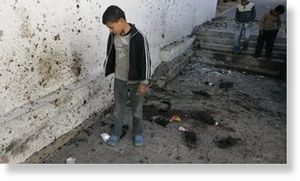

© AP Photo / Hatem Moussa
Palestinian children gather at the site where three people died
in a Israeli air strike outside a United Nations school in the Shati
refugee camp, Tuesday, Jan. 6, 2009.

In the wake of Israel's invasion of Gaza, Israel's Defense Minister Ehud Barak made this analogy: "Think about what would happen if for seven years rockets had been fired at San Diego, California from Tijuana, Mexico."

Within hours scores of American pundits and politicians had mimicked Barak's comparisons almost verbatim. In fact, in this very paper on January 9 , House Majority Leader Steny Hoyer and House Minority Whip Eric Cantor ended an opinion piece by saying "America would never sit still if terrorists were lobbing missiles across our border into Texas or Montana." But let's see if our political and pundit class can parrot this analogy.

Think about what would happen if San Diego expelled most of its Hispanic, African American, Asian American, and Native American population, about 48 percent of the total, and forcibly relocated them to Tijuana? Not just immigrants, but even those who have lived in this country for many generations. Not just the unemployed or the criminals or the America haters, but the school teachers, the small business owners, the soldiers, even the baseball players.

What if we established government and faith-based agencies to help move white people into their former homes? And what if we razed hundreds of their homes in rural areas and, with the aid of charitable donations from people in the United States and abroad, planted forests on their former towns, creating nature preserves for whites to enjoy? Sounds pretty awful, huh? I may be called anti-Semitic for speaking this truth. Well, I'm Jewish and the scenario above is what many prominent Israeli scholars say happened when Israel expelled Palestinians from southern Israel and forced them into Gaza. But this analogy is just getting started.

What if the United Nations kept San Diego's discarded minorities in crowded, festering camps in Tijuana for 19 years? Then, the United States invaded Mexico, occupied Tijuana and began to build large housing developments in Tijuana where only whites could live.

And what if the United States built a network of highways connecting American citizens of Tijuana to the United States? And checkpoints, not just between Mexico and the United States but also around every neighborhood of Tijuana? What if we required every Tijuana resident, refugee or native, to show an ID card to the U.S. military on demand? What if thousands of Tijuana residents lost their homes, their jobs, their businesses, their children, their sense of self worth to this occupation? Would you be surprised to hear of a protest movement in Tijuana that sometimes became violent and hateful? Okay, now for the unbelievable part.

Think about what would happen if, after expelling all of the minorities from San Diego to Tijuana and subjecting them to 40 years of brutal military occupation, we just left Tijuana, removing all the white settlers and the soldiers? Only instead of giving them their freedom, we built a 20-foot tall electrified wall around Tijuana? Not just on the sides bordering San Diego, but on all the Mexico crossings as well. What if we set up 50-foot high watchtowers with machine gun batteries, and told them that if they stood within 100 yards of this wall we would shoot them dead on sight? And four out of every five days we kept every single one of those border crossings closed, not even allowing food, clothing, or medicine to arrive. And we patrolled their air space with our state-of-the-art fighter jets but didn't allow them so much as a crop duster. And we patrolled their waters with destroyers and submarines, but didn't even allow them to fish.

Would you be at all surprised to hear that these resistance groups in Tijuana, even after having been "freed" from their occupation but starved half to death, kept on firing rockets at the United States? Probably not. But you may be surprised to learn that the majority of people in Tijuana never picked up a rocket, or a gun, or a weapon of any kind.

The majority, instead, supported against all hope negotiations toward a peaceful solution that would provide security, freedom and equal rights to both people in two independent states living side by side as neighbors. This is the sound analogy to Israel's military onslaught in Gaza today. Maybe some day soon, common sense will prevail and no corpus of misleading analogies abut Tijuana or the crazy guy across the hall who wants to murder your daughter will be able to obscure the truth. And at that moment, in a country whose people shouted We Shall Overcome, Ich bin ein Berliner, End Apartheid, Free Tibet and Save Darfur, we will all join together and shout "Free Gaza. Free Palestine." And because we are Americans, the world will take notice and they will be free, and perhaps peace will prevail for all the residents of the Holy Land.

Randall Kuhn is an assistant professor and Director of the Global Health Affairs Program at the University of Denver Josef Korbel School of International Studies. He just returned from a trip to Israel and the West Bank.

Thursday, January 17, 2008

Israel Comes Clean on Gaza Policies

Yossi Wolfson
Challenge Magazine
Thu, 17 Jan 2008 08:41 EST

©Wissam Nassar
Gaza City, January 8, 2008. From a demonstration against the Bush visit: empty coffins symbolize 62 patients who have died since June because Israel denied them access to medical treatment outside Gaza.

No more lies or twisted tongues. Israel is saying at last what, in the past, it always refused to acknowledge: its war is against the Palestinian population.

Until now, in discussions about the separation wall, closures, blockades, house demolition, and other sorts of collective punishment, the State Attorney's Office lacked the gumption to admit in court that the aim of such measures is to harm civilians. It always came up with convoluted security claims in order to present some vital military necessity for the sake of the War against Terror. Harm to the population was described as a regrettable side effect.

But now a Rubicon has been crossed. This happened after ten human-rights organizations petitioned the High Court on October 28, 2007 against cuts in the supply of electricity and gasoline to Gaza. The petitioners claimed that the cuts amount to collective punishment, which is forbidden under international law. The State might have answered that the cuts are a necessary military measure aimed at stopping the production of Qassam rockets. Or it might have tried some other tongue twister. But no. In their response to the petition, Dana Briskman and Gilad Shirman from the State Attorney's Office announced openly, without blinking an eye, that the cuts' main purpose is to exert pressure on the economy as a way of influencing Hamas.

Thus the State clamps the arteries of life for 1.5 million Gazans and describes its action as an economic war. Here it infringes a basic principle of the international laws concerning warfare, which distinguish between the civilian population and the armed forces. One main purpose of these laws is to shield civilians from the battlefield and mitigate the effects war can have on them. The lawyers for the State Attorney do not dispute this principle. Rather they would limit it to strictly military operations. Cutting the supply of electricity or gasoline is not a strictly military operation. In an economic war, they hold, the principle does not apply. Following this logic to its absurd conclusion, we find that it is forbidden to blow up a civilian installation, but it is permissible to disable it by cutting off raw materials. It is forbidden to blow up a power plant, but it's OK to turn off the electricity.

This is not to imply that Israel abides by the law in its strictly military decisions. In summer of 2006, for example, it did blow up the Palestinian power plant in Gaza, raising the Strip's dependence on itself for electricity - the same electricity that it today proposes to cut.

The state turns international law on its head. Various provisions regulate civilian supplies in wartime, with the aim of keeping the situation from reaching the threshold of a humanitarian crisis. Israel cites these provisions but interprets them as allowing it to harm civilians as long as it stops short of that threshold, defined by it.

What is the humanitarian threshold in Israel's view? The blockade of Gaza has been going on at various levels for years. Since Hamas ousted Fatah there in the summer of 2007, the shipment of goods to the Strip has been restricted almost totally to basic foods, medicines, medical equipment, cooking gas, gasoline and electricity. Karni, the main checkpoint for transfer of goods, earlier functioned in a spotty manner, but today it is completely shut. The code for importing goods to Gaza has been deleted from the computers of Israel's Customs Authority, which (according to the Paris Protocol) is supposed to collect the tariffs. The supply of fuel (except cooking gas) has been cut (without court interference). The electricity cut has not yet been implemented, but the shortage is already severe. Electricity and water are available only intermittently. Most of the industrial plants are closed for lack of raw materials and replacement parts. Hospitals, water and sewage services have been operating for the last year and a half (since Israel blew up the power plant) by means of emergency generators. Because replacement parts are lacking, the infrastructures are running down, and there is increasing danger of disaster. A harbinger was the bursting of the cesspool wall in Um al-Nassar last year, where five people drowned in a river of sewage.

According to statistics from the summer of 2007 (See the Gisha web site: "New Report: Commercial Closure"), before Israel hardened its measures, 87% of Gazans lived beneath the poverty line, which was reckoned at $2.40 per day. Already then there were perceived shortages in basic products, and food prices rose by tens of percentage points. According to figures of the World Food Program, 85% of Gazans depend on aid to purchase food.

In the view of Israel, however, the existing supply of goods is above what the law obligates it to allow, and the supplies of electricity and gasoline are even twice the minimum required. Below the humanitarian threshold as defined by it, Israel includes little more than hospitals run by generators, ambulances, supply trucks, and minimal public transport. On November 1, it repeated its assurances to the Court that its measures are carefully weighed and considered. It promised to watch the situation closely to prevent a humanitarian crisis. Yet the government had no up-to-date figures on the likely effects of an electricity cut. The Court asked for data, but the State did not provide them. Instead, it became clear that even the partial statistics cited earlier were misleading (See the Gisha web site: "Court criticizes State Attorneys...").

Israel claims in court that it has the right to choose the countries it trades with, as if Gaza were just one independent state among the many. It views a cut in electricity to Gaza as not essentially different from, say, a cut in the sale of diamonds to Spain. This claim conceals the self-righteous notion that Israel, having disengaged, is no longer responsible for the Strip. But who presides over Gaza's borders? Who rules its air space? Whose jets and attack helicopters are those up there? Who controls Gaza's sea, preventing the erection of an independent harbor?

Gaza's economic dependence on Israel is the fruit of a deliberate policy that has been in effect for decades. Here as well as in the West Bank, Israel stymied any fledgling industry that might compete with it. It developed Gaza's dependence on it for electricity and gas. It turned the Gazans into a cheap labor force to serve Israeli industry - at first by having them commute into Israel and later by developing an industrial area at Checkpoint Erez. Israel also benefited from Gazan dependence on its products. When Karni was closed, among the loudest protestors were Israeli farmers. According to reports from the summer of 2007, about a fourth of the fruit grown in Israel was marketed in the Occupied Territories. The cut in gasoline shipments also made a dent in the income of Dor-Alon, the Israeli energy company supplying Gaza.

Yet Israel's conceptual change about Gaza is not consistent. Disengaged or not, it can't resist the temptation to exploit the Strip's resources. Parallel to the discussion on cutting energy supplies, there is another petition before the High Court that also concerns energy - but here the supply would go from Gaza to Israel. In this petition, two corporate groups are battling for an Israeli license to pump natural gas from the reservoir off Gaza's coast, a reservoir that - if Gaza belonged to a Palestinian state - would be in its territorial waters. The pumped gas is slated to become a major energy source in Israel's economy. Did the Justices happen to recall another case they are hearing, in which the State says it no longer occupies Gaza? If so, they haven't indicated this. Needless to say, no Justice cried in astonishment, "By what right do you intend to exploit the gas reserves of the Gaza Strip? This is against the provisions of international law, which forbid an occupying power from exploiting the natural resources of an occupied territory for its own use!"

Finally, we cannot ignore the similarities between Israel's policies in Gaza and in Lebanon. In southern Lebanon too (if to a lesser degree), Israel for years used the population as a cheap commuting workforce and as consumers of its products, all in the framework of the so-called "Good Fence" policy. This ended, as in Gaza, in a unilateral withdrawal (May 2000). Israel's interest in controlling the water that flows its way from southern Lebanon brings to mind its interest in Gaza's gas reserves. Its attack on Lebanon in 2006 also has its Gazan parallels. In both places Israel learned that it has no military answer to the threat of rockets in the hands of militias. With Hezbollah as with Hamas, Israel refused to negotiate. In Lebanon too, it hesitated to open a broad ground war, and rightly so. It learned that it cannot rule a hostile area in the face of attrition from guerrillas. When it undertook military action in Lebanon, the weakness of its own armed forces became apparent. This weakness derives from the moral corruption of the military and political leadership. The war revealed an impossible combination: on the one hand, the leadership's overall contempt for human life, and, on the other, Israeli society's unwillingness to accept battle casualties.

In both cases, Gaza and Lebanon, Israel has made indiscriminate war from the air on civilians while hesitating to commit ground forces. In both it has sought to destroy the economic infrastructure and reduce the civilian population to primitive conditions. By harming them, it was thought, you could get them to pressure their leaders and thus make political gains. This notion proved false in Lebanon, as in Gaza. The Israeli attacks amount to an expression of weakness, but the price will not be paid by those who launch them, rather by civilians on both sides.

Tuesday, June 12, 2007

Israel Forty Years On: What Has Been Wrought

Short and powerful, SOTT editor Henry See, exposes the shallow hypocrisy of the average well-heeled Israeli illegal immigrant to the land of the Palestinians

Blue Ibis
***********************************************************

Henry See
SOTT
Sat, 09 Jun 2007 11:08 EDT

©Mike DuBose, UMCom
A Palestinian child swings over the
rubble of the family home,demolished by
Israeli bulldozers in a valley east of
Hebron.


The Forward, which bills itself as "the Jewish daily", had an article this week on American Jews who choose to become illegal settlers on occupied Palestinian land. The "difficulties" they face are illustrated by the following comment:

"'Before we found Neve Daniel, my husband told me, 'I love you and I want to live in Israel, but I'm very materialistic and if I don't have a nice house, we're not moving,' said Lara Kwalbrun, a peppy mother of six, as she gave a tour of her luxurious new home while toting a baby in her arms."
As long as moving into an illegal settlement meant life in a mobile home, a large number of American Jews weren't interested. They left it up to their more pioneering and violent brethren to go out and "colonize" the area, to actually confront the owners of the land with clubs and guns and chain saws and bulldozers. Now that the out and out outlaws have "claimed" the land, so to speak, and the base can move into a gated community fed by water siphoned away from the Palestinians and policed by troops paid for by American taxpayers, these new settlers can move in and never have to come into contact with the people they have displaced. You know, the ones walled up in the concentration - uh, refugee - camps out of sight and out of mind.

Another choice quote:
"Jerusalem has evolved to be like Manhattan in terms of prices and having to live in an apartment," said Michael Chernofsky, an orthopedic surgeon from Pennsylvania who recently moved with his family to Efrat, a Gush Etzion settlement. "If you want to live in a house, you need to move out to the suburbs."

Language is a powerful means of creating an illusory world. We make up words to replace other words, antiseptic words to replace bothersome and ugly words, neutral or comfortable words that point away from injustice and suffering. The Palestinians are being ejected out of Jerusalem by force and by a series of laws that mandate that if they are essentially imprisoned on the West Bank and unable to return to their homes in East Jerusalem, after a certain amount of time, the state can confiscate their property.

"Suburbs" brings to mind the manicured lawns of the New Jersey many of these settlers have left. "Suburbs" has associations of being the epitome of American life. The word "Suburbs" is a telling example of how language is used to create an illusory world that we take for reality.

Settlements on Palestinian land are illegal according to international law. The settlers are criminals. Not only that, they are actively aiding and abetting the genocide of the original inhabitants of the land, the Palestinians who have been walled off into compounds on their own land.

If such actions don't make your blood boil, then you probably don't have a conscience. When I say "conscience," I'm not talking about a set of rules you live by that allows you to believe you are a 'good person', the kind of things you can apply mechanically as a series of if-then statements that allow you to see how much you can get away with in any given situation. We all go through that stage as kids, and some people do actually outgrow it, though from the state of the world, it is clear that it is a small percentage. There are unfortunately large numbers of people for whom this stage represents the pinnacle of their moral development.

Illegal settlers are certainly counted among their number. They are, moreover, buttressed in their selfishness by the ideology that justifies killing off the Palestinians in the name of their psychopathic god, so their crimes, crimes to anyone of conscience; holy acts according to the ideology of Judaism as well as to their Christian supporters. American intervention in Iraq is based upon pretty much the same thought process where the religion descends from the Almighty Dollar and "Democracy" rather than the bloodthirsty Yahweh.

There is no excuse for the seizure of this land and the justifications of "Chosen People" or "God-given right". None. Those are fairy tales told to cover up theft and murder. And anyone with a functioning conscience knows this, feels this deep in his or her gut. Any attempt to justify or explain away the theft of land and genocide of the people of Palestine is a clear marker that the individual has no conscience or that it is so totally anaesthetized that it may as well not exist.

Note: If you wish to take a voyage into the very pit of soullessness, some black and clammy void that would not be out of place in the works of H.P. Lovecraft, then go to Wikipedia and do a search on "Gush Etzion" and start following the links.

Monday, February 05, 2007

West Bank & Gaza: A Pyschopath's Paradise


Quick, describe the difference between the actions of anti-semitic nazi soldiers and anti-palestinian IDF soldiers. From forcing the oppressed to entertain their oppressors at checkpoints to killing them with beauracracy (see below), it's getting hard to tell the difference. I don't see no moral high ground here folks.

Blue Ibis

***************************************

The Twilight Zone/By the book

Gideon Levy
Haaretz
Fri, 02 Feb 2007 14:36 EST

There's no question about it - everything was done by the book. The gate was locked at 7 P.M. and 16,000 people, residents of the villages of Beit Furik and Beit Dajan, were imprisoned behind it until 6 A.M. That's the procedure. A woman who wants to cross the checkpoint at night has to go on foot, to wait until a female soldier comes to do a body check, even if she is about to give birth; that, too, is procedure. And only cars with permits are allowed to enter Nablus, even if dying people are sitting inside them; that is also according to procedure. No soldier deviated from the procedure, everything was done by the book, the book of the occupation.

That is how it happened that a cancer patient was delayed for about an hour and a half at the Hawara checkpoint, until he died in a taxi that was not allowed to enter Nablus, a taxi in which he was trying to get from the hospital to his home, his final request. That is also what happened when the young woman in labor was forced to stand in the cold and the rain for about half an hour and to make her way on foot for several hundred meters while in labor. That's the procedure.

The death of cancer patient Taysir Kaisi was inevitable, but why in such pain, waiting endlessly in a "non-permitted" taxi at the checkpoint? And the young woman from Beit Furik who was about to give birth, Roba Hanani, finally arrived at the hospital in Nablus and successfully gave birth there to her first child, but why with such torture? Why did they deserve it? What would we think if our loved ones were to die or suffer labor pains at a checkpoint separating the city and the village? Life and death are in the hands of the checkpoint: The story of the death of Taysir Kaisi and the birth of Raghad Hanani, between the Hawara checkpoint and the Beit Furik checkpoint, during an easing of restrictions at the checkpoints, less than an hour's drive from Tel Aviv, is a story that should disturb our equanimity.

Taysir Kaisi worked in Hazem Samara's hummus shop in Nablus. He was 45 years old, with seven children, a hummus maker, with two bedrooms and a living room in a house in the Ain Bet Ilma refugee camp in the city. He fell ill a year ago; he was diagnosed with metastasizing liver cancer only a month ago. Dr. Hurani prescribed chemotherapy, which he received at the Al Watani hospital in the city.

His situation deteriorated, his pains increased, Kaisi wanted a second opinion. Someone recommended the Hadassah Hospital, but in the end he only managed to go to the Al Mutla hospital in East Jerusalem. On Monday, January 15, he went to Jerusalem accompanied by his cousin Hussein Kaisi. They had four permits, that is the only way one can travel to receive a second opinion, a permit for two days, one for each day, for two people, one for "the purpose of medical needs" and the other "for the purpose of accompanying a patient," all properly stamped, all after they showed the doctor's appointment from the hospital in Jerusalem, and that is also according to the rules. Kaisi was still in reasonable shape when he left his house on Monday, and he did part of the long trip to Jerusalem walking from one taxi to another, between the checkpoints. At the Qalandiyah checkpoint, they asked him to pull down his pants - security - and he managed that too.

At Al Mutla they decided to hospitalize the patient for four days. He and his cousin had permits for only two days. After several examinations the doctors recommended that Kaisi return home and continue to receive chemotherapy in Nablus, near his family and his children. On Thursday morning Taysir and Hussein left the hospital on their way home. That was Taysir's final journey.

We are now sitting with the cousin Hussein on a rock overlooking the improvised taxi stand at the Hawara checkpoint, exactly where he left Taysir to die in a taxi that was not permitted to cross. The taxi drivers that the two stopped when they left the hospital in East Jerusalem refused to take them, because their permits for medical purposes and for the purpose of accompanying a patient were no longer valid, because of the hospitalization that had lasted two days beyond the permits. That is why the two, the patient and his cousin, traveled by bus to the Qalandiyah checkpoint, after waiting a long time at the bus stop. They crossed the checkpoint on foot, Taysir was still able to walk, and there they took a taxi from Ramallah to bring them to Nablus. Taysir screamed with pain during the entire trip, asking his cousin, "When will we get to Nablus already?"

When they reached the Hawara checkpoint, the checkpoint at the entrance to Nablus, Hussein asked the driver to enter the checkpoint and drive them home. The soldier at the checkpoint asked for permits. Hussein, who speaks Hebrew, explained to him that Taysir was a critically ill man who was returning to his home. The soldier asked for a permit from the taxi driver, but the taxi driver from Ramallah did not have a permit to enter Nablus. "Go back," ordered the soldier. Hussein tried to explain to the soldier that Taysir was incapable of going on foot, and that all he wanted was to get home, but the soldiers insisted. Those are the procedures. They said that Hussein and Taysir could enter Nablus, but only on foot.

Taysir was no longer in any condition to walk even one step. The pains in his stomach had increased during the course of the uncomfortable trip and he was no longer capable of standing on his feet. "This is a cancer patient," Hussein tried to explain, to no avail. The soldiers, he says, did not pay attention. For lack of any other choice, they turned back, doing the soldier's bidding.

The driver parked his taxi at the improvised taxi stand at the front of the checkpoint, Taysir groaned with pain and Hussein asked him to set out with him on foot. Taysir was incapable of doing so. So Hussein went out to look for a taxi with a permit to enter Nablus, leaving his cousin in the taxi. "Take care of my wife and the children," Taysir asked Hussein, apparently his last words.

The desperate Hussein tried to find a driver who would agree to take them through the checkpoint. In an UNRWA vehicle that just passed there was no room, no other car came. One of the taxi drivers suggested that he call the ambulance in Nablus. Only in an ambulance will you be able to cross, the driver advised him. Hussein called the Red Crescent in Nablus, another 15 minutes passed until the ambulance arrived at the checkpoint. The ambulance driver didn't find the two, Hussein ran to him and directed him to the taxi where Taysir was dying.

The paramedic got out of the ambulance and approached Taysir, asking him how he was, but Taysir didn't reply. He was sitting in the back seat of the taxi. The driver of another taxi that was standing at the taxi stand, Jihad Hareb, says that he saw Taysir sitting in the taxi for about an hour and a half, his yellow skin slowly turning black, "as though someone had choked him." The paramedic checked his pulse and respiration and determined that Taysir was dead. Hussein also says that about an hour and a half passed from the moment they arrived at the checkpoint until the ambulance arrived. With the help of two taxi drivers, they removed Taysir from the taxi and carried him to the ambulance, and drove to the hospital in Nablus, where his death was determined. The doctors estimated that Taysir had died about 45 minutes before arriving at the hospital.

Hussein called Taysir's wife, Nawal, and informed her: "Taysir died at the checkpoint, on the way home." He says that it was hard for him to give the news over the phone, Taysir had so much wanted to get home. A B'Tselem investigator, Salma al-Debai, also took testimony from Hussein, in order to prepare a report about the incident on behalf of her organization.

The IDF Spokesman's Office, for its part, responds with a total denial: "An investigation regarding a claim that a Palestinian cancer patient was delayed at the Hawara checkpoint found the claim to be incorrect. An investigation carried out by the Civil Administration's coordinator of health showed that the Palestinian died on the way, during a taxi ride from the hospital in Jerusalem to the Hawara checkpoint."

Some people die at the checkpoint and some are born there: Wrapped in a woolen blanket, an electric heater warming her well-appointed room, lies the infant Raghad Hanani, 25 days old, in her bed. When she grows up, maybe her parents, Roba and Derar - he a Palestinian policeman and she a 25-year-old housewife - will tell her about her mother's travails when she was about to give birth.

It was Roba's first pregnancy. On Friday, December 7, she went into labor. An act of the devil - evening had already fallen on their village, Beit Furik, east of Nablus; an act of the devil - the IDF had locked the iron gate. The coordinator of ground operations of Rabbis for Human Rights, Zacharia Sadeh, says that for months this gate has been locked every night, from 7 P.M. to 6 A.M., imprisoning behind it the 16,000 residents of the two neighboring villages, Beit Furik and Beit Dajan.

It was 8:30 P.M., about an hour and a half after the gate had been locked; the couple ordered a taxi and drove toward the iron gate intending to reach the hospital in Nablus, a few minutes' drive away. There are two roads to Nablus; one is short and is open to Jews only, and one is longer and passes through the Beit Furik checkpoint. Access to both roads passes first of all through the iron gate, and it was locked, as we have said.

The taxi driver, Mahmoud Melitat, approached the iron gate and began to flash his car lights in the direction of the IDF guard tower, which is located a few hundred meters from the gate. Derar says that it was cold and rainy outside. After about 10 minutes, a Hummer arrived. The driver, Melitat, tried to explain to the soldiers that there was a woman in labor in his taxi, but the soldiers insisted that she had to get out and cross the gate on foot.

[any woman who has ever experienced hard labor will know the depth of this cruelty]

The couple got out of the taxi, Roba was crying, holding her stomach, scared about her first birth, leaning on her husband's shoulders.
They walked from the gate in the direction of the checkpoint, a distance of several hundred meters, and there the soldiers ordered them to wait until a female soldier came to do a body check on Roba - maybe she was carrying a bomb on her way to Nablus. On the other side of the checkpoint a Palestinian ambulance that had been ordered by Derar was waiting, and the soldiers did not let its driver pass to the other side of the checkpoint, which is closed at night. Derar says that the soldiers did not even allow Roba to get into the ambulance and to wait inside. They said that these were the orders.

So they stood outside until the female soldier arrived, Roba was examined and the permit to go to the hospital was finally given. The IDF Spokesman responded that he was not familiar with this case.

In the end, Raghad was born in the hospital in Nablus. Mother and baby are doing well. Grandma and grandpa, Roba's parents, have seen their granddaughter only once so far, in the hospital. The residents of their village of Salem, which can be seen on the opposite hill, are not allowed to enter Beit Furik.

And nevertheless the Hananis were lucky: Late in 2003 Rula Ashateya, who was also in labor, tried to cross that same accursed checkpoint. The soldiers prevented her from crossing at the time, and Rula crouched to give birth on the ground, hiding behind one of the cement blocks of the checkpoint, with her husband serving as midwife. The newborn apparently hit the rock and died. Her parents had intended to call her Mira, I wrote here at the time, since all their children's names begin with M. Then, too, the IDF Spokesman said that "the soldiers are instructed to allow crossing at the checkpoint in humanitarian cases, at any time and in any situation."