Showing posts with label Boycott Israel. Show all posts

Thursday, July 09, 2009

Three Cheers for the Irish activists kidnapped by Israel

© Michael Gallagher

IPSC members and other supporters greet the
heroes at Dublin Airport
Speech by Freda Hughes,
National Events Coordinator of the IPSC


7th July 2009, Radisson Blu Hotel, Free Gaza Homecoming Press Conference.


Last Monday 29th June, Derek and Mariead set sail on the Free Gaza boat the Spirit of Humanity, along with 19 other international peace activists on a mission to deliver much needed medical supplies, food, toys and olives tree to the Gaza Strip. The Gaza Strip has been officially under siege since 2007. A recent International Committee of the Red Cross report highlighted the stark living conditions for the people of this beleaguered strip.

For example seriously ill patients are not getting the treatment they need and thousands of Gazans whose homes and belongings were destroyed half a year ago remain without adequate shelter. It states that the almost 4.5 billion dollars pledged for reconstruction by donor countries will be of little use as long as Israel prevents building materials and other essential items from being imported into the Gaza Strip. Essential water and sanitation infrastructure remain insufficient: every day the equivalent of 28 Olympic-size swimming pools of sewage is pumped directly, more or less untreated, into the Mediterranean. Hospitals are struggling because complex and lengthy Israeli import procedures slow down the delivery of basic medical necessities. The ICRC demanded that the restrictions on the movement of people and goods be lifted. This is also the stance of the Ireland Palestine Solidarity Campaign.

© Michael Gallagher

The Gaza 2: Derek Graham and Mairead Maguire

On a diplomatic level, the IPSC is calling for the suspension of the EU-Israel Association agreement (also known as the Euro Med Agreement) on the grounds of constant Israeli breaches of Article 2 of the agreement. The agreement grants Israel preferential trading relations with EU member states, as well as cooperation in scientific, educational and artistic fields .

Article 2 states that respect for human rights and democratic principles are - quote- "an essential element" - unquote - of the Euro Med Agreement. Essential, not optional. The Israeli slaughter in Gaza at the beginning of the year that left over 2,400 people dead, and the ongoing brutal Siege of Gaza in place since 2007 are just two in a long line of actions that have shown Israel's contempt for human rights and democratic principles.

The IPSC feels, given that the EU is Israel's biggest trading partner, that even the threat of suspension of the Agreement could see a change in Israeli behaviour towards the Palestinians. However, it is not something the EU seems willing to act on. The IPSC therefore calls on the Irish Government to take a leading role in Europe in arguing for the suspension of the Euro Med Agreement.

On an individual and institutional level, we advocate a comprehensive Economic, Cultural, Sporting and Academic Boycott campaign against the Apartheid State of Israel and its representatives, similar to the international campaign adopted against Apartheid South Africa. We also call on businesses involved with Israel to divest.

We must remember that the kidnapping of the 21 Free Gaza activists, which, however horrific for the abductees and their families, is merely the latest in a long line of Israeli acts of disregard for international law - from the ethnic cleansing of 700,000 Palestinians in 1948, to the illegal Occupation of the West Bank and Gaza in 1967, to the brutal suppression of the first and second intifadas, to the ravaging of Gaza earlier this year, through to the ongoing Siege of Gaza of which the kidnapping is a part. The Ireland Palestine Solidarity Campaign will continue to fight against these, and future, injustices.

© Michael Gallagher

Friday, March 06, 2009

Boycott of Israel is starting to bite

Do your part and boycott products owned by Zionist supporters. See here for a good place to start. If it worked on South Africa, it can work here.

See here for a comprehensive list of brands to avoid (scroll down about 1/2 way). Spend your hard-earned funds supporting your local businesses.

From the FAQ:

Take the example of Coca-Cola in the middle east, the boycott has hit them so hard that their sales are down 60%. This has created an opportunity for a Muslim alternative, ZamZam Cola of Iran, which is owned by the religious charity the Foundation of the Dispossessed, to take Coca-Colas share of the market. Zam Zam Cola is struggling to keep up with demand - it exceeded all expectations by selling four million cans in its first week. It is now planning to expand by build factories in the gulf states, helping provide local employment. And for the first time even European countries like Denmark, are importing ZamZam Cola.

Similar success stories can be told of Sainsburys closer in Egypt in April 2001, which resulted in a blossoming of local stores which would not have otherwise survived in an unfair market monopolised by a foreign giant.

Blue Ibis
***********************************************************************


Shir Hever, an economist with the Palestinian-Israeli Alternative Information Center (AIC), notes that four recent articles in Ha'aretz' business section, The Marker, have fretted about the impact of boycotts, divestment & sanctions (BDS) on the Israeli economy. Writes Hever in the AIC, March 1:

The growing protest against the atrocities committed by the Israeli military in the Gaza Strip have begun to change something in the Israeli political discourse, and the first indication of this can already be seen in the Israeli economic media.

Although the Israeli economic media doesn't concern itself with the moral dimension of the attacks on Gaza, the economic dimension of recent events have created a rising level of concern. In order to demonstrate this trend, here are summaries of four articles that appeared in the Israeli The Marker magazine for economic news:

1. On 2 February, Guy Grimland warned about a growing phenomenon of boycott of Israeli high-tech companies, and several Israeli companies received letters from European and U.S. companies explaining that they cannot invest in Israel for moral reasons.

2. In 3 February, Nehemia Strassler, one of Israel's most famous economic correspondents, attacked the Israeli Minister of Industry, Trade and Labor, Eli Yishai, for calling on the Israeli military to "destroy one hundred homes in Gaza for every rocket that falls in Israel." Strassler had nothing to say about the Palestinians living in these homes or about the loss of life, but he warned:

"[the minister] doesn't even understand how the operation in Gaza hurts the economy. The horror sights on television and the words of politicians in Europe and Turkey change the behavior of consumers, businessmen and potential investors. Many European consumers boycott Israeli products in practice. Intellectuals call for an economic war against us and to enforce an official and full consumer boycott.

Calls are heard in board meetings of economic corporations to boycott trade relations with Israel. So far deals were cancelled with Turkey, the UK, Egypt and the Gulf States, and visits by economic delegations were cancelled. It's much easier now to switch providers while abandoning Israeli providers. Many company boards are required to take wide considerations into account with regards to the good of society and the environment, and they put political considerations in that slot as well.

Of course there is an economic cost to severing diplomatic ties. Qatar cut its trade relations with Israel, Venezuela and Bolivia cut diplomatic relations. Mauritania recalled its ambassador and the relations with Turkey worsened considerably - and this bad ambience seeps into the business sector decisions. Here, just yesterday Dudi Ovshitz, who grows peppers for export, said that 'there is a concealed boycott of Israeli products in Europe.'"

3. On 6 February, Shuki Sadeh wrote about even more companies that have decided to boycott relations with Israel. A Turkish company demanded that Israeli companies sign a document condemning the Israeli massacre in Gaza before they can offer their services for it. Sadeh quoted Naomi Klein's recent call for boycott, the 2005 Palestinian civil society call for boycott and Israeli organizations that support the boycott and provide information for the global BDS movement. Sadeh's article also had concerned quotes by Israeli businessmen who demanded government intervention to protect them from the growing boycott.

4. In 11 February, Ora Koren reported that the Israeli business sectors feel the effects of the attack on Gaza. She reported that Israeli businessmen in Turkey are hiding their names so that the local BDS organizations won't learn about their activities, and that the situation is even worse in the UK.
These four articles are a sign that there is a shift in the effectiveness of the BDS movement against Israel, and that if the momentum is maintained and strengthened, Israeli businessmen may decide to move their headquarters away from Israel, or to begin to put pressure on the Israeli government to begin respecting international law, and ending the occupation.

Hever has written extensively on the economy of the occupation & the usefulness of BDS tactics to fight it, available here.

Thursday, March 05, 2009

The growing Boycott of Israel: "Payback's a b****" ain't it?

As the pithy comment at the end puts it:
As for the claim that the Arab world and Iran and Afghanistan have "no human rights" - well, last time we checked, no Arab nation has recently attacked and murdered over 1000 innocent civilians, but Israeli certainly has.
Blue Ibis
**************************************************************
Israeli scientists and officials reacted angrily yesterday to calls by more than 400 British academics for the Science Museum to cancel educational workshops planned to promote Israeli science tomorrow.

The cancellation call and claims that Israeli universities are "complicit" in the occupation of Palestinian territories and this year's "disastrous" offensive in Gaza, reported in The Independent yesterday, were condemned as "absurd" by the Israeli Foreign Ministry. Its spokesman, Yigal Palmor, said: "These calls cannot but be motivated by extreme blindness and silly ideology. This of course does not promote the good causes which the boycotters are presumed to promote - not peace, understanding, nor compromise."

The British academics, among them 40 professors, include many of those behind the eventually unsuccessful campaign to impose a full-scale boycott of Israeli academics. The "educational seminars" - in Manchester yesterday and at the Science Museum in London tomorrow - are being run by the UK Zionist Federation.

Yivsam Azgad, a spokesman for Israel's Weizmann Institute, said: "We don't believe that science and politics should be combined. Period." Dan Zaslavsky, professor of hydrology at the Technion-Israel Institute in Haifa and one of Israel's leading energy experts, said: "It's ugly and it is 100 per cent certain that this will hurt British science in the long run if the largest group don't stand up and reject this repulsive stance." Professor Zaslavsky said academics who thought good would come out of boycotts and protests of this kind were "distorted in their minds".

Professor Amnon Yogev, a former professor of laser chemistry at the Weizmann Institute, said that "freedom of speech is one of the basic principles of democracy". He said that singling out Israel on human rights issues when so much of the Arab world, Iran and Afghanistan had "no human rights" was "an illness". He added: "If you look back at history you will see that when they want to stop people communicating their ideas, it starts with the Jews, then goes on to other minorities and then you can't stop it."

Comment: Notice the entirely laughable arguments against a boycott that are put forward by the pro Israel camp. Science and politics are intricately linked, it is science after all that makes the weapons that Israel uses to massacre innocent Arabs.

As for the claim that the Arab world and Iran and Afghanistan have "no human rights" - well, last time we checked, no Arab nation has recently attacked and murdered over 1000 innocent civilians, but Israeli certainly has.

Sunday, January 25, 2009

Sharpeville 1960, Gaza 2009

Sharpeville 1960, Gaza 2009
Gaza 2009 to Sharpeville Massacre
© Wissam Nassar/MaanImages


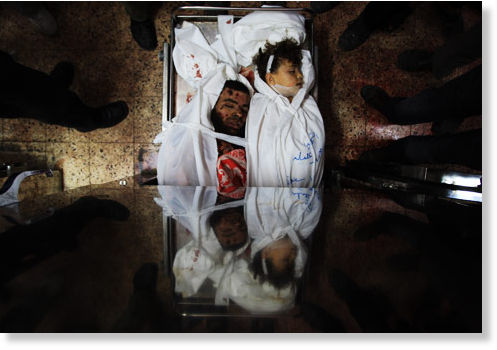
The 2009 massacre in Gaza will be for international solidarity with Palestine what the Sharpeville massacre was for the international solidarity against apartheid in South Africa.
"Where can I bring him a father from? Where can I bring him a mother from? You tell me!"

These are the desperate words of Subhi Samuni to Al-Jazeera's Gaza correspondent. Subhi lost 17 members of his immediate family, including the parents of his seven-year-old grandson. Shockingly, even as I write this article, corpses of the Samuni family are still being retrieved from under the rubble -- 15 days after the Israeli occupation forces shelled the two houses. The Israeli army locked 120 members of the family in one house for 12 hours before they shelled it.

Subhi's words echo the harsh reality of all Palestinians in Gaza: alone, abandoned, hunted down, brutalized, and, like Subhi's grandson, orphaned. Twenty-two days of savage butchery took the lives of more than 1,300 Palestinians, at least 85 percent of them civilians, including 434 children, 104 women, 16 medics, four journalists, five foreigners, and 105 elderly people.

What can one say to comfort a man who has the harrowing task of having to bury his entire family, including his wife, his sons, his daughters and his grandchildren? Tell us and we will relay your words to Uncle Subhi because his loss has made our words of condolences meaningless to our ears.

Think also of words you want to say to 70-year-old Rashid Muhammad, whose 44-year-old son Samir was executed with a single bullet to the heart in front of his wife and children. The Israeli army refused to let an ambulance pick up his corpse for 11 days so his family had to wait for the assault to stop before they could bury him. Rashid had the excruciatingly painful experience of looking at, touching, kissing, and then burying the decomposed body of his son. Tell this family how to make sense of their harsh reality -- say something to make the children sleep, to ease the anguish in the father's heart, to help the wife understand why her husband had to be taken from her.

You might prefer to talk to 14-year-old Amira Qirm, whose house in Gaza City was shelled with artillery and phosphorous bombs -- bombs which burnt to death three members of her immediate family: her father, her 12-year-old brother, Alaa, and her 11-year-old sister, Ismat. Alone, injured and terrified, Amira crawled 500 meters on her knees to a house close by -- it was empty because the family had fled when the Israeli attack began. She stayed there for four days, surviving only on water, and listening to the sounds of the Israeli killing machine all around her, too afraid to cry out in pain in case the soldiers heard her. When the owner of the house returned to get clothes for his family, he found Amira, weak and close to death. She is now being treated for her injuries in the overcrowded and under-resourced al-Shifa Hospital.

You can try to comfort 10-year-old Muhammad Samuni who was found lying next to the bodies of his mother and siblings, five days after they were killed. He would tell you what he has been telling everyone -- that his brother woke suddenly after being asleep for a long time. His brother told him that he was hungry, asked for a tomato to eat and then died. Are there any other 10-year-olds in the world who are asked to carry this experience around with them for the rest of their lives? Of course not -- this "privilege" is reserved just for Palestinian children because they were born on the land that Israel wants for itself. But it is these traumatized children who will deny Israel what it wants because their very survival is a challenge to that apartheid state. It is these same children who will surely inherit Palestine: it is their birthright and no assault can change that fact -- not today, not ever.

And through it all we were subjected to Tzipi Livni, Israel's foreign minister, adamant in her defense of the world's most "moral" army. "We don't target civilians" she lied. "We don't want the Palestinians to leave Gaza. We just want them to move within Gaza itself!" Israeli Prime Minister Ehud Olmert too had something to say to Palestinians in Gaza: "We are not your enemy. Hamas is your enemy."

Amira, Muhammad, Rashid, Subhi and the more than 40,000 families whose houses have been demolished know differently. Those people who rushed to the cemetery after it was bombed and found the body parts of their dead relatives exposed to the elements know differently. They know that they were deliberately targeted because they are Palestinian. All the rest is propaganda to appease the conscience of those with Palestinian blood on their hands -- those who are both inside and outside Israel.

For 22 long days and dark nights, Palestinians in Gaza were left alone to face one of the strongest armies in the world -- an army that has hundreds of nuclear warheads, thousands of trigger-happy soldiers armed with Merkava tanks, F-16s, Apache helicopters, naval gunships and phosphorous bombs. Twenty-two sleepless nights, 528 hours of constant shelling and shooting, every single minute expecting to be the next victim.

During these 22 days, while morgues overflowed and hospitals struggled to treat the injured, Arab regimes issued tons of statements, condemned and denounced and held one meaningless press conference after another. They even held two summits, the first one convened 19 full days after the assault on Gaza began and the second one the day after Israel had declared a unilateral ceasefire!

The official Arab position vis-a-vis the Palestinians since 1948, with the exception of the progressive nationalist era (1954-1970) has been a lethal cocktail of cowardice and hypocrisy. Their latest collective failure to break the two-year old Israeli siege of the Gaza Strip and their lack of action to support Palestinians under brutal military assault must be questioned.

Arabs must demand answers from the spineless Arab League because there was no brotherly solidarity shown to Gazans during the Israeli assault. There was no pan-Arabism evident in their platitudes. Some, shockingly, even found it an appropriate time to blame Palestinians for the situation they found themselves in, instead of demanding that Israel stop its merciless assault.

In Gaza today, we wonder how the expressions of support for us in the streets of Arab capitals can be translated into action in the absence of democracy. We wonder whether Arab citizens of despotic regimes can nonviolently change the system. We torment ourselves with trying to discern the means that are currently available for democratic political change. With the ongoing massacre in Gaza, and the construction of an apartheid system in Palestine (in all of historic Palestine, including the areas occupied by Israel in 1967), we know that to survive, we must have the support and solidarity of our Arab brothers and sisters. We saw the Arab people rise to that challenge and stand by us for 22 days but we did not see their leaders behind them.

Archbishop Desmund Tutu of South Africa said, "If you are neutral in situations of injustice, you have chosen the side of the oppressor." The UN, EU, Arab League and the international community by and large have remained silent in the face of atrocities committed by Apartheid Israel. They are therefore on the side of Israel. Hundreds of dead corpses of children and women have failed to convince them to act. This is what every Palestinian knows today -- whether on the streets of the Gaza Strip, the Tzipi Livnior refugee camps in the Diaspora.

We are, therefore, left with one option; an option that does not wait for the United Nations Security Council, Arab Summits, or Organization of Islamic Conference to convene: the option of people's power. This remains the only power capable of counteracting the massive power imbalance in the Israeli-Palestinian conflict.

The horror of the racist apartheid regime in South Africa was challenged with a sustained campaign of boycott, divestment and sanctions initiated in 1958 and given new urgency in 1960 after the Sharpeville Massacre. This campaign led ultimately to the collapse of white rule in 1994 and the establishment of a multi-racial, democratic state.

Similarly, the Palestinian call for boycott, divestment and sanctions has been gathering momentum since 2005. Gaza 2009, like Sharpeville 1960, cannot be ignored: it demands a response from all who believe in a common humanity. Now is the time to boycott the apartheid Israeli state, to divest and to impose sanctions against it. This is the only way to ensure the creation of a secular, democratic state for all in historic Palestine.

This is the only answer to Uncle Subhi's puzzling questions: it is the only way to give his grandson a future, a life of dignity and equality, a life with both peace and justice, because like all children, he deserves nothing less.

Haidar Eid teaches English literature in Gaza City. He is also a political commentator and activist.