Showing posts with label Intifada. Show all posts

Sunday, June 07, 2009

Auschwitz survivor: "I can identify with Palestinian youth"


Hajo Meyer, author of the book The End of Judaism, was born in Bielefeld, in Germany, in 1924. In 1939, he fled on his own at age 14 to the Netherlands to escape the Nazi regime, and was unable to attend school. A year later, when the Germans occupied the Netherlands he lived in hiding with a poorly forged ID. Meyer was captured by the Gestapo in March 1944 and deported to the Auschwitz concentration camp a week later. He is one of the last survivors of Auschwitz.

Adri Nieuwhof: What would you like to say to introduce yourself to EI's readers?

Hajo Meyer: I had to quit grammar school in Bielefeld after the Kristallnacht [the two-day pogrom against Jews in Nazi Germany], in November 1938. It was a terrible experience for an inquisitive boy and his parents. Therefore, I can fully identify with the Palestinian youth that are hampered in their education. And I can in no way identify with the criminals who make it impossible for Palestinian youth to be educated.

AN: What motivated you to write your book, The End of Judaism?

HM: In the past, the European media have written extensively about extreme right-wing politicians like Joerg Haider in Austria and Jean-Marie Le Pen in France. But when Ariel Sharon was elected [prime minister] in Israel in 2001, the media remained silent. But in the 1980s I understood the deeply fascist thinking of these politicians. With the book I wanted to distance myself from this. I was raised in Judaism with the equality of relationships among human beings as a core value. I only learned about nationalist Judaism when I heard settlers defend their harassment of Palestinians in interviews. When a publisher asked me to write about my past, I decided to write this book, in a way, to deal with my past. People of one group who dehumanize people who belong to another group can do this, because they either have learned to do so from their parents, or they have been brainwashed by their political leaders. This has happened for decades in Israel in that they manipulate the Holocaust for their political aims. In the long-run the country is destructing itself this way by inducing their Jewish citizens to become paranoid. In 2005 [then Prime Minister Ariel] Sharon illustrated this by saying in the Knesset [the Israeli parliament], we know we cannot trust anyone, we only can trust ourselves. This is the shortest possible definition of somebody who suffers from clinical paranoia. One of the major annoyances in my life is that Israel by means of trickery calls itself a Jewish state, while in fact it is Zionist. It wants the maximum territory with a minimum number of Palestinians. I have four Jewish grandparents. I am an atheist. I share the Jewish socio-cultural inheritance and I have learned about Jewish ethics. I don't wish to be represented by a Zionist state. They have no idea about the Holocaust. They use the Holocaust to implant paranoia in their children.

AN: In your book you write about the lessons you have learned from your past. Can you explain how your past influenced your perception of Israel and Palestine?

HM: I have never been a Zionist. After the war, Zionist Jews spoke about the miracle of having "our own country." As a confirmed atheist I thought, if this is a miracle by God, I wished that he had performed the smallest miracle imaginable by creating the state 15 years earlier. Then my parents would not have been dead.

I can write up an endless list of similarities between Nazi Germany and Israel. The capturing of land and property, denying people access to educational opportunities and restricting access to earn a living to destroy their hope, all with the aim to chase people away from their land. And what I personally find more appalling then dirtying one's hands by killing people, is creating circumstances where people start to kill each other. Then the distinction between victims and perpetrators becomes faint. By sowing discord in a situation where there is no unity, by enlarging the gap between people - like Israel is doing in Gaza.

AN: In your book you write about the role of Jews in the peace movement in and outside Israel, and Israeli army refuseniks. How do you value their contribution?

HM: Of course it is positive that parts of the Jewish population of Israel try to see Palestinians as human beings and as their equals. However, it disturbs me how paper-thin the number is that protests and is truly anti-Zionist. We get worked up by what happened in Hitler's Germany. If you expressed only the slightest hint of criticism at that time, you ended up in the Dachau concentration camp. If you expressed criticism, you were dead. Jews in Israel have democratic rights. They can protest in the streets, but they don't.

AN: Can you comment on the news that Israeli ministers approved a draft law banning commemoration of the Nakba, or the dispossession of historic Palestine? The law proposes punishment of up to three years in prison.

HM: It is so racist, so dreadful. I am at a loss for words. It is an expression of what we already know. [The Israeli Nakba commemoration organization] Zochrot was founded to counteract Israeli efforts to wipe out the marks that are a reminder of Palestinian life. To forbid Palestinians to publicly commemorate the Nakba. ... they cannot act in a more Nazi-like, fascist way. Maybe it will help to awaken the world.

AN: What are your plans for the future?

HM: [Laughs] Do you know how old I am? I am almost 85 years old. I always say cynically and with self-mockery that I have a choice: either I am always tired because I want to do so much, or I am going to sit still waiting for the time to go by. Well, I plan to be tired, because I have still so much to say.

Adri Nieuwhof is consultant and human rights advocate based in Switzerland.

Sunday, January 25, 2009

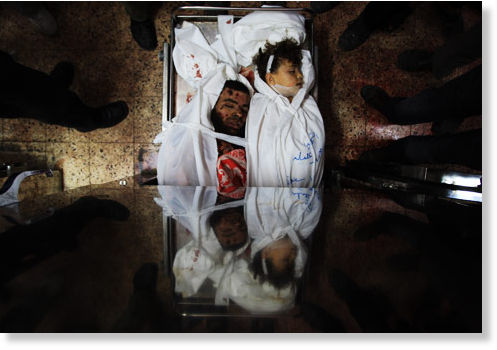
Sharpeville 1960, Gaza 2009

Sharpeville 1960, Gaza 2009
Gaza 2009 to Sharpeville Massacre
© Wissam Nassar/MaanImages


The 2009 massacre in Gaza will be for international solidarity with Palestine what the Sharpeville massacre was for the international solidarity against apartheid in South Africa.
"Where can I bring him a father from? Where can I bring him a mother from? You tell me!"

These are the desperate words of Subhi Samuni to Al-Jazeera's Gaza correspondent. Subhi lost 17 members of his immediate family, including the parents of his seven-year-old grandson. Shockingly, even as I write this article, corpses of the Samuni family are still being retrieved from under the rubble -- 15 days after the Israeli occupation forces shelled the two houses. The Israeli army locked 120 members of the family in one house for 12 hours before they shelled it.

Subhi's words echo the harsh reality of all Palestinians in Gaza: alone, abandoned, hunted down, brutalized, and, like Subhi's grandson, orphaned. Twenty-two days of savage butchery took the lives of more than 1,300 Palestinians, at least 85 percent of them civilians, including 434 children, 104 women, 16 medics, four journalists, five foreigners, and 105 elderly people.

What can one say to comfort a man who has the harrowing task of having to bury his entire family, including his wife, his sons, his daughters and his grandchildren? Tell us and we will relay your words to Uncle Subhi because his loss has made our words of condolences meaningless to our ears.

Think also of words you want to say to 70-year-old Rashid Muhammad, whose 44-year-old son Samir was executed with a single bullet to the heart in front of his wife and children. The Israeli army refused to let an ambulance pick up his corpse for 11 days so his family had to wait for the assault to stop before they could bury him. Rashid had the excruciatingly painful experience of looking at, touching, kissing, and then burying the decomposed body of his son. Tell this family how to make sense of their harsh reality -- say something to make the children sleep, to ease the anguish in the father's heart, to help the wife understand why her husband had to be taken from her.

You might prefer to talk to 14-year-old Amira Qirm, whose house in Gaza City was shelled with artillery and phosphorous bombs -- bombs which burnt to death three members of her immediate family: her father, her 12-year-old brother, Alaa, and her 11-year-old sister, Ismat. Alone, injured and terrified, Amira crawled 500 meters on her knees to a house close by -- it was empty because the family had fled when the Israeli attack began. She stayed there for four days, surviving only on water, and listening to the sounds of the Israeli killing machine all around her, too afraid to cry out in pain in case the soldiers heard her. When the owner of the house returned to get clothes for his family, he found Amira, weak and close to death. She is now being treated for her injuries in the overcrowded and under-resourced al-Shifa Hospital.

You can try to comfort 10-year-old Muhammad Samuni who was found lying next to the bodies of his mother and siblings, five days after they were killed. He would tell you what he has been telling everyone -- that his brother woke suddenly after being asleep for a long time. His brother told him that he was hungry, asked for a tomato to eat and then died. Are there any other 10-year-olds in the world who are asked to carry this experience around with them for the rest of their lives? Of course not -- this "privilege" is reserved just for Palestinian children because they were born on the land that Israel wants for itself. But it is these traumatized children who will deny Israel what it wants because their very survival is a challenge to that apartheid state. It is these same children who will surely inherit Palestine: it is their birthright and no assault can change that fact -- not today, not ever.

And through it all we were subjected to Tzipi Livni, Israel's foreign minister, adamant in her defense of the world's most "moral" army. "We don't target civilians" she lied. "We don't want the Palestinians to leave Gaza. We just want them to move within Gaza itself!" Israeli Prime Minister Ehud Olmert too had something to say to Palestinians in Gaza: "We are not your enemy. Hamas is your enemy."

Amira, Muhammad, Rashid, Subhi and the more than 40,000 families whose houses have been demolished know differently. Those people who rushed to the cemetery after it was bombed and found the body parts of their dead relatives exposed to the elements know differently. They know that they were deliberately targeted because they are Palestinian. All the rest is propaganda to appease the conscience of those with Palestinian blood on their hands -- those who are both inside and outside Israel.

For 22 long days and dark nights, Palestinians in Gaza were left alone to face one of the strongest armies in the world -- an army that has hundreds of nuclear warheads, thousands of trigger-happy soldiers armed with Merkava tanks, F-16s, Apache helicopters, naval gunships and phosphorous bombs. Twenty-two sleepless nights, 528 hours of constant shelling and shooting, every single minute expecting to be the next victim.

During these 22 days, while morgues overflowed and hospitals struggled to treat the injured, Arab regimes issued tons of statements, condemned and denounced and held one meaningless press conference after another. They even held two summits, the first one convened 19 full days after the assault on Gaza began and the second one the day after Israel had declared a unilateral ceasefire!

The official Arab position vis-a-vis the Palestinians since 1948, with the exception of the progressive nationalist era (1954-1970) has been a lethal cocktail of cowardice and hypocrisy. Their latest collective failure to break the two-year old Israeli siege of the Gaza Strip and their lack of action to support Palestinians under brutal military assault must be questioned.

Arabs must demand answers from the spineless Arab League because there was no brotherly solidarity shown to Gazans during the Israeli assault. There was no pan-Arabism evident in their platitudes. Some, shockingly, even found it an appropriate time to blame Palestinians for the situation they found themselves in, instead of demanding that Israel stop its merciless assault.

In Gaza today, we wonder how the expressions of support for us in the streets of Arab capitals can be translated into action in the absence of democracy. We wonder whether Arab citizens of despotic regimes can nonviolently change the system. We torment ourselves with trying to discern the means that are currently available for democratic political change. With the ongoing massacre in Gaza, and the construction of an apartheid system in Palestine (in all of historic Palestine, including the areas occupied by Israel in 1967), we know that to survive, we must have the support and solidarity of our Arab brothers and sisters. We saw the Arab people rise to that challenge and stand by us for 22 days but we did not see their leaders behind them.

Archbishop Desmund Tutu of South Africa said, "If you are neutral in situations of injustice, you have chosen the side of the oppressor." The UN, EU, Arab League and the international community by and large have remained silent in the face of atrocities committed by Apartheid Israel. They are therefore on the side of Israel. Hundreds of dead corpses of children and women have failed to convince them to act. This is what every Palestinian knows today -- whether on the streets of the Gaza Strip, the Tzipi Livnior refugee camps in the Diaspora.

We are, therefore, left with one option; an option that does not wait for the United Nations Security Council, Arab Summits, or Organization of Islamic Conference to convene: the option of people's power. This remains the only power capable of counteracting the massive power imbalance in the Israeli-Palestinian conflict.

The horror of the racist apartheid regime in South Africa was challenged with a sustained campaign of boycott, divestment and sanctions initiated in 1958 and given new urgency in 1960 after the Sharpeville Massacre. This campaign led ultimately to the collapse of white rule in 1994 and the establishment of a multi-racial, democratic state.

Similarly, the Palestinian call for boycott, divestment and sanctions has been gathering momentum since 2005. Gaza 2009, like Sharpeville 1960, cannot be ignored: it demands a response from all who believe in a common humanity. Now is the time to boycott the apartheid Israeli state, to divest and to impose sanctions against it. This is the only way to ensure the creation of a secular, democratic state for all in historic Palestine.

This is the only answer to Uncle Subhi's puzzling questions: it is the only way to give his grandson a future, a life of dignity and equality, a life with both peace and justice, because like all children, he deserves nothing less.

Haidar Eid teaches English literature in Gaza City. He is also a political commentator and activist.

Monday, October 22, 2007

More on the "Most Ethical Army in the World"

Don't say you didn't know. Without news services like SOTT and Haartz we never would. They shine the light on the darkness most want to avoid.

Blue Ibis
Warning: descriptions of graphic violence against women and children follow.

***********************************************
Israel shaken by psychopathic troops' tales of brutality against Palestinian civilians

Conal Urquhart
The Guardian
Sun, 21 Oct 2007 07:26 EDT

The soldiers described dozens of incidents of extreme violence. One recalled an incident when a Palestinian was shot for no reason and left on the street. 'We were in a weapons carrier when this guy, around 25, passed by in the street and, just like that, for no reason - he didn't throw a stone, did nothing - bang, a bullet in the stomach, he shot him in the stomach and the guy is dying on the pavement and we keep going, apathetic. No one gave him a second look,' he said.

One soldier recalled: 'After two months in Rafah, a [new] commanding officer arrived... So we do a first patrol with him. It's 6am, Rafah is under curfew, there isn't so much as a dog in the streets. Only a little boy of four playing in the sand. He is building a castle in his yard. He [the officer] suddenly starts running and we all run with him. He was from the combat engineers.

'He grabbed the boy. I am a degenerate if I am not telling you the truth. He broke his hand here at the wrist, broke his leg here. And started to stomp on his stomach, three times, and left. We are all there, jaws dropping, looking at him in shock...

'The next day I go out with him on another patrol, and the soldiers are already starting to do the same thing."

A study by an Israeli psychologist into the violent behaviour of the country's soldiers is provoking bitter controversy and has awakened urgent questions about the way the army conducts itself in the Gaza Strip and West Bank.

Nufar Yishai-Karin, a clinical psychologist at the Hebrew University in Jerusalem, interviewed 21 Israeli soldiers and heard confessions of frequent brutal assaults against Palestinians, aggravated by poor training and discipline. In her recently published report, co-authored by Professor Yoel Elizur, Yishai-Karin details a series of violent incidents, including the beating of a four-year-old boy by an officer.

The report, although dealing with the experience of soldiers in the 1990s, has triggered an impassioned debate in Israel, where it was published in an abbreviated form in the newspaper Haaretz last month. According to Yishai Karin: 'At one point or another of their service, the majority of the interviewees enjoyed violence. They enjoyed the violence because it broke the routine and they liked the destruction and the chaos. They also enjoyed the feeling of power in the violence and the sense of danger.'

In the words of one soldier:'The truth? When there is chaos, I like it. That's when I enjoy it. It's like a drug. If I don't go into Rafah, and if there isn't some kind of riot once in some weeks, I go nuts.'

Another explained: 'The most important thing is that it removes the burden of the law from you. You feel that you are the law. You are the law. You are the one who decides... As though from the moment you leave the place that is called Eretz Yisrael [the Land of Israel] and go through the Erez checkpoint into the Gaza Strip, you are the law. You are God.'

The soldiers described dozens of incidents of extreme violence. One recalled an incident when a Palestinian was shot for no reason and left on the street. 'We were in a weapons carrier when this guy, around 25, passed by in the street and, just like that, for no reason - he didn't throw a stone, did nothing - bang, a bullet in the stomach, he shot him in the stomach and the guy is dying on the pavement and we keep going, apathetic. No one gave him a second look,' he said.

The soldiers developed a mentality in which they would use physical violence to deter Palestinians from abusing them. One described beating women. 'With women I have no problem. With women, one threw a clog at me and I kicked her here [pointing to the crotch], I broke everything there. She can't have children. Next time she won't throw clogs at me. When one of them [a woman] spat at me, I gave her the rifle butt in the face. She doesn't have what to spit with any more.'

Yishai-Karin found that the soldiers were exposed to violence against Palestinians from as early as their first weeks of basic training. On one occasion, the soldiers were escorting some arrested Palestinians. The arrested men were made to sit on the floor of the bus. They had been taken from their beds and were barely clothed, even though the temperature was below zero. The new recruits trampled on the Palestinians and then proceeded to beat them for the whole of the journey. They opened the bus windows and poured water on the arrested men.

The disclosure of the report in the Israeli media has occasioned a remarkable response. In letters responding to the recollections, writers have focused on both the present and past experience of Israeli soldiers to ask troubling questions that have probed the legitimacy of the actions of the Israeli Defence Forces.

The study and the reactions to it have marked a sharp change in the way Israelis regard their period of military service - particularly in the occupied territories - which has been reflected in the increasing levels of conscientious objection and draft-dodging.

The debate has contrasted sharply with an Israeli army where new recruits are taught that they are joining 'the most ethical army in the world' - a refrain that is echoed throughout Israeli society. In its doctrine, published on its website, the Israeli army emphasises human dignity. 'The Israeli army and its soldiers are obligated to protect human dignity. Every human being is of value regardless of his or her origin, religion, nationality, gender, status or position.'

However, the Israeli army, like other armies, has found it difficult to maintain these values beyond the classroom. The first intifada, which began in 1987, before the wave of suicide bombings, was markedly different to the violence of the second intifada, and its main events were popular demonstrations with stone-throwing.

Yishai-Karin, in an interview with Haaretz, described how her research came out of her own experience as a soldier at an army base in Rafah in the Gaza Strip. She interviewed 18 ordinary soldiers and three officers whom she had served with in Gaza. The soldiers described how the violence was encouraged by some commanders. One soldier recalled: 'After two months in Rafah, a [new] commanding officer arrived... So we do a first patrol with him. It's 6am, Rafah is under curfew, there isn't so much as a dog in the streets. Only a little boy of four playing in the sand. He is building a castle in his yard. He [the officer] suddenly starts running and we all run with him. He was from the combat engineers.

'He grabbed the boy. I am a degenerate if I am not telling you the truth. He broke his hand here at the wrist, broke his leg here. And started to stomp on his stomach, three times, and left. We are all there, jaws dropping, looking at him in shock...

'The next day I go out with him on another patrol, and the soldiers are already starting to do the same thing."

Yishai-Karin concluded that the main reason for the soldiers' violence was a lack of training. She found that the soldiers did not know what was expected of them and therefore were free to develop their own way of behaviour. The longer a unit was left in the field, the more violent it became. The Israeli soldiers, she concluded, had a level of violence which is universal across all nations and cultures. If they are allowed to operate in difficult circumstances, such as in Gaza and the West Bank, without training and proper supervision, the violence is bound to come out.

Comment: Spare us these patronizing apologetics. One doesn't break the wrists and legs of 4 year-olds or kick a woman in the crotch for "lack of training". The soldiers and the leaders who sent them into these positions are psychopathic monsters.

A spokeswoman for the Israeli army said that, if a soldier deviates from the army's norms, they could be investigated by the military police or face criminal investigation.

Comment: Where they will be duly exonerated.

She said: 'It should be noted that since the events described in Nufar Yishai-Karin's research the number of ethical violations by IDF soldiers involving the Palestinian population has consistently dropped. This trend has continued in the last few years.'

Comment: It should be noted that the examples given above are but a drop in the ocean of humiliation, abuse and murder that the Palestinian people have been subjected to before, during and since the illegal foundation of the corrupt state of Israel and the Zionist regime that occupies Palestinian land.

The addition of "Palestinian suicide bombings" in the second Intifada is used to excuse such inhuman behavior by Israeli troops and their commanding officers. The truth of the matter however is that "Palestinian suicide bombings" are very probably Israeli false flag operations, designed to provide justification to Israel for its continued murder of Palestinian civilians and the theft of what is left of their land.