Showing posts with label Apartheid Wall. Show all posts

Tuesday, July 28, 2009

Cellcom: Fantasy and Truth

Palestinians answer back to racist ad with truth


Pro-Palestinian protesters have made their own version of a controversial Israeli mobile phone advert.

The Cellcom ad, widely criticised for bad taste, shows troops enjoying a game of football with unseen Palestinians on the other side of a high concrete wall.

At protests against Israel's West Bank barrier, activists filmed themselves kicking a ball to Israeli troops.

The video footage shows their gesture being met with tear gas canisters and their ball left trapped in barbed wire.

The Cellcom advert, which first aired earlier in July, opens with a football landing on the bonnet of an Israeli military vehicle patrolling along the West Bank separation barrier.

After initial apprehension, one of the soldiers kicks the ball back over the high wall and seconds later it comes flying over once again.

Seeing the opportunity for an impromptu kick-about, the troops call in reinforcements, more jeeps arrive and everyone enjoys themselves with an upbeat tune playing in the background.

"After all, what are we all after? Just a little fun," says the voiceover.

The advert was derided by critics for trivialising the fraught issue of the separation barrier and portraying the Palestinians as an invisible other.


Abdullah Abu Rahme, a leader of the weekly protest in the frontline village of , said their video - which uses the same sound track as Cellcom - was to show "we are here, we are suffering, this wall killed our life".

"We threw the football to the soldiers, but they sent tear gas and stinking water back at us."

Israeli Arab politicians have already called for the Cellcom advert to be removed from their airwaves.

"The barrier separates families and prevents children from reaching schools and clinics," Ahmed Tibi told Reuters news agency.

"Yet the advertisement presents the barrier as though it were just a garden fence in Tel Aviv."

Cellcom has said its "core value is communication between people" regardless of "religion, race or gender".

The advertisement illustrates the possibility of "mutual entertainment" for people of diverse opinions, it said.

Deadly fire

Bilin protesters - who include local Palestinians, Israeli activists and internationals - say they are non-violent. The Israeli military says the protests are "unauthorised", that stones and Molotov cocktails are often thrown and Israeli security infrastructure damaged.

Israeli forces frequently disperse protesters with tear gas, rubber-coated steel bullets and a foul-smelling liquid spray.

Six protesters have died from Israeli fire in Bilin and nearby Naalin in recent years, with two killed in recent months.

Israel began building the West Bank barrier - part wall, part metal fence - in 2002. It said it was to stop suicide bombers, but Palestinians see the structure as a land grab.

The barrier's route has been widely criticised internationally for looping into Palestinian areas around Israeli settlements, rather than following the Green Line, which marks the boundary that separates Israel from the West Bank.

International Court of Justice ruled in 2004 that the barrier is illegal where it cuts into the West Bank and called for it to be pulled down.

A spokeswoman for Cellcom said it was just a coincidence that the advert was aired the same week as the fifth anniversary of the advisory verdict.

Sunday, January 25, 2009

Sharpeville 1960, Gaza 2009

Sharpeville 1960, Gaza 2009
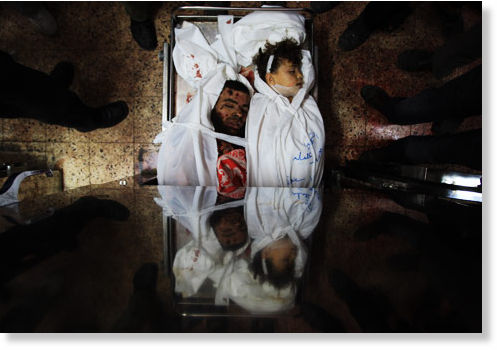
Gaza 2009 to Sharpeville Massacre
© Wissam Nassar/MaanImages


The 2009 massacre in Gaza will be for international solidarity with Palestine what the Sharpeville massacre was for the international solidarity against apartheid in South Africa.
"Where can I bring him a father from? Where can I bring him a mother from? You tell me!"

These are the desperate words of Subhi Samuni to Al-Jazeera's Gaza correspondent. Subhi lost 17 members of his immediate family, including the parents of his seven-year-old grandson. Shockingly, even as I write this article, corpses of the Samuni family are still being retrieved from under the rubble -- 15 days after the Israeli occupation forces shelled the two houses. The Israeli army locked 120 members of the family in one house for 12 hours before they shelled it.

Subhi's words echo the harsh reality of all Palestinians in Gaza: alone, abandoned, hunted down, brutalized, and, like Subhi's grandson, orphaned. Twenty-two days of savage butchery took the lives of more than 1,300 Palestinians, at least 85 percent of them civilians, including 434 children, 104 women, 16 medics, four journalists, five foreigners, and 105 elderly people.

What can one say to comfort a man who has the harrowing task of having to bury his entire family, including his wife, his sons, his daughters and his grandchildren? Tell us and we will relay your words to Uncle Subhi because his loss has made our words of condolences meaningless to our ears.

Think also of words you want to say to 70-year-old Rashid Muhammad, whose 44-year-old son Samir was executed with a single bullet to the heart in front of his wife and children. The Israeli army refused to let an ambulance pick up his corpse for 11 days so his family had to wait for the assault to stop before they could bury him. Rashid had the excruciatingly painful experience of looking at, touching, kissing, and then burying the decomposed body of his son. Tell this family how to make sense of their harsh reality -- say something to make the children sleep, to ease the anguish in the father's heart, to help the wife understand why her husband had to be taken from her.

You might prefer to talk to 14-year-old Amira Qirm, whose house in Gaza City was shelled with artillery and phosphorous bombs -- bombs which burnt to death three members of her immediate family: her father, her 12-year-old brother, Alaa, and her 11-year-old sister, Ismat. Alone, injured and terrified, Amira crawled 500 meters on her knees to a house close by -- it was empty because the family had fled when the Israeli attack began. She stayed there for four days, surviving only on water, and listening to the sounds of the Israeli killing machine all around her, too afraid to cry out in pain in case the soldiers heard her. When the owner of the house returned to get clothes for his family, he found Amira, weak and close to death. She is now being treated for her injuries in the overcrowded and under-resourced al-Shifa Hospital.

You can try to comfort 10-year-old Muhammad Samuni who was found lying next to the bodies of his mother and siblings, five days after they were killed. He would tell you what he has been telling everyone -- that his brother woke suddenly after being asleep for a long time. His brother told him that he was hungry, asked for a tomato to eat and then died. Are there any other 10-year-olds in the world who are asked to carry this experience around with them for the rest of their lives? Of course not -- this "privilege" is reserved just for Palestinian children because they were born on the land that Israel wants for itself. But it is these traumatized children who will deny Israel what it wants because their very survival is a challenge to that apartheid state. It is these same children who will surely inherit Palestine: it is their birthright and no assault can change that fact -- not today, not ever.

And through it all we were subjected to Tzipi Livni, Israel's foreign minister, adamant in her defense of the world's most "moral" army. "We don't target civilians" she lied. "We don't want the Palestinians to leave Gaza. We just want them to move within Gaza itself!" Israeli Prime Minister Ehud Olmert too had something to say to Palestinians in Gaza: "We are not your enemy. Hamas is your enemy."

Amira, Muhammad, Rashid, Subhi and the more than 40,000 families whose houses have been demolished know differently. Those people who rushed to the cemetery after it was bombed and found the body parts of their dead relatives exposed to the elements know differently. They know that they were deliberately targeted because they are Palestinian. All the rest is propaganda to appease the conscience of those with Palestinian blood on their hands -- those who are both inside and outside Israel.

For 22 long days and dark nights, Palestinians in Gaza were left alone to face one of the strongest armies in the world -- an army that has hundreds of nuclear warheads, thousands of trigger-happy soldiers armed with Merkava tanks, F-16s, Apache helicopters, naval gunships and phosphorous bombs. Twenty-two sleepless nights, 528 hours of constant shelling and shooting, every single minute expecting to be the next victim.

During these 22 days, while morgues overflowed and hospitals struggled to treat the injured, Arab regimes issued tons of statements, condemned and denounced and held one meaningless press conference after another. They even held two summits, the first one convened 19 full days after the assault on Gaza began and the second one the day after Israel had declared a unilateral ceasefire!

The official Arab position vis-a-vis the Palestinians since 1948, with the exception of the progressive nationalist era (1954-1970) has been a lethal cocktail of cowardice and hypocrisy. Their latest collective failure to break the two-year old Israeli siege of the Gaza Strip and their lack of action to support Palestinians under brutal military assault must be questioned.

Arabs must demand answers from the spineless Arab League because there was no brotherly solidarity shown to Gazans during the Israeli assault. There was no pan-Arabism evident in their platitudes. Some, shockingly, even found it an appropriate time to blame Palestinians for the situation they found themselves in, instead of demanding that Israel stop its merciless assault.

In Gaza today, we wonder how the expressions of support for us in the streets of Arab capitals can be translated into action in the absence of democracy. We wonder whether Arab citizens of despotic regimes can nonviolently change the system. We torment ourselves with trying to discern the means that are currently available for democratic political change. With the ongoing massacre in Gaza, and the construction of an apartheid system in Palestine (in all of historic Palestine, including the areas occupied by Israel in 1967), we know that to survive, we must have the support and solidarity of our Arab brothers and sisters. We saw the Arab people rise to that challenge and stand by us for 22 days but we did not see their leaders behind them.

Archbishop Desmund Tutu of South Africa said, "If you are neutral in situations of injustice, you have chosen the side of the oppressor." The UN, EU, Arab League and the international community by and large have remained silent in the face of atrocities committed by Apartheid Israel. They are therefore on the side of Israel. Hundreds of dead corpses of children and women have failed to convince them to act. This is what every Palestinian knows today -- whether on the streets of the Gaza Strip, the Tzipi Livnior refugee camps in the Diaspora.

We are, therefore, left with one option; an option that does not wait for the United Nations Security Council, Arab Summits, or Organization of Islamic Conference to convene: the option of people's power. This remains the only power capable of counteracting the massive power imbalance in the Israeli-Palestinian conflict.

The horror of the racist apartheid regime in South Africa was challenged with a sustained campaign of boycott, divestment and sanctions initiated in 1958 and given new urgency in 1960 after the Sharpeville Massacre. This campaign led ultimately to the collapse of white rule in 1994 and the establishment of a multi-racial, democratic state.

Similarly, the Palestinian call for boycott, divestment and sanctions has been gathering momentum since 2005. Gaza 2009, like Sharpeville 1960, cannot be ignored: it demands a response from all who believe in a common humanity. Now is the time to boycott the apartheid Israeli state, to divest and to impose sanctions against it. This is the only way to ensure the creation of a secular, democratic state for all in historic Palestine.

This is the only answer to Uncle Subhi's puzzling questions: it is the only way to give his grandson a future, a life of dignity and equality, a life with both peace and justice, because like all children, he deserves nothing less.

Haidar Eid teaches English literature in Gaza City. He is also a political commentator and activist.

Tuesday, September 02, 2008

Terrorism: Israeli army targets family over brutality film

Truly, no good deed seems to go unpunished. Especially when it is the act of exposing the inhumanity of a pschopathic system.

Blue Ibis
*****************************************************

Jonathan Cook
The National
Mon, 01 Sep 2008 18:52 EDT

Salam Amira
©Jonathan Cook / The National
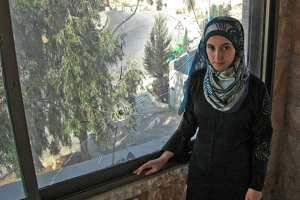
Salam Amira stands by the window where she filmed a bound and blindfolded Palestinian being shot by an Israeli soldier. The roadblock is seen at a distance.


Nilin, West Bank - The window through which Salam Amira, 16, filmed the moment when an Israeli soldier shot from close range a handcuffed and blindfolded Palestinian detainee has a large hole at its centre with cracks running in every direction.

"Since my video was shown, the soldiers shoot at our house all the time," she said. The shattered and cracked windows at the front of the building confirm her story. "When we leave the windows open, they fire tear gas inside too."

Her home looks out over the Israeli road block guarding the only entrance to the village of Nilin, located just inside the West Bank midway between Jerusalem and Tel Aviv. It was here that a bound Ashraf Abu Rahma, 27, was shot in the foot in July with a rubber bullet under orders from an Israeli regiment commander.

The treatment of the family stands in stark contrast to the leniency shown to the soldier and his commander involved in that incident.

B'Tselem, an Israeli human rights group, has accused the Israeli army of seeking "revenge" for the girl's role in exposing the actions of its armed forces in the West Bank.

It may also be hoping to dissuade other families from airing similar evidence of army brutality, particularly since B'Tselem began distributing dozens of video cameras to Palestinians across the West Bank.

Scenes captured on film of hooded settlers attacking Palestinian farmers near Hebron came as a shock to many early this summer.

The village of Nilin has been the focus of the Israeli army's actions since May, when its 4,700 inhabitants began a campaign of mainly non-violent demonstrations to halt the building of Israel's separation wall across their land.

After the wall is completed, the village will be cut off from 40 per cent of its remaining farmland, effectively annexing it to half a dozen large Jewish settlements that encircle Nilin. The settlements are all illegal under international law.

Several times a week the villagers, joined by small numbers of Israeli and international supporters, congregate in olive fields where bulldozers are tearing up the land to make way for the wall.

The people of Nilin have tried various non-violent forms of protest, including praying in the path of the heavy machinery, using mirrors to reflect sunlight at the construction workers, banging pots and pans and placing rocks in the way of the bulldozers during the night.

The army has responded with tear gas and stun grenades, as well as on occasion, with rubber bullets and live ammunition. Last month it was reported that Israel was also experimenting with a new crowd dispersal method called "skunk", which involves firing a foul-smelling liquid at demonstrators.

In the past few weeks, two youngsters have been shot dead by the army, including one, Ahmed Moussa, who was 10. The army claimed he was throwing stones. An autopsy showed he was hit in the head by a bullet from an M-16 rifle.

Comment: What justification? What other place on earth justifies shooting 10 year old children in the head for throwing stones? What type of being is it capable of committing such an act, if not a psychopath?

Yesterday, a soldier fired from close range three rubber bullets at Awad Surur, a mentally disabled man, as he tried to prevent his brother from being arrested. Two bullets penetrated his skull, according to B'Tselem, which denounced the army as increasingly "trigger-happy" and "reckless".

Salam's family, like many other villagers, bear the injuries from attendance at protests. Most of her five brothers have been hit by rubber bullets, as has her father, Jamal Amira, 53. The army has sealed the village off on several occasions and, according to villagers, beaten and terrorised inhabitants.

Mr Amira is among at least 100 farmers whose livelihoods will be devastated by the wall. He will lose all 14 hectares of his land, fields on which his ancestors have made their living by growing olives, cucumbers, aubergine and tomatoes.

But Salam's five-minute film of the roadblock incident, taken during a four-day curfew imposed on the village, has only intensified the family's troubles.

Three days after the video was aired, the army arrested her father during a peaceful protest.

He was the only one seized after the army claimed the demonstrators had entered a closed military zone. Mr Amira was also charged with assaulting a soldier.

He was held for three and a half weeks before an Israeli military judge rejected the army's demand that he be remanded for a further three months until his trial.

In an almost unprecedented rebuke to the prosecution, the judge questioned the army's case, saying he could see no evidence of an assault. He also asked why Salam's father was singled out from all of those protesting.

Mr Amira's lawyer, Gabi Laski, said the decision confirmed "our preliminary claim that the arrest was out of vengeance and punishment for the video filmed by the girl".

Nonetheless, Mr Amira still faces a military trial. A report last year by Yesh Din, a human rights group, found that in only 0.25 per cent of cases heard by military tribunals was the defendant found innocent. Even if acquitted, Mr Amira is expected to face legal costs amounting to nearly US$10,000 (Dh36,700), a sum the family says it cannot pay.

In contrast, the two soldiers responsible for the shooting of the detainee at the roadblock have been reprimanded with the minor charge of "unbecoming conduct". Neither will stand criminal trial. B'Tselem has called the decision "shameful".

According to the legal group, the Association of Civil Rights in Israel, the punishment under Israeli law for aggravated abuse of a detainee is seven years imprisonment. ACRI's lawyers have submitted a petition arguing the lenient charge "transmits to officers and other soldiers an extremely grave message of contempt for human life".

Lt Col Omri Borberg, the commander who gave the order to shoot Abu Rahma, resigned his post but was immediately moved sideways to a senior post in a different unit. In a show of support, Gabi Ashkenazi, the head of the army, said Lt Col Borberg may be reinstated to a command position.

Meanwhile, the villagers said the army's behaviour would not dissuade them from protesting or cause them to renounce their commitment to non-violence.

Salah Hawaja, a protest organiser, said: "When we started our demonstrations, maybe 50 soldiers showed up. Now there are hundreds stationed permanently around us. Israel is treating us like a major war zone, even though we are using non-violence.

"The people of Nilin have accepted that the best strategy to stop Israel's plans to steal our land and leave us inside a ghetto is non-violence," said Mr Hawaja.

"We need to show the world who is the occupier and who the occupied. Israel understands how threatening this is, which is why it is using so much force against us."