Showing posts with label B'Tselem. Show all posts

Wednesday, May 27, 2009

Time for US to stop fueling the conflict

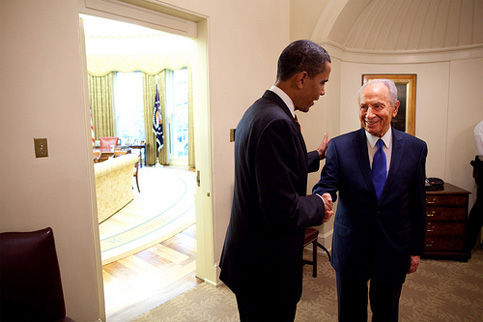
Obama Peres
© Pete Souza/White House Photo
Seen in the Oval Office with Israeli President Shimon Peres in May 2009, US President Barack Obama requested $2.775 billion in military aid to Israel

In pledging to trim ineffective spending, US President Obama declared that "there will be no sacred cows and no pet projects. All across America, families are making hard choices, and it's time their government did the same."

By asking earlier this month for $2.775 billion in military aid to Israel in his FY2010 budget request, it would seem that on this important policy issue President Obama's commitment is more rhetorical than substantive. Since 1949, according to the Congressional Research Service, the United States has provided to Israel more than $100 billion in military and economic assistance. In 2007, the US and Israel signed an agreement for $30 billion in additional military aid through FY2018.

Yet the provision of US weapons to Israel at taxpayer expense has done nothing to bring Israelis and Palestinians closer to achieving a just and lasting peace. Rather, these weapons have had the exact opposite effect, as documented recently by Amnesty International, which pointed to US weapons as a prime factor "fueling" the Israeli-Palestinian conflict.

According to the Israeli human rights group B'Tselem and the Palestinian Centre for Human Rights, during the Bush Administration, Israel killed more than 3,000 innocent Palestinian civilians, including more than 1,000 children. During its December 2008-January 2009 war on the occupied Gaza Strip alone, Israel killed nearly 1,200 non-combatants.

On average, for each day that President Bush sat in the Oval Office, Israel killed one Palestinian civilian, often with US weapons. Before Congress appropriates any additional military aid to Israel, it should insist upon President Obama providing a comprehensive and transparent review of the effects US weapons transfers to Israel have on Palestinian civilians. The Arms Export Control Act limits the use of US weapons given to a foreign country to "internal security" and "legitimate self-defense."

If, after reviewing the impact of Israel's misuse of US weapons, the President and Congress cannot find the political will to sanction Israel for its violations of the Arms Export Control Act and prohibit future arms transfers as is required by law, then there are still steps that the US government should take to ensure that any future transfers are not used to commit human rights abuses but instead to promote US policy goals. For example, previous US loan guarantees to Israel have stipulated that funds cannot be used to support Israeli activities in the Occupied Palestinian Territories. Conditioning US military aid to Israel in the same way would prevent these weapons from being used to kill innocent Palestinian civilians.

As President Obama has stated, "We can't sustain a system that bleeds billions of taxpayer dollars, on programs that have outlived their usefulness or exist solely because of the power of politicians, lobbyists or interest groups. We simply can't afford it." In regard to US aid to Israel, this is true as much from a budgetary standpoint as it is from a moral one.

Josh Ruebner is the National Advocacy Director of the US Campaign to End the Israeli Occupation. This essay was originally published by the Detroit Free Press.

Thursday, February 26, 2009

Human Rights Watch: If Israel has nothing to hide, let us into Gaza

Sounds reasonable to me.

Blue Ibis
***********************************************************************

Israel is preventing independent human rights monitors from entering Gaza, Human Rights Watch and B'Tselem said Sunday.

"Israel continues to obstruct independent investigations into allegations of laws of war violations by the Israel Defense Forces (IDF) and Hamas military forces in Gaza," the groups said in a joint statement to Ma'an.

After submitting applications for permission to enter via the Erez crossing in January 2009, the groups faced continued delays from the military unit reviewing the applications. In February, the army told Human Rights Watch that it had rejected its application. The Israeli military denied B'Tselem's first request to enter Gaza and has failed to respond to a second.

"Israel's refusal to allow human rights groups access to Gaza raises a strong suspicion that there are things it doesn't want us to see or the world to know about its military operation there," said Sarah Leah Whitson, Middle East director at Human Rights Watch. "If Israel has nothing to hide, why is it refusing to allow us in?"

Human Rights Watch requested permission to enter Gaza on 5 January. After weeks of delay, the military rejected the application on 9 February, on the grounds that Human Rights Watch "was not registered with the [Israeli] Ministry of Social Affairs." On all previous occasions, including several times in 2008, Israeli authorities permitted Human Rights Watch staff to enter and leave Gaza via the Erez crossing.

The army never previously suggested such a requirement for access to Gaza, and Human Rights Watch is not aware of any such Israeli law or regulation. The Israeli military has not responded to Human Rights Watch's requests for clarification, they said.

Israel does not allow Jewish citizens of Israel, other than security forces, to enter Gaza on the grounds that their security would be at risk. B'Tselem, the Israeli Information Center for Human Rights in the Occupied Territories, on 20 January requested permission from the military to allow the organization's fieldwork director (a Palestinian citizen of Israel) to enter Gaza. The military refused the request nine days later.

B'Tselem submitted an additional request on 29 January for entry for three staff members and an international consultant. The Israeli military has not responded to this request.

Human Rights Watch and other international human rights groups were able to enter Gaza via Egypt in late January to carry out initial investigations. The international researchers left Gaza just before 5 February, when Egypt had announced it would close the Rafah crossing.

The army had told Human Rights Watch that because its researchers had entered Gaza through Rafah, they would not permit the researchers to exit through Erez.

B'Tselem has not managed to gain access for its Israeli or West Bank staff, or for international consultants. Only the organization's two field researchers, who are residents of the Gaza Strip, have been able to conduct research on the ground, they said.

"Israel puts itself in the same league as Burma, North Korea, and Syria in keeping out independent human rights monitors," said Jessica Montell, executive director of B'Tselem. "The people of Israel deserve to know the truth about the conduct of our forces in Gaza. It is also in Israel's best interest that the full picture comes out."

The army prevented journalists from entering Gaza during the 22-day military operation, called "Operation Cast Lead," even after an Israeli Supreme Court ruling on 2 January ordered the state to allow entry to members of the Foreign Press Association.

Since the escalation of fighting in Gaza on 27 December, 2008, both Human Rights Watch and B'Tselem have documented serious violations of international humanitarian law by Israel and Hamas. On 10 January, Human Rights Watch exposed Israel's unlawful use of white phosphorus in civilian areas, an allegation the army initially denied but now claims to be investigating.

B'Tselem has expressed grave concern over violations of the principles of proportionality and distinction, including the deliberate targeting of civilian installations, such as government ministries and the Palestinian Legislative Council. Both organizations have, for over two decades, documented violations of international human rights and humanitarian law in Israel and the occupied Palestinian territories.

Article Six of the Human Rights Defenders Declaration ensures that everyone has the right, individually and in association with others, "to know, seek, obtain, receive, and hold information about all human rights and fundamental freedoms," B'Tselem noted.

In addition, "the apparent blanket denial of access to Gaza by human rights groups violates the right to freedom of movement," B'Tselem said. "Although human rights law permits restrictions on freedom of movement for security reasons, the restrictions must have a clear legal basis, be limited to what is necessary, and be proportionate to the threat."

Tuesday, September 02, 2008

Terrorism: Israeli army targets family over brutality film

Truly, no good deed seems to go unpunished. Especially when it is the act of exposing the inhumanity of a pschopathic system.

Blue Ibis
*****************************************************

Jonathan Cook
The National
Mon, 01 Sep 2008 18:52 EDT

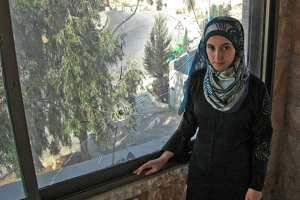
Salam Amira
©Jonathan Cook / The National
Salam Amira stands by the window where she filmed a bound and blindfolded Palestinian being shot by an Israeli soldier. The roadblock is seen at a distance.


Nilin, West Bank - The window through which Salam Amira, 16, filmed the moment when an Israeli soldier shot from close range a handcuffed and blindfolded Palestinian detainee has a large hole at its centre with cracks running in every direction.

"Since my video was shown, the soldiers shoot at our house all the time," she said. The shattered and cracked windows at the front of the building confirm her story. "When we leave the windows open, they fire tear gas inside too."

Her home looks out over the Israeli road block guarding the only entrance to the village of Nilin, located just inside the West Bank midway between Jerusalem and Tel Aviv. It was here that a bound Ashraf Abu Rahma, 27, was shot in the foot in July with a rubber bullet under orders from an Israeli regiment commander.

The treatment of the family stands in stark contrast to the leniency shown to the soldier and his commander involved in that incident.

B'Tselem, an Israeli human rights group, has accused the Israeli army of seeking "revenge" for the girl's role in exposing the actions of its armed forces in the West Bank.

It may also be hoping to dissuade other families from airing similar evidence of army brutality, particularly since B'Tselem began distributing dozens of video cameras to Palestinians across the West Bank.

Scenes captured on film of hooded settlers attacking Palestinian farmers near Hebron came as a shock to many early this summer.

The village of Nilin has been the focus of the Israeli army's actions since May, when its 4,700 inhabitants began a campaign of mainly non-violent demonstrations to halt the building of Israel's separation wall across their land.

After the wall is completed, the village will be cut off from 40 per cent of its remaining farmland, effectively annexing it to half a dozen large Jewish settlements that encircle Nilin. The settlements are all illegal under international law.

Several times a week the villagers, joined by small numbers of Israeli and international supporters, congregate in olive fields where bulldozers are tearing up the land to make way for the wall.

The people of Nilin have tried various non-violent forms of protest, including praying in the path of the heavy machinery, using mirrors to reflect sunlight at the construction workers, banging pots and pans and placing rocks in the way of the bulldozers during the night.

The army has responded with tear gas and stun grenades, as well as on occasion, with rubber bullets and live ammunition. Last month it was reported that Israel was also experimenting with a new crowd dispersal method called "skunk", which involves firing a foul-smelling liquid at demonstrators.

In the past few weeks, two youngsters have been shot dead by the army, including one, Ahmed Moussa, who was 10. The army claimed he was throwing stones. An autopsy showed he was hit in the head by a bullet from an M-16 rifle.

Comment: What justification? What other place on earth justifies shooting 10 year old children in the head for throwing stones? What type of being is it capable of committing such an act, if not a psychopath?

Yesterday, a soldier fired from close range three rubber bullets at Awad Surur, a mentally disabled man, as he tried to prevent his brother from being arrested. Two bullets penetrated his skull, according to B'Tselem, which denounced the army as increasingly "trigger-happy" and "reckless".

Salam's family, like many other villagers, bear the injuries from attendance at protests. Most of her five brothers have been hit by rubber bullets, as has her father, Jamal Amira, 53. The army has sealed the village off on several occasions and, according to villagers, beaten and terrorised inhabitants.

Mr Amira is among at least 100 farmers whose livelihoods will be devastated by the wall. He will lose all 14 hectares of his land, fields on which his ancestors have made their living by growing olives, cucumbers, aubergine and tomatoes.

But Salam's five-minute film of the roadblock incident, taken during a four-day curfew imposed on the village, has only intensified the family's troubles.

Three days after the video was aired, the army arrested her father during a peaceful protest.

He was the only one seized after the army claimed the demonstrators had entered a closed military zone. Mr Amira was also charged with assaulting a soldier.

He was held for three and a half weeks before an Israeli military judge rejected the army's demand that he be remanded for a further three months until his trial.

In an almost unprecedented rebuke to the prosecution, the judge questioned the army's case, saying he could see no evidence of an assault. He also asked why Salam's father was singled out from all of those protesting.

Mr Amira's lawyer, Gabi Laski, said the decision confirmed "our preliminary claim that the arrest was out of vengeance and punishment for the video filmed by the girl".

Nonetheless, Mr Amira still faces a military trial. A report last year by Yesh Din, a human rights group, found that in only 0.25 per cent of cases heard by military tribunals was the defendant found innocent. Even if acquitted, Mr Amira is expected to face legal costs amounting to nearly US$10,000 (Dh36,700), a sum the family says it cannot pay.

In contrast, the two soldiers responsible for the shooting of the detainee at the roadblock have been reprimanded with the minor charge of "unbecoming conduct". Neither will stand criminal trial. B'Tselem has called the decision "shameful".

According to the legal group, the Association of Civil Rights in Israel, the punishment under Israeli law for aggravated abuse of a detainee is seven years imprisonment. ACRI's lawyers have submitted a petition arguing the lenient charge "transmits to officers and other soldiers an extremely grave message of contempt for human life".

Lt Col Omri Borberg, the commander who gave the order to shoot Abu Rahma, resigned his post but was immediately moved sideways to a senior post in a different unit. In a show of support, Gabi Ashkenazi, the head of the army, said Lt Col Borberg may be reinstated to a command position.

Meanwhile, the villagers said the army's behaviour would not dissuade them from protesting or cause them to renounce their commitment to non-violence.

Salah Hawaja, a protest organiser, said: "When we started our demonstrations, maybe 50 soldiers showed up. Now there are hundreds stationed permanently around us. Israel is treating us like a major war zone, even though we are using non-violence.

"The people of Nilin have accepted that the best strategy to stop Israel's plans to steal our land and leave us inside a ghetto is non-violence," said Mr Hawaja.

"We need to show the world who is the occupier and who the occupied. Israel understands how threatening this is, which is why it is using so much force against us."