Showing posts with label Palestinian Occupied Territories. Show all posts

Wednesday, May 27, 2009

Time for US to stop fueling the conflict

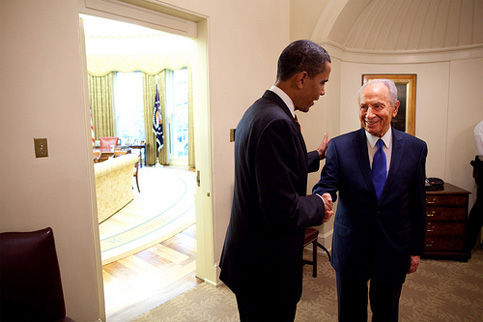
Obama Peres
© Pete Souza/White House Photo
Seen in the Oval Office with Israeli President Shimon Peres in May 2009, US President Barack Obama requested $2.775 billion in military aid to Israel

In pledging to trim ineffective spending, US President Obama declared that "there will be no sacred cows and no pet projects. All across America, families are making hard choices, and it's time their government did the same."

By asking earlier this month for $2.775 billion in military aid to Israel in his FY2010 budget request, it would seem that on this important policy issue President Obama's commitment is more rhetorical than substantive. Since 1949, according to the Congressional Research Service, the United States has provided to Israel more than $100 billion in military and economic assistance. In 2007, the US and Israel signed an agreement for $30 billion in additional military aid through FY2018.

Yet the provision of US weapons to Israel at taxpayer expense has done nothing to bring Israelis and Palestinians closer to achieving a just and lasting peace. Rather, these weapons have had the exact opposite effect, as documented recently by Amnesty International, which pointed to US weapons as a prime factor "fueling" the Israeli-Palestinian conflict.

According to the Israeli human rights group B'Tselem and the Palestinian Centre for Human Rights, during the Bush Administration, Israel killed more than 3,000 innocent Palestinian civilians, including more than 1,000 children. During its December 2008-January 2009 war on the occupied Gaza Strip alone, Israel killed nearly 1,200 non-combatants.

On average, for each day that President Bush sat in the Oval Office, Israel killed one Palestinian civilian, often with US weapons. Before Congress appropriates any additional military aid to Israel, it should insist upon President Obama providing a comprehensive and transparent review of the effects US weapons transfers to Israel have on Palestinian civilians. The Arms Export Control Act limits the use of US weapons given to a foreign country to "internal security" and "legitimate self-defense."

If, after reviewing the impact of Israel's misuse of US weapons, the President and Congress cannot find the political will to sanction Israel for its violations of the Arms Export Control Act and prohibit future arms transfers as is required by law, then there are still steps that the US government should take to ensure that any future transfers are not used to commit human rights abuses but instead to promote US policy goals. For example, previous US loan guarantees to Israel have stipulated that funds cannot be used to support Israeli activities in the Occupied Palestinian Territories. Conditioning US military aid to Israel in the same way would prevent these weapons from being used to kill innocent Palestinian civilians.

As President Obama has stated, "We can't sustain a system that bleeds billions of taxpayer dollars, on programs that have outlived their usefulness or exist solely because of the power of politicians, lobbyists or interest groups. We simply can't afford it." In regard to US aid to Israel, this is true as much from a budgetary standpoint as it is from a moral one.

Josh Ruebner is the National Advocacy Director of the US Campaign to End the Israeli Occupation. This essay was originally published by the Detroit Free Press.

Thursday, February 26, 2009

Human Rights Watch: If Israel has nothing to hide, let us into Gaza

Sounds reasonable to me.

Blue Ibis
***********************************************************************

Israel is preventing independent human rights monitors from entering Gaza, Human Rights Watch and B'Tselem said Sunday.

"Israel continues to obstruct independent investigations into allegations of laws of war violations by the Israel Defense Forces (IDF) and Hamas military forces in Gaza," the groups said in a joint statement to Ma'an.

After submitting applications for permission to enter via the Erez crossing in January 2009, the groups faced continued delays from the military unit reviewing the applications. In February, the army told Human Rights Watch that it had rejected its application. The Israeli military denied B'Tselem's first request to enter Gaza and has failed to respond to a second.

"Israel's refusal to allow human rights groups access to Gaza raises a strong suspicion that there are things it doesn't want us to see or the world to know about its military operation there," said Sarah Leah Whitson, Middle East director at Human Rights Watch. "If Israel has nothing to hide, why is it refusing to allow us in?"

Human Rights Watch requested permission to enter Gaza on 5 January. After weeks of delay, the military rejected the application on 9 February, on the grounds that Human Rights Watch "was not registered with the [Israeli] Ministry of Social Affairs." On all previous occasions, including several times in 2008, Israeli authorities permitted Human Rights Watch staff to enter and leave Gaza via the Erez crossing.

The army never previously suggested such a requirement for access to Gaza, and Human Rights Watch is not aware of any such Israeli law or regulation. The Israeli military has not responded to Human Rights Watch's requests for clarification, they said.

Israel does not allow Jewish citizens of Israel, other than security forces, to enter Gaza on the grounds that their security would be at risk. B'Tselem, the Israeli Information Center for Human Rights in the Occupied Territories, on 20 January requested permission from the military to allow the organization's fieldwork director (a Palestinian citizen of Israel) to enter Gaza. The military refused the request nine days later.

B'Tselem submitted an additional request on 29 January for entry for three staff members and an international consultant. The Israeli military has not responded to this request.

Human Rights Watch and other international human rights groups were able to enter Gaza via Egypt in late January to carry out initial investigations. The international researchers left Gaza just before 5 February, when Egypt had announced it would close the Rafah crossing.

The army had told Human Rights Watch that because its researchers had entered Gaza through Rafah, they would not permit the researchers to exit through Erez.

B'Tselem has not managed to gain access for its Israeli or West Bank staff, or for international consultants. Only the organization's two field researchers, who are residents of the Gaza Strip, have been able to conduct research on the ground, they said.

"Israel puts itself in the same league as Burma, North Korea, and Syria in keeping out independent human rights monitors," said Jessica Montell, executive director of B'Tselem. "The people of Israel deserve to know the truth about the conduct of our forces in Gaza. It is also in Israel's best interest that the full picture comes out."

The army prevented journalists from entering Gaza during the 22-day military operation, called "Operation Cast Lead," even after an Israeli Supreme Court ruling on 2 January ordered the state to allow entry to members of the Foreign Press Association.

Since the escalation of fighting in Gaza on 27 December, 2008, both Human Rights Watch and B'Tselem have documented serious violations of international humanitarian law by Israel and Hamas. On 10 January, Human Rights Watch exposed Israel's unlawful use of white phosphorus in civilian areas, an allegation the army initially denied but now claims to be investigating.

B'Tselem has expressed grave concern over violations of the principles of proportionality and distinction, including the deliberate targeting of civilian installations, such as government ministries and the Palestinian Legislative Council. Both organizations have, for over two decades, documented violations of international human rights and humanitarian law in Israel and the occupied Palestinian territories.

Article Six of the Human Rights Defenders Declaration ensures that everyone has the right, individually and in association with others, "to know, seek, obtain, receive, and hold information about all human rights and fundamental freedoms," B'Tselem noted.

In addition, "the apparent blanket denial of access to Gaza by human rights groups violates the right to freedom of movement," B'Tselem said. "Although human rights law permits restrictions on freedom of movement for security reasons, the restrictions must have a clear legal basis, be limited to what is necessary, and be proportionate to the threat."

Sunday, February 01, 2009

What if the entire tale of the Jewish Diaspora is historically wrong?

What if the entire tale of the Jewish Diaspora is historically wrong?

When and How the Jewish People Was Invented

Shlomo Sand: “When and
How the Jewish People
Was Invented?”


What if the Palestinian Arabs who have lived for decades under the heel of the modern Israeli state are in fact descended from the very same "children of Israel" described in the Old Testament?

And what if most modern Israelis aren't descended from the ancient Israelites at all, but are actually a mix of Europeans, North Africans and others who didn't "return" to the scrap of land we now call Israel and establish a new state following the attempt to exterminate them during World War II, but came in and forcefully displaced people whose ancestors had lived there for millennia?

What if the entire tale of the Jewish Diaspora -- the story recounted at Passover tables by Jews around the world every year detailing the ancient Jews' exile from Judea, the years spent wandering through the desert, their escape from the Pharaoh's clutches -- is all wrong?

That's the explosive thesis of When and How Was the Jewish People Invented?, a book by Tel Aviv University scholar Shlomo Zand (or Sand) that sent shockwaves across Israeli society when it was published last year. After 19 weeks on the Israeli best-seller list, the book is being translated into a dozen languages and will be published in the United States this year by Verso.

Its thesis has ramifications that go far beyond some antediluvian academic debate. Few modern conflicts are as attached to ancient history as that decades-long cycle of bloodletting between Israelis and Palestinians. Each group lays claim to the same scrap of land -- holy in all three of the world's major Abrahamic religions -- based on long-standing ties to that chunk of earth and national identities formed over long periods of time. There's probably no other place on Earth where the present is as intimately tied to the ancient.

Central to the ideology of Zionism is the tale -- familiar to all Jewish families -- of exile, oppression, redemption and return. Booted from their kingdom by the Romans around 2,000 years ago, the "Jewish people" -- sons and daughters of ancient Judea -- wandered the earth, rootless, where they faced cruel suppression from all corners -- from being forced to toil in slavery under the Egyptians, to the Spanish massacres of the 14th century and Russian pogroms of the 19th, through to the horrors of the Third Reich.

This view of history animates all Zionists, but none more so than the influential but reactionary minority -- in the United States as well as Israel -- who believe that God bestowed a "Greater Israel" -- one that encompasses the modern state as well as the Occupied Territories -- on the Jewish people, and who resist any effort to create a Palestinian state on biblical grounds.

Inventing a People?

Zand's central argument is that the Romans didn't expel whole nations from their territories. Zand estimates that perhaps 10,000 ancient Judeans were vanquished during the Roman wars, and the remaining inhabitants of ancient Judea remained, converting to Islam and assimilating with their conquerors when Arabs subjugated the area. They became the progenitors of today's Palestinian Arabs, many of whom now live as refugees who were exiled from their homeland during the 20th century.

As Israeli journalist Tom Segev summarized, in a review of the book in Ha'aretz:

There never was a Jewish people, only a Jewish religion, and the exile also never happened -- hence there was no return. Zand rejects most of the stories of national-identity formation in the Bible, including the exodus from Egypt and, most satisfactorily, the horrors of the conquest under Joshua.

But this begs the question: if the ancient people of Judea weren't expelled en masse, then how did it come to pass that Jewish people are scattered across the world? According to Zand, who offers detailed histories of several groups within what is conventionally known as the Jewish Diaspora, some were Jews who emigrated of their own volition, and many more were later converts to Judaism. Contrary to popular belief, Zand argues that Judaism was an evangelical religion that actively sought out new adherents during its formative period.

This narrative has huge significance in terms of Israel's national identity. If Judaism is a religion, rather than "a people" descended from a dispersed nation, then it brings into question the central justification for the state of Israel remaining a "Jewish state."

And that brings us to Zand's second assertion. He argues that the story of the Jewish nation -- the transformation of the Jewish people from a group with a shared cultural identity and religious faith into a vanquished "people" -- was a relatively recent invention, hatched in the 19th century by Zionist scholars and advanced by the Israeli academic establishment. It was, argues Zand, an intellectual conspiracy of sorts. Segev says, "It's all fiction and myth that served as an excuse for the establishment of the State of Israel."

Zand Gets Slammed; Do His Arguments Stand Up?

The ramifications of Zand's argument are far-reaching; "the chances that the Palestinians are descendants of the ancient Judaic people are much greater than the chances that you or I are its descendants," he told Ha'aretz. Zand argues that Israel should be a state in which all of the inhabitants of what was once "British Palestine" share the full rights and responsibilities of citizenship, rather than maintaining it as a "Jewish and democratic" state, as it's now identified.

Predictably, Zand was pilloried according to the time-tested formula. Ami Isseroff, writing on ZioNation, the Zionism-Israel blog, invoked the customary Holocaust imagery, accusing Zand of offering a "final solution to the Jewish problem," one in which "No auto da fe is required, no charging Cossacks are needed, no gas chambers, no smelly crematoria." Another feverish ideologue called Zand's work "another manifestation of mental disorder in the extreme academic Left in Israel."

That kind of overheated rhetoric is a standard straw man in the endless roil of discourse over Israel and the Palestinians, and is easily dismissed. But more serious criticism also greeted Zand's work. In a widely read critical review of Zand's work, Israel Bartal, dean of humanities at the Hebrew University, slammed the author's second assertion -- that Zionist academics had suppressed the true history of Judaism's spread through emigration and conversion in favor of a history that would give legitimacy to the quest for a Jewish state.

Bartal raised important questions about Zand's methodology and pointed out what appears to be some sloppy details in the book. But, interestingly, in defending Israel's academic community, Bartal supported Zand's more consequential thesis, writing, "Although the myth of an exile from the Jewish homeland (Palestine) does exist in popular Israeli culture, it is negligible in serious Jewish historical discussions." Bartal added: "no historian of the Jewish national movement has ever really believed that the origins of the Jews are ethnically and biologically 'pure.' " He noted that "[i]mportant groups in the [Zionist] movement expressed reservations regarding this myth or denied it completely."

"As far as I can discern," Bartal wrote, "the book contains not even one idea that has not been presented" in previous historical studies. Segev added that "Zand did not invent [his] thesis; 30 years before the Declaration of Independence, it was espoused by David Ben-Gurion, Yitzhak Ben-Zvi and others."

One can reasonably argue that this ancient myth of a Jewish nation exiled until its 20th century return is of little consequence; whether the Jewish people share a common genetic ancestry or are a far-flung collection of people who share the same faith, a common national identity has in fact developed over the centuries. But Zand's central contention stands, and has some significant implications for the current conflict between Israel and the Palestinians.

Changing the Conversation?

The primary reason it's so difficult to discuss the conflict between Israelis and Palestinians is the remarkably effective job supporters of Israel's control of the Occupied Territories -- including Gaza, still under de facto occupation -- have done equating support for Palestinian self-determination with a desire to see the destruction of Israel. It effectively conflates any advocacy of Palestinian rights with the specter of Jewish extermination.

That's certainly been the case with arguments for a single-state solution to the Israeli-Palestinian conflict. Until recent years, advocating a "single-state" solution -- a binational state where all residents of what are today Israel and the Occupied Territories share the full rights and responsibilities of citizenship -- was a relatively mainstream position to take. In fact, it was one of several competing plans considered by the United Nations when it created the state of Israel in the 1940s.

But the idea of a single, binational state has more recently been marginalized -- dismissed as an attempt to destroy Israel literally and physically, rather than as an ethnic and religious-based political entity with a population of second-class Arab citizens and the legacy of responsibility for world's longest-standing refugee population.

A logical conclusion of Zand's work exposing Israel's founding mythology may be the restoration of the idea of a one-state solution to a legitimate place in the debate over this contentious region. After all, while it muddies the waters in one sense -- raising ancient, biblical questions about just who the "children of Israel" really are -- in another sense, it hints at the commonalities that exist between Israeli Jews and Palestinian Arabs. Both groups lay claim to the same crust of earth, both have faced historic repression and displacement and both hold dear the idea that they should have a "right of return."

And if both groups in fact share common biblical ties, then it begs the question of why the entirety of what was Palestine under the British mandate should remain a refuge for people of one religion instead of being a country in which Jews and Arabs are guaranteed equal protection -- equal protection under the laws of a state whose legitimacy would never again be open to question.

Friday, August 31, 2007

Then and Now, Zionist Style


Not a lot to add here, except the U.S. recently committed 30 BILLION ("yes, with a B") more of your tax dollars to support this inhumanity. Not only does it deprive you in the US of decent schools, good affordable medical care, safe roads and other things that make a life livable, it makes EVERY U.S. taxpayer complicit in these crimes. Think about that.

Blue Ibis
*************************************************************

Khalid Amayreh
Coastal Post
Wed, 29 Aug 2007 23:21 EDT

In 1940, several months after invading Poland in September 1939, the Nazis forced about 500,000 Jews into the Warsaw Ghetto, surrounding it with a high wall. Tens of thousands died from hunger and disease. Eventually, 300,000 were sent to death camps, mainly Treblinka in eastern Poland.

Similarly, Israel is now incarcerating nearly a million and a half helpless Palestinians in the Gaza Strip into a hell similar in nature to the Warsaw Ghetto. The Gaza concentration camp is not only fitted with a wall, but also with every conceivable tool of repression, such as electric fences and watch towers manned by Gestapo-like trigger-happy Jewish soldiers who shoot first and ask questions later.

Moreover, thousands of Israeli soldiers, are surrounding Gaza in a hermetic manner, shooting and killing any Palestinian trying to escape, e.g. enter Israel to search for work or even food.

Palestinian kids survive on bread and tea

Even Palestinian kids playing soccer near the hateful fences, are routinely riddled with bullets or reduced into pieces of human flesh by the "most moral army in the world."

As a result of these genocidal designs, Gazans in the thousands are dying of malnutrition and illness resulting from anemia. Moreover, Children in great numbers are surviving on a meager and totally inadequate diet consisting mainly of bread and tea.

This week, this writer contacted several Gaza families and asked to speak with the kids. The answers I received were truly horrifying. I did speak with 10 kids and was shocked to find out that seven of the kids told me their diet during the previous week consisted mainly of bread and tea in addition to some tomatoes.

The grown-ups, especially the parents, wouldn't reveal the extent of the unfolding tragedy they are facing. They would only say a terse "al hamdulillah" (thank God). But the tone of their voices tells us that they are in real distress.

The Gaza Strip made into the largest detention camp in the world

The harsh blockade of Gaza didn't start in mid June when Hamas took over the small seaside region after defeating and ousting the American-backed Fatah forces led by Muhammed Dahlan and cohorts who had been planning, with American dollars and arms, to murder the Hamas leadership in order to receive a certificate of good conduct from the Bush Administration and Israel.

In fact, Gaza has been effectively under siege since 2000 when the second Palestinian intifada or uprising broke out. Since, then Gazans have been barred from exporting their products and produces.

Moreover, Israel, which has been telling the world that it had ended its occupation of Gaza, still retains full control of the Rafah border crossing with Egypt, thus reducing the Gaza Strip into the largest detention camp in the world.

To make a long story short, Gazans are being pushed into a situation very similar to that which prevailed at the Ghetto Warsaw. They are not allowed to work (unemployment in Gaza stands at more than 70%), they are not allowed to travel abroad, they are not allowed to enter Israel for work, they are not allowed even to go fishing offshore since Israeli gunboats would open fire at any fishing-boat daring to go more than a mile off the shore.

The criminal and draconian measures are meant to further impoverish Gazans to the extent that they won't be able to purchase food.

The declared Israeli goal behind starving and tormenting the people of Gaza is to force them to revolt against the democratically-elected government, led by the Hamas movement, and settle for a quisling-like government that would sell-out Palestinian national rights, including the paramount right of return for Palestinian refugees uprooted from their homes and villages by Jewish gangs in 1948, when Israel was created.

It is believed that up to two thirds of the inhabitants of Gaza are refugees. Hence, the intensive repression and coercion being meted out to these people in order to force them to give up their right to return to their homes and villages in what is now Israel.

It is crystal clear that Israel is steadily but certainly effecting a Nazi-like approach toward the people of the Gaza Strip.

The PR-conscious Israeli government, however, is hoping that the world will not take proactive measures to expose the creeping genocide in Gaza . This is why Israel is allowing limited shipments of food products, such as flour and cooking oil, into Gaza, to avoid a possible international outcry.

However, the supplies are conspicuously meager and don't meet the basic nutritional needs of the vast bulk of Gaza children.

Unfortunately, the United Nations Relief and Work Agency (UNRWA) seems to be conniving and colluding with Israel to keep the unfolding Gaza tragedy as silent as possible.

UNRWA officials do make idle statements from time to time, warning of an impending "humanitarian crisis" in Gaza. However, the UN agency often refrains from "saying it as it is," probably for fear of upsetting the Israelis and the Americans, who apparently don't like to hear words like "starvation, and concentration camps" with regard to the situation in Gaza find their way to the international media.

Israel is undoubtedly the central culprit in this man-made tragedy in Gaza, since it is up to her to allow Gazans to obtain food and export their products and especially their produces to the West Bank. Such a step, which would cost Israel nothing, would help Gazans obtain some meager income to feed their children.

However, Israel, as always, has apparently chosen to be faithful to long traditions of callousness and moral depravity, not unlike the way the Nazis treated their victims.

US administration, Abbas as guilty as Israel

But Israel is not the only guilty party in this tragedy. The US is actually as criminal as Israel, since the Bush administration is urging Israel to keep up the pressure on Gaza.

In fact, American officials keep congratulating their Israeli colleagues on the "success" of the blockade against Gaza. I wonder what kind of politicians are those who enjoy watching children starve to death? [Hint: try here] Are they human beings or cannibalistic beasts? This question ought to be directed to Condoleezza Rice whose behavior toward the Palestinian people is probably a thousand times worse than the behavior of the worst American white slave masters toward here forefathers.

Maybe it is naive to appeal to Rice's sense of justice and morality since her manifestly criminal record with regard to the Palestinian cause leaves no doubt as to the woman's unethical and evil character.

But if the Bush administration, which has been carrying a holocaust in Iraq, and Israel, which has been effecting ethnic cleansing in Palestine in the name of Jewish nationalism, can be "excused" on the ground that only evil can be expected from evil governments, the Palestinian regime of Mahmoud Abbas has no excuse whatsoever to collude and connive with Israel against the very people it is claiming to serve. [Psychopaths recognize each other, and band together when it serves their individual interests.]

Such behavior, including the tacit and implicit encouragement of Israel to tighten the blockade of Gaza, and keep hundreds of thousands of encircled Gazans hungry and thoroughly tormented, characterizes quislings and agents of a foreign occupation.

Clearly, Abbas and his aides have much to explain to the Palestinian people. They also have much to atone for. This is if they still possess any sense of shame. [Don't bet on it. They will tell you they are good patriots.]
Saturday, June 23, 2007

Political Ponerology


A powerful presentation. It gets right to the heart of this most important book. Available from Red Pill Press (www.redpillpress.com) This is a book the fate of the world might depend on.

Tuesday, June 12, 2007

Israel Forty Years On: What Has Been Wrought

Short and powerful, SOTT editor Henry See, exposes the shallow hypocrisy of the average well-heeled Israeli illegal immigrant to the land of the Palestinians

Blue Ibis
***********************************************************

Henry See
SOTT
Sat, 09 Jun 2007 11:08 EDT

©Mike DuBose, UMCom
A Palestinian child swings over the
rubble of the family home,demolished by
Israeli bulldozers in a valley east of
Hebron.


The Forward, which bills itself as "the Jewish daily", had an article this week on American Jews who choose to become illegal settlers on occupied Palestinian land. The "difficulties" they face are illustrated by the following comment:

"'Before we found Neve Daniel, my husband told me, 'I love you and I want to live in Israel, but I'm very materialistic and if I don't have a nice house, we're not moving,' said Lara Kwalbrun, a peppy mother of six, as she gave a tour of her luxurious new home while toting a baby in her arms."
As long as moving into an illegal settlement meant life in a mobile home, a large number of American Jews weren't interested. They left it up to their more pioneering and violent brethren to go out and "colonize" the area, to actually confront the owners of the land with clubs and guns and chain saws and bulldozers. Now that the out and out outlaws have "claimed" the land, so to speak, and the base can move into a gated community fed by water siphoned away from the Palestinians and policed by troops paid for by American taxpayers, these new settlers can move in and never have to come into contact with the people they have displaced. You know, the ones walled up in the concentration - uh, refugee - camps out of sight and out of mind.

Another choice quote:
"Jerusalem has evolved to be like Manhattan in terms of prices and having to live in an apartment," said Michael Chernofsky, an orthopedic surgeon from Pennsylvania who recently moved with his family to Efrat, a Gush Etzion settlement. "If you want to live in a house, you need to move out to the suburbs."

Language is a powerful means of creating an illusory world. We make up words to replace other words, antiseptic words to replace bothersome and ugly words, neutral or comfortable words that point away from injustice and suffering. The Palestinians are being ejected out of Jerusalem by force and by a series of laws that mandate that if they are essentially imprisoned on the West Bank and unable to return to their homes in East Jerusalem, after a certain amount of time, the state can confiscate their property.

"Suburbs" brings to mind the manicured lawns of the New Jersey many of these settlers have left. "Suburbs" has associations of being the epitome of American life. The word "Suburbs" is a telling example of how language is used to create an illusory world that we take for reality.

Settlements on Palestinian land are illegal according to international law. The settlers are criminals. Not only that, they are actively aiding and abetting the genocide of the original inhabitants of the land, the Palestinians who have been walled off into compounds on their own land.

If such actions don't make your blood boil, then you probably don't have a conscience. When I say "conscience," I'm not talking about a set of rules you live by that allows you to believe you are a 'good person', the kind of things you can apply mechanically as a series of if-then statements that allow you to see how much you can get away with in any given situation. We all go through that stage as kids, and some people do actually outgrow it, though from the state of the world, it is clear that it is a small percentage. There are unfortunately large numbers of people for whom this stage represents the pinnacle of their moral development.

Illegal settlers are certainly counted among their number. They are, moreover, buttressed in their selfishness by the ideology that justifies killing off the Palestinians in the name of their psychopathic god, so their crimes, crimes to anyone of conscience; holy acts according to the ideology of Judaism as well as to their Christian supporters. American intervention in Iraq is based upon pretty much the same thought process where the religion descends from the Almighty Dollar and "Democracy" rather than the bloodthirsty Yahweh.

There is no excuse for the seizure of this land and the justifications of "Chosen People" or "God-given right". None. Those are fairy tales told to cover up theft and murder. And anyone with a functioning conscience knows this, feels this deep in his or her gut. Any attempt to justify or explain away the theft of land and genocide of the people of Palestine is a clear marker that the individual has no conscience or that it is so totally anaesthetized that it may as well not exist.

Note: If you wish to take a voyage into the very pit of soullessness, some black and clammy void that would not be out of place in the works of H.P. Lovecraft, then go to Wikipedia and do a search on "Gush Etzion" and start following the links.

Saturday, June 09, 2007

The Six-Day "War" at 40: The Theme is Fraud

So, it's the anniversary of the "great Zionist victory". An illegal state born of deception (no Arab states were present at the UN when the resolution was passed) and fed on the blood of those who's homes and futures and very lives were taken from them to give space to these interlopers. And they know it. . . . . .

Blue Ibis

*****************************************************************
Even after 40 years, Abba Eban's great fraud defines the official version of the 1967 War

Greg Felton
Canadian Arab News
Thu, 07 Jun 2007 15:21 EDT

Some people make history; some people invent it. Abba Eban falls into the latter category. As Israel's foreign minister at the time of the 1967 War, Eban delivered a speech to the Security Council that must rank as the most erudite, sophisticated fraud ever heard by the world body.

He did nothing less than invent for our consumption the twin myths of Egyptian aggression and Israeli self-defence, all the while intoning the requisite verities of peace and international law. Eban stood history on its head and the non-Arab world was only too willing to embrace his dissembling and deceit.

Eban was an easy man to like, respect and believe, because he was cultured and thoroughly Western. He was one of us. Born Aubrey Solomon Meir, in Cape Town, South Africa, in 1915 Eban was educated in Britain and spent much of his adult life in politics. Among his numerous accomplishments are:

- Israel's first permanent delegate to the United Nations (1949-1959);
- Ambassador to the United States (1950-1959); and
- Israeli foreign minister (1966-1974).

Compared to the brutal gangsterism of Begin, Sharon, Shamir, Olmert, and Netanyahu, Eban stands like a colossus of conspicuous decency. Unfortunately, the comparison is purely relative. For all of his dovishness and diplomatic acumen Eban was still a zionist, and therefore an apologist for aggression and a spokesman for an outlaw state.

As the world marks the 40th anniversary of the 1967 War, Eban's looking-glass reality is given new life as the zionist media dutifully reinforce the founding myths of the war. Even today, with the benefit of the Internet and hindsight, those who point out the errors of fact and tendentious arguments in Eban's speech stand little chance of a fair hearing, if they get a hearing at all.

If Israel's illegal Occupation of Palestine is to end, as it must, Eban's speech must be subjected to honest analysis, because a polite liar is still a liar, and the fruit of this particular lie is the genocide of Palestine.

Eban's speech runs more than 4,800 words and can be viewed here: For brevity's sake, I will focus on two key themes.

Israel's existence was threatened.

Abba Eban: "Two days ago...an army, greater than any force ever assembled in history in Sinai, had massed against Israel's southern frontier. Egypt had dismissed the United Nations forces which symbolized the international interest in the maintenance of peace in our region. Nasser had provocatively brought five infantry divisions and two armoured divisions up to our very gates; 80,000 men and 900 tanks were poised to move.

"...As time went on, there was no doubt that our margin of general security was becoming smaller and smaller. Thus, on the morning of 5 June, when Egyptian forces engaged us by air and land, bombarding the villages of Kissufim, Nahal-Oz and Ein Hashelosha we knew that our limit of safety had been reached, and perhaps passed. In accordance with its inherent right of self-defence as formulated in Article 51 of the United Nations Charter, Israel responded defensively in full strength. Never in the history of nations has armed force been used in a more righteous or compelling cause."

First, Egypt's president Gamel Abdel Nasser did not "provocatively" bring five infantry divisions and two armoured divisions up to "[Israel's] very gates." Eban's doom-and-gloom scenario is propaganda, as Israel's generals and politicians later confessed, e.g.:

Mordechai Bentov, cabinet minister: "This story about the danger of extermination has been a complete invention and has been blown up a posteriori to justify the annexation of new Arab territories." (cited in Le Monde, June 3, 1972)

Menachem Begin, leader of Gahal Party: "In June 1967 we again had a choice. The Egyptian army concentrations in the Sinai approaches did not prove that Nasser was really about to attack us. We must be honest with ourselves. We decided to attack him." (cited in New York Times, Aug. 21, 1982.)

Gen. Matityahu Peled: "To pretend that the Egyptian forces massed on our frontiers were in a position to threaten the existence of Israel constitutes an insult not only to the intelligence of anyone capable of analyzing this sort of situation, but above all an insult to the Zahal [Israeli army]." (cited in Ha'aretz, March 19, 1972.)

The second fallacy, related to the first, is the idea that Israel's use of armed force was the most righteous and compelling in history. Leaving aside the sanctimonious hyperbole, Eban makes no mention of Israel's repeated border aggressions against Syria that precipitated the conflict, or that Egypt and Syria had signed a mutual defence pact the previous year.

Israel precipitated the 1967 War by staging border aggressions against Syria and seizing Syrian land in the demilitarized zone between the two countries. From 1948 to 1967, Syria reported more than 1,000 armed clashes, and in a candid 1976 interview, Moshe Dayan admitted that Israel provoked 80 percent of them:

"We would send a tractor to plow some [disputed] area... and we knew in advance that the Syrians would start to shoot. If they didn't shoot, we would tell the tractor to advance further, until in the end the Syrians would get annoyed and shoot. And then we would use artillery and later the air force also, and that's how it was.... I made a mistake in allowing the conquest of the Golan Heights. As defense minister I should have stopped it because the Syrians were not threatening us at the time."

Therefore, Nasser's provocative [sic] build-up on the Sinai had nothing to do with Israel, per se, but with the need to come to Syria's aid. Moreover, and this point is never mentioned, Nasser had reluctantly sent 100,000 of his best troops to fight in Yemen's civil war and was in no position to start hostilities.

Nasser did evict the UN peacekeeping force, and he did close the Red Sea port of Eilat, but these were marginal actions, as Israel well knew. Nevertheless, Eban blew them out of proportion and repeatedly invoked Eilat as justification for invasion: "There was in this wanton act a quality of malice. For surely the closing of the Strait of Tiran gave no benefit whatever to Egypt except the perverse joy of inflicting injury on others. It was an anarchic act, because it showed a total disregard for the law of nations..."

Israel's "right to exist"

Abba Eban: "The central point remains the need to secure an authentic intellectual recognition by our neighbours of Israel's deep roots in the Middle Eastern reality. There is an intellectual tragedy in the failure of Arab leaders to come to grips, however reluctantly, with the depth and authenticity of Israel's roots in the life, the history, the spiritual experience and the culture of the Middle East.... There are not two categories of States. The United Arab Republic, Iraq, Syria, Jordan, Lebanon - not one of these has a single ounce or milligram of statehood which does not adhere in equal measures to Israel itself."

Eban is reinforcing the Israel-as-victim myth, which is still heard to day as "picking on Israel." Of course, the Palestinians get no mention because at this time they are not even deemed to exist. Note also how Israel's equivalence with other states is merely asserted, not proven. The reason is simple - Israel's roots have no depth or authenticity - it is an artificial, un-Semitic, Western creation born of guilt, terrorism and blackmail. It has no place in the culture of the Middle East; it is a foreign body that is destroying the very culture of which Eban claims it is a part.

The real perversity of Eban's speech is his genteel hypocrisy. He condemned Nasser for violating the law of nations, but says nothing of Israel's transgressions against Palestine or Syria. He spoke of the equality of sovereignty, but made no mention of Israel's conditional admission to the UN or of its refusal to finalize its borders. He spoke of peace, yet said nothing about Israel being responsible for breaking the peace.

Less than two weeks after he addressed the Security Council, Eban gave a more accurate account of Israel's contempt for international law: "If the General Assembly were to vote by 121 votes to 1 in favor of 'Israel' returning to the armistice lines [pre June 1967 borders] 'Israel' would refuse to comply with the decision." (New York Times, June 19, 1967.)

Eban seemed so reasonable, educated and Western that to disbelieve him was unthinkable. Now, we must do more than think about it - we must recognize Eban as an artful liar, and engender public discussion about the real cause of the 1967 War.

Monday, February 05, 2007

West Bank & Gaza: A Pyschopath's Paradise


Quick, describe the difference between the actions of anti-semitic nazi soldiers and anti-palestinian IDF soldiers. From forcing the oppressed to entertain their oppressors at checkpoints to killing them with beauracracy (see below), it's getting hard to tell the difference. I don't see no moral high ground here folks.

Blue Ibis

***************************************

The Twilight Zone/By the book

Gideon Levy
Haaretz
Fri, 02 Feb 2007 14:36 EST

There's no question about it - everything was done by the book. The gate was locked at 7 P.M. and 16,000 people, residents of the villages of Beit Furik and Beit Dajan, were imprisoned behind it until 6 A.M. That's the procedure. A woman who wants to cross the checkpoint at night has to go on foot, to wait until a female soldier comes to do a body check, even if she is about to give birth; that, too, is procedure. And only cars with permits are allowed to enter Nablus, even if dying people are sitting inside them; that is also according to procedure. No soldier deviated from the procedure, everything was done by the book, the book of the occupation.

That is how it happened that a cancer patient was delayed for about an hour and a half at the Hawara checkpoint, until he died in a taxi that was not allowed to enter Nablus, a taxi in which he was trying to get from the hospital to his home, his final request. That is also what happened when the young woman in labor was forced to stand in the cold and the rain for about half an hour and to make her way on foot for several hundred meters while in labor. That's the procedure.

The death of cancer patient Taysir Kaisi was inevitable, but why in such pain, waiting endlessly in a "non-permitted" taxi at the checkpoint? And the young woman from Beit Furik who was about to give birth, Roba Hanani, finally arrived at the hospital in Nablus and successfully gave birth there to her first child, but why with such torture? Why did they deserve it? What would we think if our loved ones were to die or suffer labor pains at a checkpoint separating the city and the village? Life and death are in the hands of the checkpoint: The story of the death of Taysir Kaisi and the birth of Raghad Hanani, between the Hawara checkpoint and the Beit Furik checkpoint, during an easing of restrictions at the checkpoints, less than an hour's drive from Tel Aviv, is a story that should disturb our equanimity.

Taysir Kaisi worked in Hazem Samara's hummus shop in Nablus. He was 45 years old, with seven children, a hummus maker, with two bedrooms and a living room in a house in the Ain Bet Ilma refugee camp in the city. He fell ill a year ago; he was diagnosed with metastasizing liver cancer only a month ago. Dr. Hurani prescribed chemotherapy, which he received at the Al Watani hospital in the city.

His situation deteriorated, his pains increased, Kaisi wanted a second opinion. Someone recommended the Hadassah Hospital, but in the end he only managed to go to the Al Mutla hospital in East Jerusalem. On Monday, January 15, he went to Jerusalem accompanied by his cousin Hussein Kaisi. They had four permits, that is the only way one can travel to receive a second opinion, a permit for two days, one for each day, for two people, one for "the purpose of medical needs" and the other "for the purpose of accompanying a patient," all properly stamped, all after they showed the doctor's appointment from the hospital in Jerusalem, and that is also according to the rules. Kaisi was still in reasonable shape when he left his house on Monday, and he did part of the long trip to Jerusalem walking from one taxi to another, between the checkpoints. At the Qalandiyah checkpoint, they asked him to pull down his pants - security - and he managed that too.

At Al Mutla they decided to hospitalize the patient for four days. He and his cousin had permits for only two days. After several examinations the doctors recommended that Kaisi return home and continue to receive chemotherapy in Nablus, near his family and his children. On Thursday morning Taysir and Hussein left the hospital on their way home. That was Taysir's final journey.

We are now sitting with the cousin Hussein on a rock overlooking the improvised taxi stand at the Hawara checkpoint, exactly where he left Taysir to die in a taxi that was not permitted to cross. The taxi drivers that the two stopped when they left the hospital in East Jerusalem refused to take them, because their permits for medical purposes and for the purpose of accompanying a patient were no longer valid, because of the hospitalization that had lasted two days beyond the permits. That is why the two, the patient and his cousin, traveled by bus to the Qalandiyah checkpoint, after waiting a long time at the bus stop. They crossed the checkpoint on foot, Taysir was still able to walk, and there they took a taxi from Ramallah to bring them to Nablus. Taysir screamed with pain during the entire trip, asking his cousin, "When will we get to Nablus already?"

When they reached the Hawara checkpoint, the checkpoint at the entrance to Nablus, Hussein asked the driver to enter the checkpoint and drive them home. The soldier at the checkpoint asked for permits. Hussein, who speaks Hebrew, explained to him that Taysir was a critically ill man who was returning to his home. The soldier asked for a permit from the taxi driver, but the taxi driver from Ramallah did not have a permit to enter Nablus. "Go back," ordered the soldier. Hussein tried to explain to the soldier that Taysir was incapable of going on foot, and that all he wanted was to get home, but the soldiers insisted. Those are the procedures. They said that Hussein and Taysir could enter Nablus, but only on foot.

Taysir was no longer in any condition to walk even one step. The pains in his stomach had increased during the course of the uncomfortable trip and he was no longer capable of standing on his feet. "This is a cancer patient," Hussein tried to explain, to no avail. The soldiers, he says, did not pay attention. For lack of any other choice, they turned back, doing the soldier's bidding.

The driver parked his taxi at the improvised taxi stand at the front of the checkpoint, Taysir groaned with pain and Hussein asked him to set out with him on foot. Taysir was incapable of doing so. So Hussein went out to look for a taxi with a permit to enter Nablus, leaving his cousin in the taxi. "Take care of my wife and the children," Taysir asked Hussein, apparently his last words.

The desperate Hussein tried to find a driver who would agree to take them through the checkpoint. In an UNRWA vehicle that just passed there was no room, no other car came. One of the taxi drivers suggested that he call the ambulance in Nablus. Only in an ambulance will you be able to cross, the driver advised him. Hussein called the Red Crescent in Nablus, another 15 minutes passed until the ambulance arrived at the checkpoint. The ambulance driver didn't find the two, Hussein ran to him and directed him to the taxi where Taysir was dying.

The paramedic got out of the ambulance and approached Taysir, asking him how he was, but Taysir didn't reply. He was sitting in the back seat of the taxi. The driver of another taxi that was standing at the taxi stand, Jihad Hareb, says that he saw Taysir sitting in the taxi for about an hour and a half, his yellow skin slowly turning black, "as though someone had choked him." The paramedic checked his pulse and respiration and determined that Taysir was dead. Hussein also says that about an hour and a half passed from the moment they arrived at the checkpoint until the ambulance arrived. With the help of two taxi drivers, they removed Taysir from the taxi and carried him to the ambulance, and drove to the hospital in Nablus, where his death was determined. The doctors estimated that Taysir had died about 45 minutes before arriving at the hospital.

Hussein called Taysir's wife, Nawal, and informed her: "Taysir died at the checkpoint, on the way home." He says that it was hard for him to give the news over the phone, Taysir had so much wanted to get home. A B'Tselem investigator, Salma al-Debai, also took testimony from Hussein, in order to prepare a report about the incident on behalf of her organization.

The IDF Spokesman's Office, for its part, responds with a total denial: "An investigation regarding a claim that a Palestinian cancer patient was delayed at the Hawara checkpoint found the claim to be incorrect. An investigation carried out by the Civil Administration's coordinator of health showed that the Palestinian died on the way, during a taxi ride from the hospital in Jerusalem to the Hawara checkpoint."

Some people die at the checkpoint and some are born there: Wrapped in a woolen blanket, an electric heater warming her well-appointed room, lies the infant Raghad Hanani, 25 days old, in her bed. When she grows up, maybe her parents, Roba and Derar - he a Palestinian policeman and she a 25-year-old housewife - will tell her about her mother's travails when she was about to give birth.

It was Roba's first pregnancy. On Friday, December 7, she went into labor. An act of the devil - evening had already fallen on their village, Beit Furik, east of Nablus; an act of the devil - the IDF had locked the iron gate. The coordinator of ground operations of Rabbis for Human Rights, Zacharia Sadeh, says that for months this gate has been locked every night, from 7 P.M. to 6 A.M., imprisoning behind it the 16,000 residents of the two neighboring villages, Beit Furik and Beit Dajan.

It was 8:30 P.M., about an hour and a half after the gate had been locked; the couple ordered a taxi and drove toward the iron gate intending to reach the hospital in Nablus, a few minutes' drive away. There are two roads to Nablus; one is short and is open to Jews only, and one is longer and passes through the Beit Furik checkpoint. Access to both roads passes first of all through the iron gate, and it was locked, as we have said.

The taxi driver, Mahmoud Melitat, approached the iron gate and began to flash his car lights in the direction of the IDF guard tower, which is located a few hundred meters from the gate. Derar says that it was cold and rainy outside. After about 10 minutes, a Hummer arrived. The driver, Melitat, tried to explain to the soldiers that there was a woman in labor in his taxi, but the soldiers insisted that she had to get out and cross the gate on foot.

[any woman who has ever experienced hard labor will know the depth of this cruelty]

The couple got out of the taxi, Roba was crying, holding her stomach, scared about her first birth, leaning on her husband's shoulders.
They walked from the gate in the direction of the checkpoint, a distance of several hundred meters, and there the soldiers ordered them to wait until a female soldier came to do a body check on Roba - maybe she was carrying a bomb on her way to Nablus. On the other side of the checkpoint a Palestinian ambulance that had been ordered by Derar was waiting, and the soldiers did not let its driver pass to the other side of the checkpoint, which is closed at night. Derar says that the soldiers did not even allow Roba to get into the ambulance and to wait inside. They said that these were the orders.

So they stood outside until the female soldier arrived, Roba was examined and the permit to go to the hospital was finally given. The IDF Spokesman responded that he was not familiar with this case.

In the end, Raghad was born in the hospital in Nablus. Mother and baby are doing well. Grandma and grandpa, Roba's parents, have seen their granddaughter only once so far, in the hospital. The residents of their village of Salem, which can be seen on the opposite hill, are not allowed to enter Beit Furik.

And nevertheless the Hananis were lucky: Late in 2003 Rula Ashateya, who was also in labor, tried to cross that same accursed checkpoint. The soldiers prevented her from crossing at the time, and Rula crouched to give birth on the ground, hiding behind one of the cement blocks of the checkpoint, with her husband serving as midwife. The newborn apparently hit the rock and died. Her parents had intended to call her Mira, I wrote here at the time, since all their children's names begin with M. Then, too, the IDF Spokesman said that "the soldiers are instructed to allow crossing at the checkpoint in humanitarian cases, at any time and in any situation."